Leaving Home This Summer? A Realistic Checklist for Keeping Your House Safe While You Travel
Summer is when the most homes sit empty. Between family trips, long weekends, and kids being out of school, July and August reliably see more households away from home at the same time than any other stretch of the year. That doesn't mean you should cancel your trip — but it's worth understanding what actually puts a home at risk while you're gone, and what's just folklore.
What the Data Actually Shows
The good news first: burglary has been falling for years. The FBI's 2024 Uniform Crime Reporting data recorded 779,542 burglaries nationwide, down 8.6% from the year before, with a national rate of 229.2 incidents per 100,000 people — among the lowest rates in two decades. The decline has continued into 2025: the Council on Criminal Justice's Mid-Year 2025 Update found residential burglary reports across 18 U.S. cities were 19% lower in the first half of 2025 than the same period in 2024, and 47% lower than the same period in 2019.
So the odds are already in your favor. The remaining risk isn't random, though — it's concentrated on homes that visibly look unoccupied. That's the part within your control, and it's also the part most people forget to plan for before a trip.
The Giveaway You Might Not Think About: Your Front Porch
A house can look "away" long before anyone notices the lawn. According to a May 2025 white paper from the U.S. Postal Service Office of Inspector General, at least 58 million packages were stolen in the United States in 2024. The OIG paper points out that responsibility for a package effectively shifts to the homeowner the moment it's dropped at the door — and most front porches were never designed to receive deliveries securely in the first place.
A stack of unclaimed boxes doesn't just cost you the contents; it's a visible signal that no one has been home in days. If you're traveling, this is one of the easiest problems to solve and one of the most commonly ignored.
A Practical Pre-Trip Checklist
None of this requires a security contract or a home renovation. Most of it takes an evening before you leave:
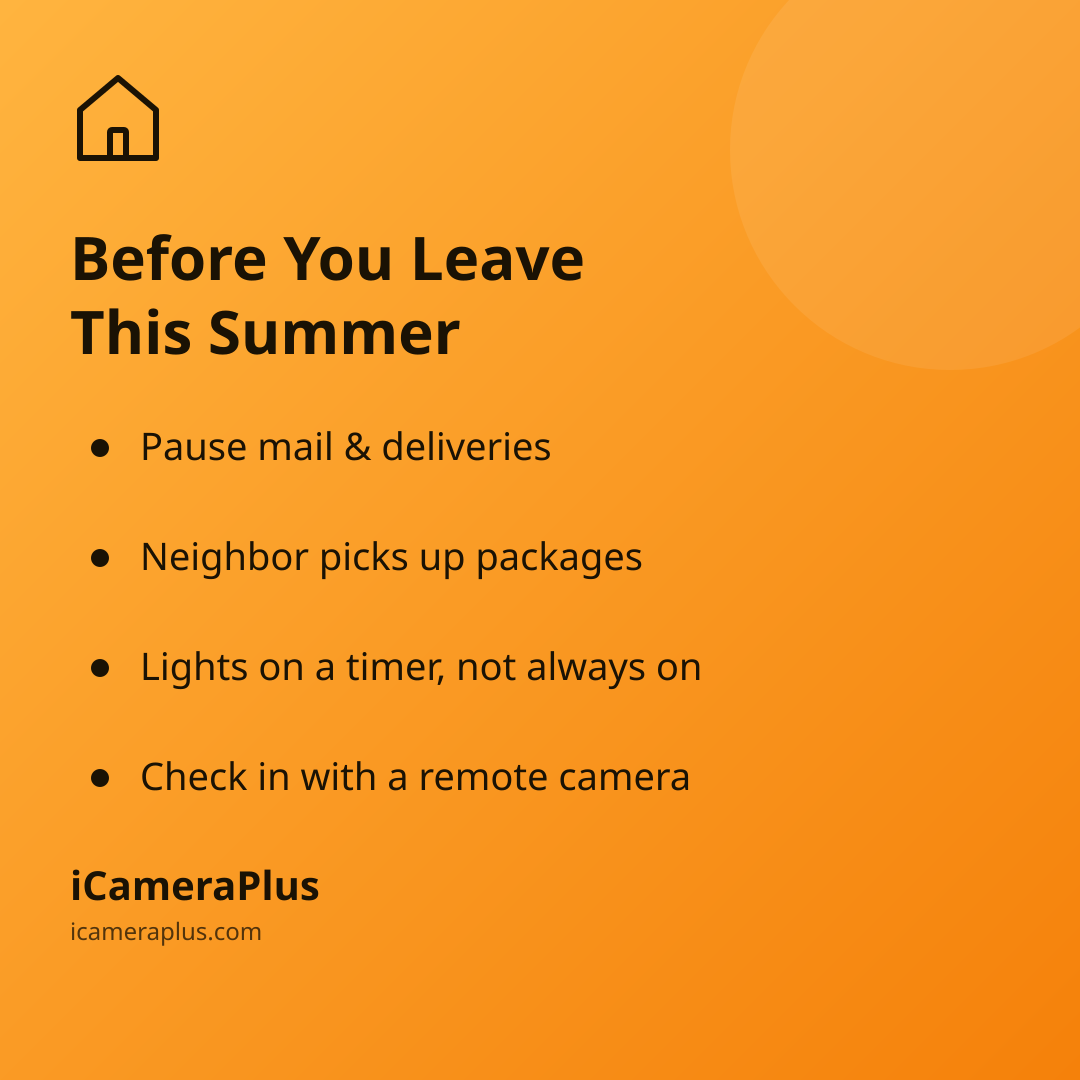
- Pause or reroute deliveries. Hold mail through the postal service, and pause subscriptions or scheduled orders that would otherwise pile up at your door.
- Ask a neighbor to collect anything that slips through. A neighbor grabbing packages off your porch every couple of days is one of the simplest deterrents available, and it costs nothing.
- Keep exterior lighting on a timer rather than leaving a single porch light burning around the clock — a light that never changes reads as "nobody's adjusting it."
- Don't broadcast the trip. Save the vacation photos for after you're home; public real-time posts about being away are an easy signal to anyone paying attention.
- Secure the obvious entry points — garage doors, side gates, and ground-floor windows are still where most break-ins start.
- Have a way to actually check on the house, not just hope everything's fine until you get back.
Remote Eyes on Your Home While You're Away
That last point is the one people most often skip, usually because they assume it means buying and installing new hardware. It doesn't have to. A spare phone — an old iPhone or Android sitting in a drawer — can be set up as a continuous camera that records around the clock and lets you check in from wherever you are. Apps built for this, including iCameraPlus, turn that old phone into a live-view camera with motion alerts and off-device video storage, so if something happens while you're traveling, there's footage of it, and you're not relying on a neighbor's memory or a hope that nothing went wrong.
It's a meaningful upgrade over the "leave a light on and hope" approach, without asking you to buy a device you don't already have. If you want the full setup walkthrough, see our guide on how to turn a spare phone into a home security camera.
What a Camera Can (and Can't) Do for You
It's worth being honest about what this actually buys you. A camera doesn't prevent a break-in by itself — it gives you visibility and a record. That's still valuable: it lets you confirm a delivery arrived and was taken from the porch versus never delivered at all, check that a window left cracked for the cat is still just cracked, and see who was at the door while you were away, rather than finding out secondhand. Set expectations accordingly, and treat the camera as one part of the checklist above, not a replacement for the rest of it.
One More Reason to Reach for the Old Phone First
There's a quieter benefit to using a device you already own instead of buying a dedicated security camera for a trip you take once or twice a year. Members of the WEEE Forum, in research consolidated by the UN Institute for Training and Research (UNITAR), estimated that 5.3 billion mobile phones would become waste worldwide in 2022 alone. A phone that would otherwise sit in a drawer between trips gets put to use instead of adding to that pile, and you skip buying new hardware for a need you already have a solution for.
Before You Lock the Door
Traveling doesn't have to mean crossing your fingers about the house you're leaving behind. The data says the overall odds are better than they've been in years — the checklist above is about closing the specific, visible gaps that matter: the packages piling up, the light that never changes, the lack of any way to check in. None of it requires new equipment you don't already have sitting around.
Sources
- FBI, "FBI Releases 2024 Reported Crimes in the Nation Statistics" (2025)
- Council on Criminal Justice, "Crime Trends in U.S. Cities: Mid-Year 2025 Update" (July 2025)
- United States Postal Service Office of Inspector General, "Package Theft in the United States" (May 2025)
- WEEE Forum / UNITAR, "~5.3 billion mobile phones will become waste in 2022" (2022)