Does Cold Weather Kill Your Security Camera's Battery? What Ring, Nest, and Apple Say in 2026
Yes — cold weather is hard on security camera batteries, and it's not just "shorter battery life." Ring, Google Nest, and Arlo all confirm in their own support documentation that their battery-powered cameras stop charging entirely once the temperature drops below freezing, and Google says a Nest battery can lose more than half its usable life at -4°F (-20°C). If your camera has ever gone offline the same week the weather turned, that's very likely why.
Why does cold weather drain a security camera battery so fast?
It comes down to basic battery chemistry. According to Battery University, the technical reference published by battery manufacturer Cadex Electronics, a lithium-ion battery that delivers 100% of its rated capacity at 27°C (80°F) typically delivers only about 50% at –18°C (0°F). Cold slows the chemical reactions inside the cell, raises internal resistance, and limits how much power the battery can actually deliver — even if it reads as "charged."
That's a problem for outdoor security cameras specifically, because most battery-powered models rely on the same consumer lithium-ion cells found in phones and laptops, mounted somewhere with zero climate control: a porch eave, a garage soffit, a fence post.
What do Ring, Nest, and Arlo actually say about cold weather?
All three major battery-camera makers document the same core limitation, in their own words:
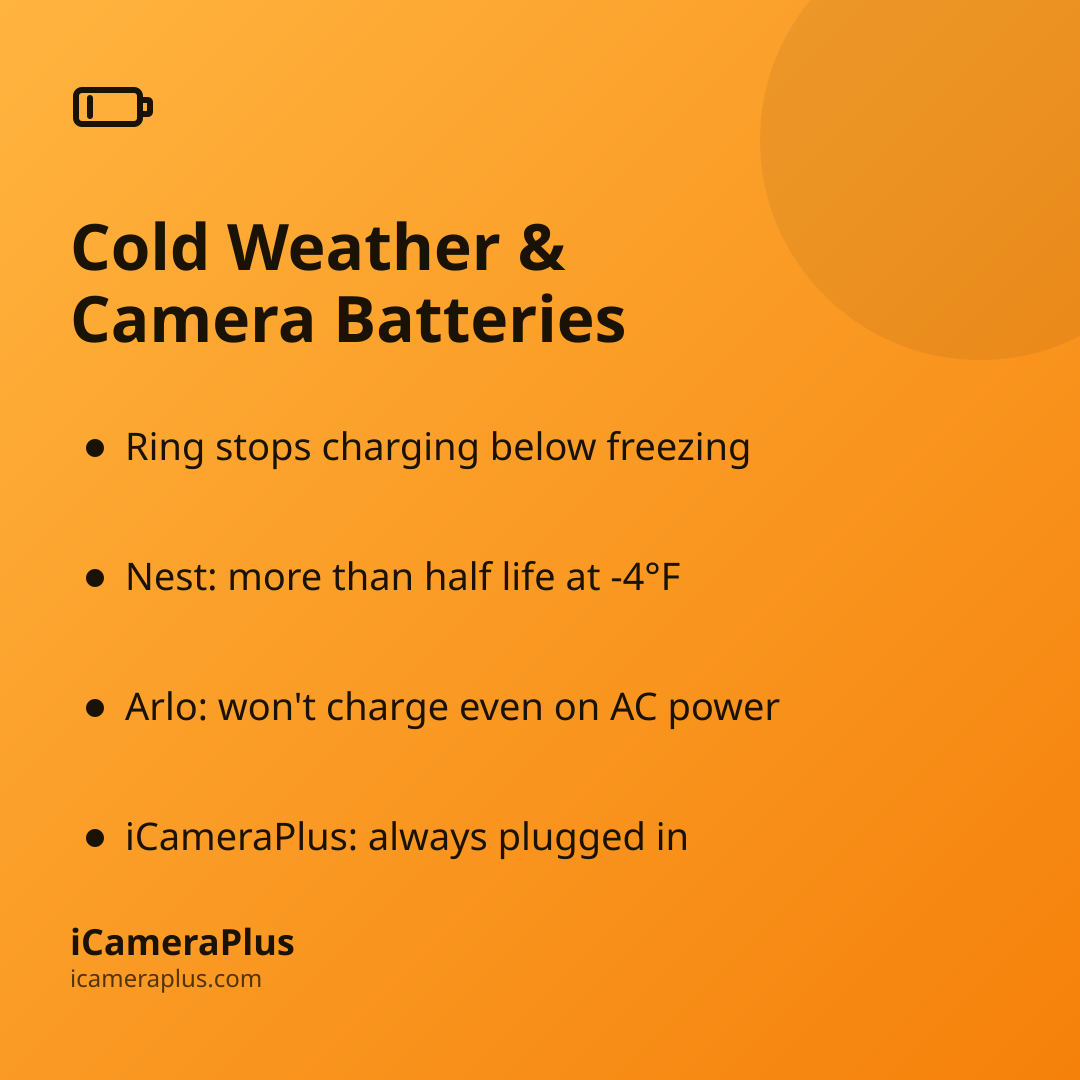
- Ring says its devices "can operate normally between -4°F and 122°F (-20°C and 50°C)," but that "your device is designed to stop charging if the temperature is below freezing," per Ring's official support page.
- Google Nest support states that at temperatures near -4°F (-20°C), a battery "may have less than half the life that it has in warm weather," and that the battery "cannot charge if the temperature drops below 32 degrees Fahrenheit (zero degrees Celsius)" — even if the camera is wired, since wired Nest doorbells still trickle-charge an internal battery. See Google Nest Help, 2026.
- Arlo tells customers its batteries "do not charge at temperatures below freezing, even if your camera is plugged into AC power or using an Arlo Solar Panel," per Arlo's support FAQ.
In other words, this isn't a defect in one brand's product. It's how lithium-ion batteries behave, and every major manufacturer warns about it in writing.
What's the difference between a camera that "won't charge" and one that's "dead"?
This distinction matters more than it sounds like it should. Manufacturers separate two different temperature thresholds:
- Operating range — the temperature at which the camera can still run on whatever charge is already in the battery (commonly down to about -4°F/-20°C).
- Charging range — the much narrower window in which the battery can actually be topped back up (generally above 32°F/0°C).
So a battery camera doesn't fail the moment the first frost hits. It keeps running on its existing charge, draining faster than usual, until that charge runs out — and then it simply can't recharge outside until the weather warms up. For a driveway or porch camera, that can mean days of no coverage during exactly the stretch of winter when a house is emptiest and darkest.
Does a plugged-in phone have the same cold-weather problem?
Partly, and it's worth being honest about the limits. Apple's own specifications state that iPhone's operating ambient temperature is 32° to 95°F (0° to 35°C), per Apple Support — so a phone mounted outdoors, uncovered, in real winter weather can shut down too.
The difference is where and how a repurposed phone camera is typically used. Rather than a battery-only unit bolted to an outside wall, a setup like iCameraPlus turns an old phone kept plugged into wall power — indoors, facing out through a window, or mounted in a garage or entryway — into a continuous, always-recording camera. The phone's battery is topped off constantly instead of being the sole power source, so it never faces the same "can't recharge below freezing" gap that battery-only outdoor cameras run into every winter. Footage also gets archived off the device continuously, so nothing depends on the camera surviving a cold snap with its local storage intact.
Quick answers
Will the cold permanently damage my camera's battery? Occasional cold exposure mostly causes temporary performance loss, not permanent damage. But repeatedly charging a battery when it's near or below freezing can cause lithium plating, which Battery University and manufacturers note is a permanent capacity loss — which is exactly why Ring, Nest, and Arlo all disable charging below 32°F rather than letting it happen.
Should I bring my battery camera inside every night in winter? If you can, yes for camera batteries or spare battery packs that need charging — bring them to room temperature to charge, then reinstall. It's not practical for a fixed doorbell, which is why Ring and Nest instead recommend removing and warming the battery pack itself when it's depleted.
Does a solar panel fix the problem? No — Arlo explicitly warns that its solar panel accessory still can't charge the camera's battery below freezing, since the limitation is in the battery chemistry, not the power source.
Cold-weather checklist
- Charge batteries only above 32°F
- Bring spares inside overnight
- Use wired power where winters get harsh
- Keep old-phone cameras indoors, facing out
Sources
- Ring — Ring devices and extreme temperatures (official support)
- Google Nest Help — Cold weather battery charging behavior in Nest cameras and doorbells (2026)
- Arlo — How do I keep my Arlo batteries charged in cold weather? (official support)
- Battery University (Cadex Electronics) — BU-502: Discharging at High and Low Temperatures
- Apple Support — If your iPhone or iPad gets too hot or too cold