Living Alone? A Practical Home-Safety Guide for Peace of Min
Living alone is one of life's underrated pleasures — your space, your rules, your quiet. The only tax on it is that late-night "what was that?" moment when there's no one to ask. The fix isn't fear or an expensive alarm contract. It's a handful of small habits and one or two tools that let you relax. In the US, only about 1 in 36 homes is burglarized in a given year, and — tellingly — roughly 6% of break-ins happen through an unlocked door. The simplest habits do the heaviest lifting.
Start with a 30-second lock-up routine
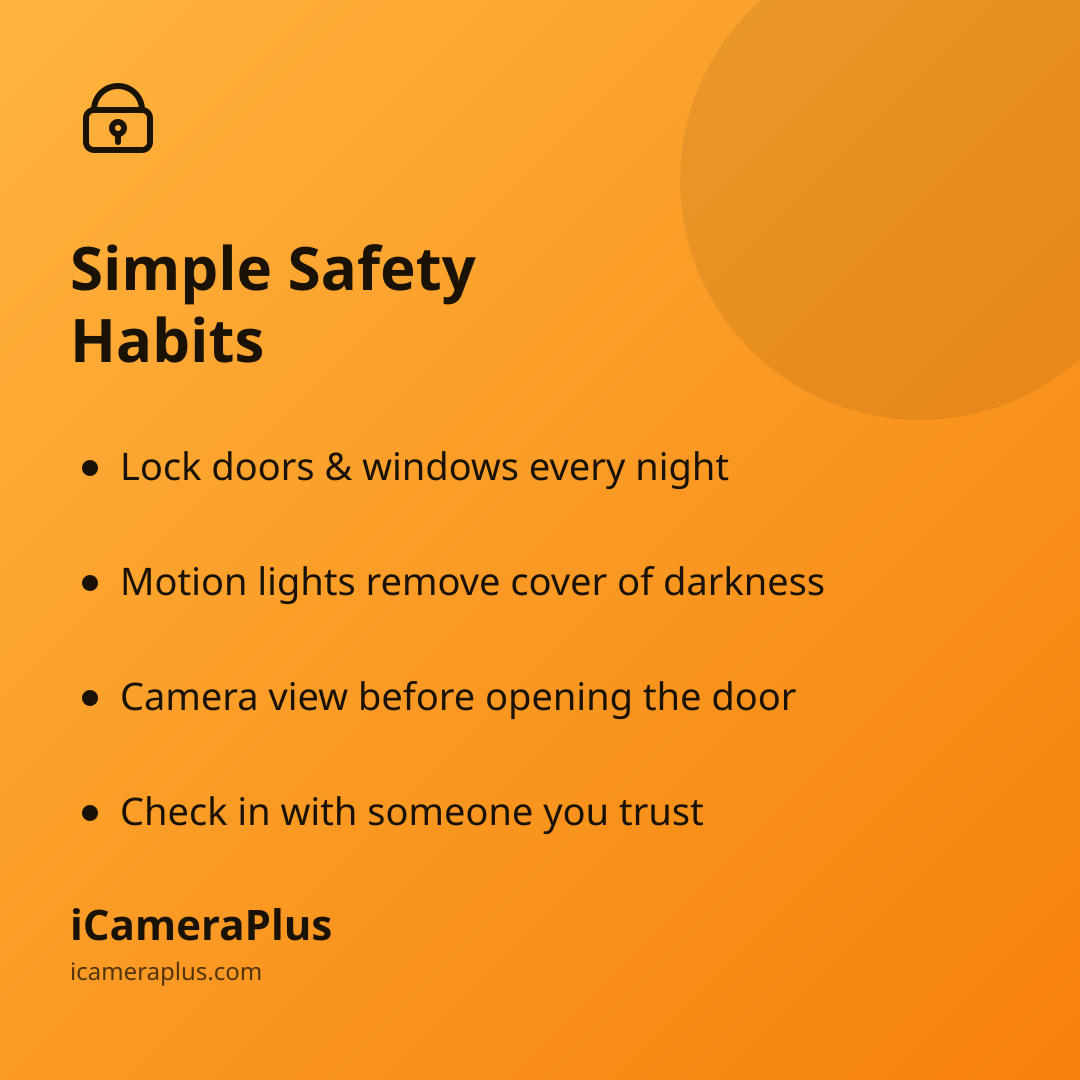
The most effective security upgrade is also the cheapest: consistently locking up. Make it a reflex, not a decision.
- Doors and windows, every night and every time you leave. Ground-floor windows are a common entry point — about 23% of break-ins in the US — so don't leave them cracked when you're out.
- Do a quick loop before bed: front door, back door, windows. Thirty seconds, every night, and it becomes automatic.
- Never rely on "I'll only be a minute." That unlocked-door statistic exists because of quick errands.
Make the house look lived-in
Burglars prefer an empty home, and most break-ins in the US actually peak during the day, roughly 10 a.m. to 3 p.m., when people are at work or school. A home that looks occupied is far less appealing.
- Motion-sensor lighting outside entries removes the cover of darkness.
- Timers or smart bulbs inside make an empty apartment look active in the evening.
- Don't broadcast an empty home — hold off on posting that you're away until you're back.
See who's at the door — without opening it
One of the biggest day-to-day comforts of living alone is not having to open the door to find out who's there. A camera pointed at your own entrance lets you check from your phone first — a delivery, a stranger, a friend — and decide on your terms. Keep it aimed at your own doorway (not a neighbor's window) and you get the reassurance without the privacy trade-offs. If you're curious where the line is, we broke it down in what you can and can't legally record at home.
Set up a simple check-in habit
The point of living alone isn't being on your own if something goes wrong. A light-touch routine means someone would notice quickly:
- Pick one trusted person and share a rough sense of your schedule.
- A quick "home safe" message after a late night costs nothing and means a lot.
- Keep your phone charged and by your bed so help is always one tap away.
Renter-friendly security: no drill, no permission needed
If you rent, most traditional security gear is off the table — you can't drill mounts, run wiring, or leave holes for your deposit to pay for. This is exactly where an old phone shines. iCameraPlus turns a phone you already own into a security camera with zero installation: no wires, no landlord conversation, no damage. Prop it by a window or entry and you get continuous recording, remote live view, and motion alerts on your main phone from anywhere. When you move, it moves with you. For the best angles, see how to set up a home security camera — and if the worst ever happens, here's exactly what to do during a break-in.
The real goal: peace of mind, not paranoia
None of this is about living on high alert — it's the opposite. You set up a few habits and one simple tool once, and then you get to stop thinking about it: enjoy your own space, sleep soundly, and answer that late-night noise with a glance at your phone instead of a knot in your stomach. That quiet confidence is the whole point.
Sources
- SafeHome.org — Burglary Statistics: safehome.org
- The Zebra — Burglary Statistics: thezebra.com
- Security.org — Home Security Systems: security.org
This article is general safety information, not professional security advice. In an emergency, always contact your local emergency services.