US Internet Outages Are Piling Up in 2026 — What That Means for the Wi-Fi Camera Watching Your Home
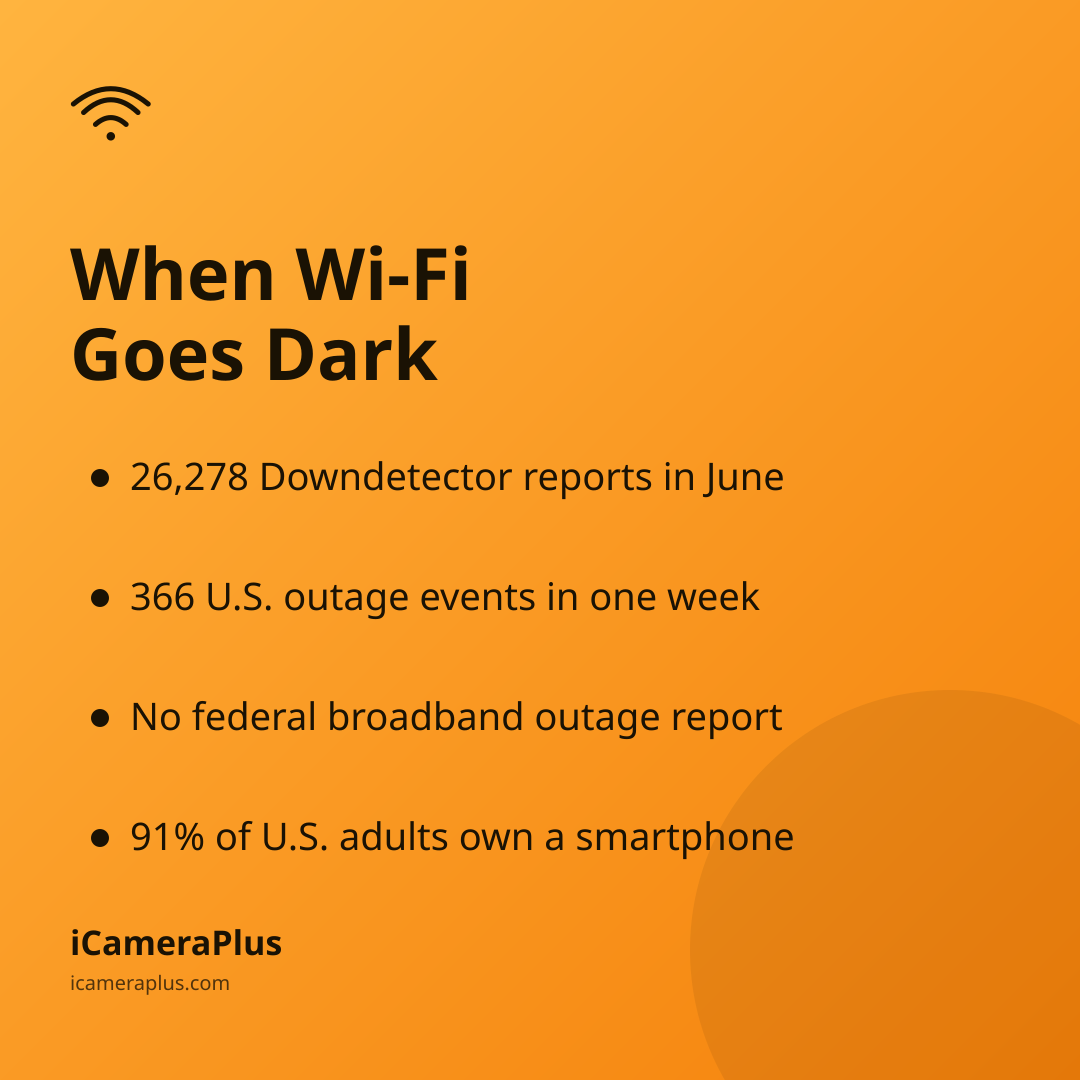
On June 22, 2026, Xfinity's internet, TV, and phone service went dark for thousands of households across San Francisco, Chicago, Austin, Boston, Baltimore, Philadelphia, Denver, Detroit, Seattle, and Miami at once. At the peak, Downdetector logged 26,278 user reports before Comcast attributed the disruption to "a system update" and restored most service within about two hours.
That kind of outage isn't rare anymore — it's a weekly occurrence somewhere in the country. And if any part of your home security setup depends on Wi-Fi to reach the internet, an outage like that doesn't just cost you streaming shows. It can mean your camera stops recording, stops alerting you, and stops being reachable from your phone, right when you'd most want it working.
How Often Is the Internet Actually Going Down in 2026?
Cisco's ThousandEyes network intelligence team, which continuously monitors internet service providers, cloud networks, and collaboration platforms, tracked 514 global outage events and 366 U.S. outage events during the week of July 27–August 2, 2026 alone, according to Network World's ongoing ThousandEyes-sourced outage report. Of those, 222 were ISP outages worldwide, with 124 in the U.S. The same report logged a 20-minute AT&T disruption on July 27 that hit multiple U.S. locations, and a 67-minute Liberty Global outage on July 30 that reached customers across several countries.
Those numbers move around week to week — the same report showed a 16% drop globally and a 20% drop in the U.S. compared to the prior week — but the baseline is the same: dozens of ISP-level outages happen across the country in any given seven-day stretch, on top of the highly visible, headline-making ones like the June Comcast/Xfinity event.
Why Nobody Has an Official Count for Broadband Outages
You'd expect a federal count of how often home internet goes down. There is one — sort of. The Federal Communications Commission's Network Outage Reporting System (NORS) has required phone, cable-voice, wireless, and interconnected VoIP providers to report significant service disruptions — generally those lasting 30 minutes or longer and meeting other severity thresholds — since the 1990s.
But broadband internet service itself isn't covered by that mandatory reporting yet. In a March 2024 rulemaking notice, the FCC proposed extending NORS-style outage reporting to broadband internet access providers — but as of today, that requirement hasn't been finalized. In practice, that means an outage like Xfinity's in June is never required to show up in an official federal report. The closest thing the public has is independent monitoring like ThousandEyes and crowdsourced trackers like Downdetector, both used to reconstruct what happened after the fact.
What Happens to a Wi-Fi Camera When the Router Loses Its Connection
Most plug-in and battery smart cameras are built around one assumption: your home Wi-Fi, and the broadband line feeding it, will be up. When that link drops, so does everything the camera does over the internet — live view on your phone, motion push alerts, and any clip that was supposed to upload to the cloud. A camera that only saves to a local SD card will keep filming, but that footage is stuck on a device sitting in your house until someone physically retrieves it — not much help if the outage coincides with a break-in, a package theft, or an emergency you'd actually want to see in real time.
That's a meaningful blind spot, because outages and break-ins don't politely avoid overlapping. A property being cased or a package being lifted off a porch doesn't wait for your ISP's status page to turn green again.
A Cellular Backup Is Simpler Than It Sounds
The fix isn't necessarily a second internet provider — it's a second network path. Home broadband (cable, fiber, DSL) and cellular data run on physically separate infrastructure, so an outage that takes down Comcast's or AT&T's fixed-line network doesn't automatically take down AT&T's, Verizon's, or T-Mobile's cellular towers, and vice versa. A device that can fall back to cellular data keeps working even when the router in the hallway is completely dead.
Most households already own the hardware for this: according to the Pew Research Center's 2025 survey data, 91% of U.S. adults own a smartphone. That's the idea behind turning a spare phone into a camera you monitor yourself with iCameraPlus — it records continuously and archives footage off the device itself, so an outage on your home network isn't the single point of failure for whether your own property is being watched. If the phone can reach a cellular signal, it can keep monitoring even while your Xfinity or AT&T line is down.
A Short Resilience Checklist
- Find your provider's outage/status page now, before you need it, so you're not searching for it on a phone with no data during an actual outage.
- Ask what "offline" looks like for your current camera — does it stop recording entirely, or keep saving locally? Test it by turning off your router for five minutes and checking the app.
- Separate your monitoring from a single network path where it matters most — a phone-based camera with cellular capability is a low-cost way to add that redundancy without replacing your whole setup.
- Keep footage archived off-device, not just on a local SD card or a device that could be offline, stolen, or damaged at the exact moment you need the recording.
September is National Preparedness Month, when the Federal Emergency Management Agency encourages households to test emergency plans and make sure important records aren't dependent on a single point of failure. A home network resilience check — including what happens to your security footage during an outage — fits squarely into that same habit, and it costs nothing but ten minutes with your router's power cord.
Sources
- GV Wire, "Xfinity Down for Thousands, Downdetector Reports" (June 22, 2026)
- Network World, "2026 network outage report and internet health check" (ThousandEyes/Cisco data, 2026)
- Federal Communications Commission, "Network Outage Reporting System (NORS)"
- Federal Register, "Amendments to Resilient Networks; Disruptions to Communications" (FCC, March 2024)
- Pew Research Center, "Mobile Fact Sheet" (2025 survey data)
- Ready.gov, "National Preparedness Month" (FEMA)