Is It Legal to Use a Nanny Cam in 2026? What Washington's New Domestic Worker Law Changes
Yes — recording video in the common areas of your own home is legal in all 50 states, and in most states you don't have to tell your nanny, babysitter, or housekeeper it's happening. What changed in 2026 is Washington state: on March 9, 2026, Gov. Bob Ferguson signed House Bill 2355, making Washington the 13th state to pass a Domestic Workers Bill of Rights — and the law spells out, for the first time in that state's statutes, exactly where an employer can't point a camera at the person working in their home.
If you employ a nanny, housekeeper, or in-home caregiver — or you're just trying to figure out where your household security camera is legally allowed to see — here's what the law actually says in 2026, and how to set up a camera that protects your home without crossing a line.
Is It Legal to Use a Nanny Cam in 2026?
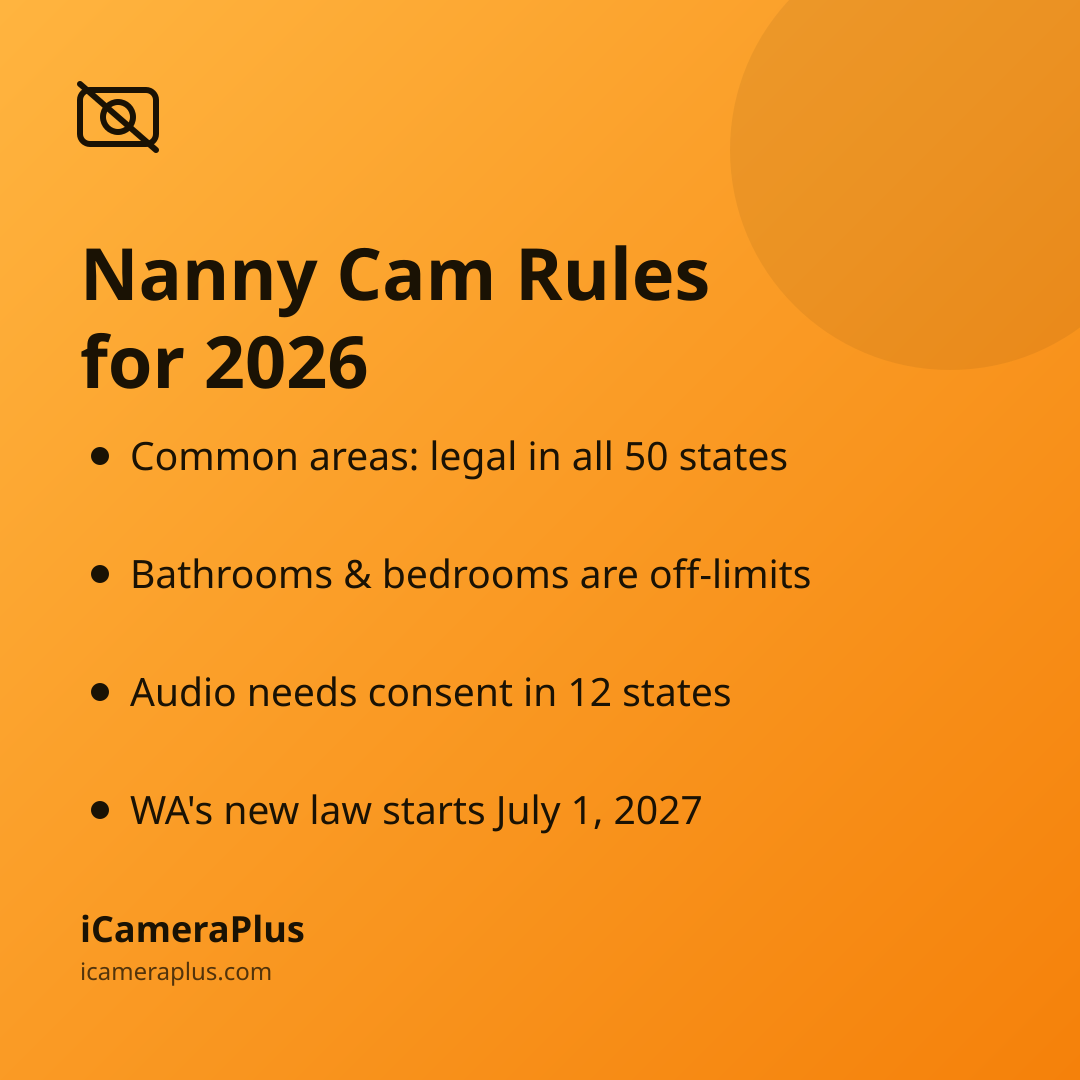
Video-only recording in the common areas of your own home — living room, kitchen, entryway, nursery — is legal in every state, and courts have generally held that homeowners don't need to disclose a camera's presence to a household employee, according to RecordingLaw.com's state-by-state survey of surveillance camera laws (2026). One notable exception: Connecticut has a separate electronic-monitoring notice statute, Connecticut General Statutes § 31-48d, that can require employers to give written notice before monitoring employees — including household employees — with a camera. The legal complications get more serious the moment audio is involved, or the camera points somewhere the law treats as private.
What Does Washington's New Domestic Worker Law Actually Change?
Washington's HB 2355 extends minimum wage, written-agreement, and anti-retaliation protections to nannies, housekeepers, cooks, gardeners, and home care workers statewide. Tucked inside those labor protections is a privacy provision: employers are barred from monitoring domestic workers in bathrooms, bedrooms, or private communications, according to the office of state Sen. Rebecca Saldaña, who championed the bill through the Senate. The law takes effect July 1, 2027, and builds on protections Seattle enacted for domestic workers back in 2018.
Washington isn't inventing the concept of a private domestic workforce that deserves labor protections — it's the 13th state to legislate one, following states like New York, California, Illinois, and New Jersey. But the explicit camera-and-communications language is a notable escalation: it moves "don't film your nanny in the bathroom" from common-sense advice into codified law. An estimated 2.2 million people work as domestic employees in U.S. households, according to the Economic Policy Institute's 2022 Domestic Workers Chartbook — a workforce large enough that state-by-state rules are starting to catch up with how common in-home cameras have become.
Which States Require Consent to Record Audio?
This is the part that trips people up, because it has nothing to do with whether you're recording a nanny, a contractor, or yourself. Federal wiretap law sets a one-party consent baseline under 18 U.S.C. § 2511, meaning it's generally legal to record a conversation if you're a participant in it. But a dozen states go further and require everyone in the conversation to agree: California, Connecticut, Delaware, Florida, Illinois, Maryland, Massachusetts, Montana, New Hampshire, Oregon, Pennsylvania, and Washington.
If you live in one of those states, recording audio of a nanny or housekeeper without their knowledge isn't just an employment-law issue — it can expose you to a civil lawsuit or, in some states, criminal wiretapping charges. The simplest fix costs nothing: mute the microphone on your camera, or get written consent from the person being recorded.
Where Can't You Point a Camera in Your Own Home?
Even without a state law like Washington's, the same boundaries apply almost everywhere by legal convention and common sense:
- Bathrooms — off-limits everywhere, no exceptions
- A live-in employee's bedroom or private living space
- Areas where a "reasonable expectation of privacy" clearly applies
- Audio in a two-party consent state, without permission
Common areas — the kitchen, living room, front door, backyard, nursery — are fair game for video in every state. That's also where a camera actually earns its keep: it's where deliveries arrive, where kids play, and where most day-to-day accountability questions come up.
How to Set Up a Nanny Cam the Transparent Way
A few habits keep a home camera on the right side of both the law and basic trust:
- Mount cameras in shared spaces only
- Turn off audio in consent states
- Tell your caregiver it's there
- Store footage off-device, not just on the camera
Plenty of families already have the hardware for this sitting in a drawer. An old phone works well as a fixed camera for a shared space like a kitchen or living room — it just needs power, a stable mount, and something to handle continuous recording and remote viewing. That's the specific gap iCameraPlus is built for: it turns a spare phone into a 24/7 home security camera with an off-device archive and live remote view, so you can check in on a shared space honestly and openly, without adding a second piece of hardware or a hidden device anywhere near a private room.
Washington just became the 13th state to write legal limits on watching the person who watches your kids.
If you're specifically weighing a dedicated camera against reusing a device you already own for childcare monitoring, the placement and consent rules above apply either way — see our baby monitor and nanny cam guides for the practical side of getting a shared-space camera running.
Quick answers
Do I have to tell my nanny there's a camera? In most states, no — video-only cameras in common areas don't legally require disclosure. Washington's new law doesn't require disclosure either, but it does ban filming in bathrooms, bedrooms, and private communications outright, and Connecticut has a separate employee-monitoring notice law worth checking if you're there.
Can I record audio of my nanny without asking? Only if you live in a one-party consent state. In the 12 all-party consent states listed above, recording audio without the other person's knowledge can carry civil or criminal liability.
Can nanny cam footage be used in court if something happens? Video from common areas, recorded legally, is generally admissible as evidence in custody, abuse, or employment disputes. Footage obtained by violating a state's audio-consent law or a specific privacy statute can be challenged or excluded.
Sources
- Washington State Legislature — HB 2355 Bill Summary (2026)
- Office of Sen. Rebecca Saldaña — Domestic Workers Bill of Rights Signed Into Law (March 2026)
- Economic Policy Institute — Domestic Workers Chartbook (2022)
- National Domestic Workers Alliance — Domestic Workers Bill of Rights, State Tracker
- RecordingLaw.com — Surveillance Camera Laws by State (2026)
- Cornell Law School Legal Information Institute — 18 U.S.C. § 2511, Federal Wiretap Act
- Justia — Connecticut General Statutes § 31-48d, Employer Electronic Monitoring Notice