Will Winter 2026–2027 Be Mild? What NOAA's Outlook Means for Frozen Pipes at Home
This article was produced with AI assistance. Sources are listed at the end.
NOAA's October 2026 winter outlook forecasts warmer-than-average temperatures across most of the United States this season — but a mild seasonal average doesn't cancel out the hard freezes that actually burst pipes. If you're planning to leave your house empty for a few days or a few weeks this winter, the forecast alone isn't protection, and the insurance numbers bear that out.
Does NOAA's mild winter forecast mean frozen pipes aren't a risk in 2026-2027?
Not really. On October 15, 2026, NOAA released its U.S. Winter Outlook for December 2026 through February 2027, built around what it calls a "very strong El Niño." Part or all of 41 of the Lower 48 states are forecast to be warmer than normal this winter, with no states favored to run cooler than average, according to NOAA (2026). The Pacific Northwest, northern Rockies, Midwest, Mississippi Valley, much of the East and Alaska have the best odds of a mild season, while the South and East Coast also lean wetter than usual.
"...Too much precipitation on dry soil can fuel destructive flash floods and mudslides. Now is the time for communities and individuals to plan ahead for the upcoming winter." — Ken Graham, National Weather Service Director, via NOAA (2026)
A seasonal average isn't a forecast for any single night, though. Even in a warm winter, cold snaps still arrive fast enough to freeze an unheated or unattended pipe before anyone notices — NOAA's outlook is a probability for the season as a whole, not a guarantee for any one week or any one house.
How much does a frozen pipe actually cost homeowners?
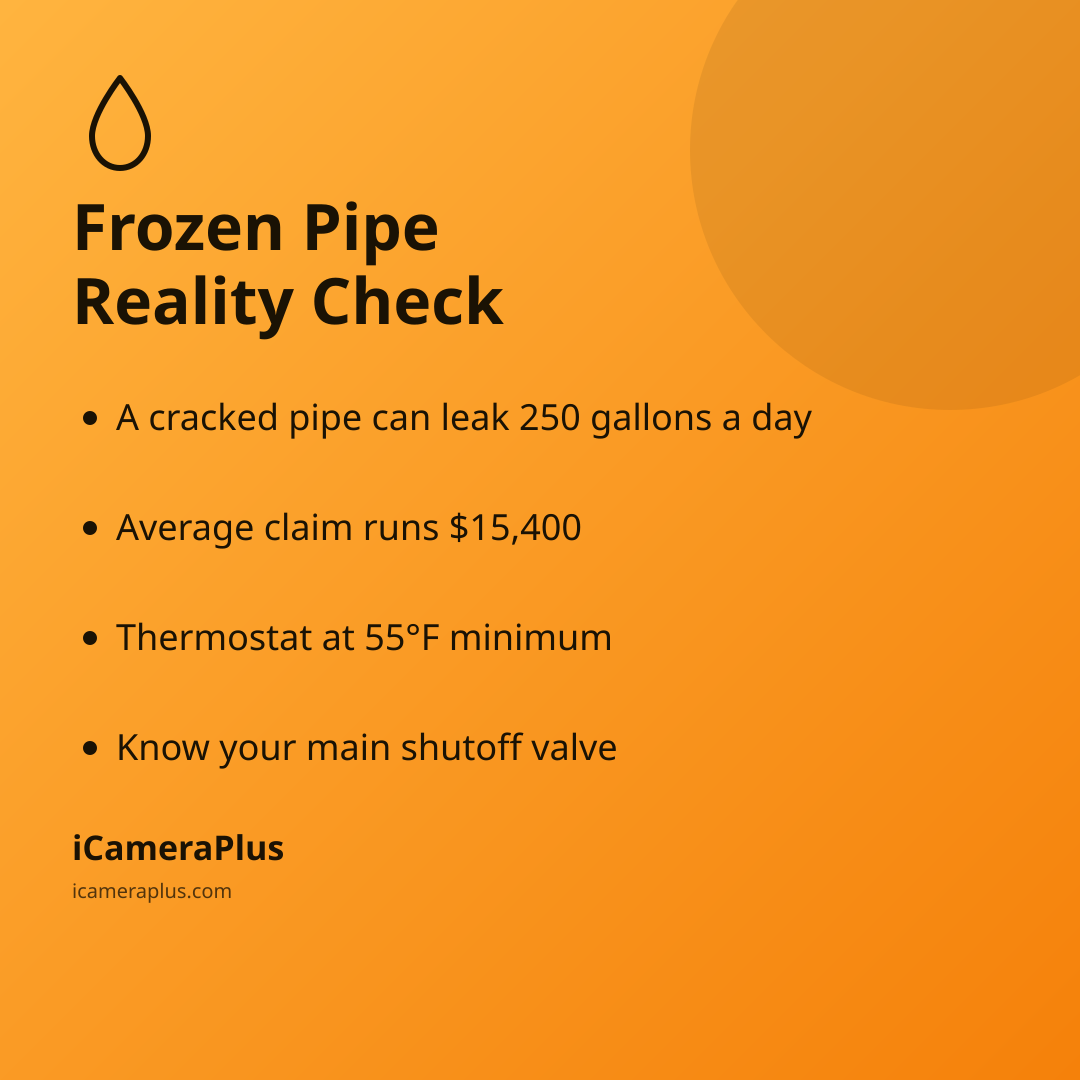
More than most people expect. A single cracked pipe can leak more than 250 gallons of water a day, according to State Farm (2026). Nationally, water damage and freezing accounted for 19.8% to 28.7% of all homeowners insurance losses by cause between 2019 and 2023, and roughly 1 in 60 insured homes files a water-damage-or-freezing claim in a given year, per the Insurance Information Institute (2026). The average claim for this category runs $15,400, according to the same Triple-I data.
State Farm's own book of business tells a similar story at a smaller scale: between January 2024 and June 2025, the insurer paid out more than $628 million on over 20,000 frozen-pipe claims, with an average payout above $30,000 per claim, the company reported in its January 2026 release.
A mild winter forecast is not pipe insurance.
What temperature should you keep your home at while you're away?
State Farm recommends keeping the thermostat no lower than 55°F while you're away during freezing weather, letting faucets drip on especially cold nights, and knowing where your main water shutoff valve is before you ever need it. Draining outdoor spigots and hoses, and sealing obvious air leaks around pipes in unheated spaces like garages, attics and crawl spaces, rounds out the standard advice from the insurer's January 2026 guidance.
Quick takeaways before you leave town:
- Thermostat at 55°F minimum
- Drip faucets on freezing nights
- Know your main shutoff valve
- Check in visually, not just by thermostat app
Can you check on your pipes without being home?
Yes — and you don't need to buy anything new to do it. A phone you already own, propped on a shelf in the utility room or aimed at the thermostat display, can tell you more than a temperature app ever will. Setting up an old phone as a security camera with an app like iCameraPlus gives you continuous recording and a live view you can pull up from the web panel whenever you want to confirm the heat is actually running and nothing looks wrong. If something does go wrong while you're away, the private cloud archive lets you scroll back and see exactly when a pipe let go or the furnace quit — useful for your own peace of mind, and for documenting the timeline if you ever need to file an insurance claim.
That's a different problem from the one most people worry about when they travel in winter. Burglary risk while you're away for the holidays gets more attention, but a burst pipe can do just as much damage with nobody breaking in at all.
Quick answers
Does homeowners insurance cover frozen pipes?
Usually yes — standard homeowners policies typically cover sudden, accidental water damage caused by freezing. Insurers can deny claims tied to neglect, such as leaving the heat off during an extended absence, so check your own policy or ask your agent before you travel.
What's the minimum safe thermostat setting while away in winter?
State Farm recommends never setting it below 55°F, since interior wall and pipe temperatures lag behind whatever the thermostat reads, especially in unheated areas like basements and garages.
Will this winter actually be warmer than normal where I live?
NOAA's 2026-2027 outlook favors warmer-than-average conditions across most of the Lower 48, but "warmer than average" is a seasonal probability, not a guarantee against any individual cold snap, so check the regional detail in NOAA's outlook for your area.