Ring's Facial Recognition Feature Is Being Sued — What It Means for the Camera at Your Door
If you own a Ring doorbell, you may have noticed a new option waiting in your app: a feature called Familiar Faces that promises to tell you not just that someone is at your door, but who. It sounds like a small convenience — "Dad is at the door" instead of "A person is at the door." But since it rolled out nationally in December 2025, the feature has drawn a federal class action lawsuit, a pointed inquiry from a U.S. senator, and non-availability in three jurisdictions. If you're a homeowner or renter trying to keep your property monitored without getting tangled in a privacy mess, here's what's actually going on — and what it means for the camera you already have, or are thinking about adding.
What Familiar Faces Actually Does
According to Ring's own support documentation, the feature uses AI to scan faces that appear in front of an enabled camera, builds a "face library," and lets the owner assign names to recurring visitors. Once a face is recognized, Ring can send a personalized alert instead of a generic motion notification. Ring says facial recognition profiles are encrypted and stored in the cloud rather than on the device itself, that unnamed profiles are deleted after 30 days, and that all profiles expire after 180 days of inactivity.
The catch, according to the Electronic Frontier Foundation (EFF, 2025), is that the system doesn't just scan the people you choose to tag. To figure out who's familiar, it has to run facial recognition on everyone who walks in front of the camera — delivery drivers, mail carriers, neighbors, canvassers, and kids selling fundraiser items included. None of them consented to having their face measured and compared against a database.
Why It's Already in Court
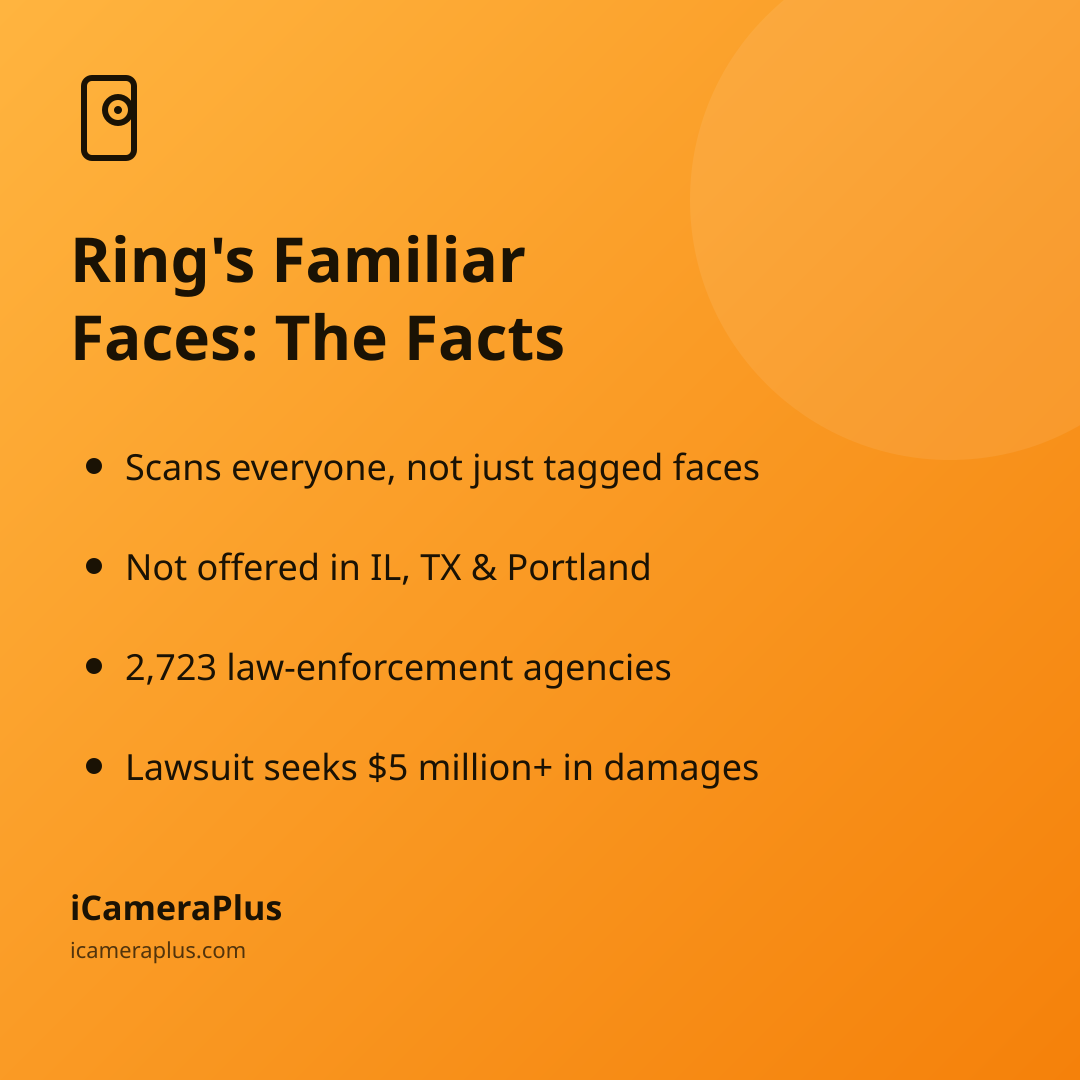
On June 1, 2026, Virginia resident Charles Sigwalt filed a nationwide class action against Amazon and Ring in federal court in Seattle, alleging his face was scanned and stored by a Ring camera he doesn't own and never agreed to interact with, according to TechCrunch (June 2026). The suit seeks at least $5 million in damages on behalf of a class of similarly affected bystanders and cites state biometric-privacy statutes that require companies to get affirmative consent before capturing someone's faceprint.
That legal theory isn't new. Facial-recognition missteps have already cost tech companies real money: Facebook paid $650 million to settle an Illinois biometric privacy class action, and Google agreed to a $1.375 billion settlement with the state of Texas over similar claims, both cited by the EFF (2025). Illinois' Biometric Information Privacy Act and Texas' Capture or Use of Biometric Identifier Act both require consent before a company can collect someone's face geometry — and neither state carries an exception for "it was just a doorbell."
Where the Feature Isn't Available
Amazon has not activated Familiar Faces in three places: Illinois and Texas, because of their biometric consent statutes, and Portland, Oregon, which restricts private-sector facial recognition under city ordinance Chapter 34.10, according to Biometric Update (2025) and Ring's own support page. It's also unavailable in Quebec and across the EU, UK, and Ireland, where GDPR sets similar consent requirements for biometric data. In other words, in the exact places with the strongest legal protections against unconsented biometric collection, Amazon decided the feature was too risky to ship.
That's a useful signal for homeowners everywhere else: the absence of a law in your state doesn't mean the practice is risk-free — it may just mean no one has passed a law yet.
What a U.S. Senator Found
Senator Edward Markey (D-MA), who has pressed Amazon on Ring's privacy practices since 2019, sent Amazon a formal inquiry after the December 2025 launch. In his December 10, 2025 press release, Markey's office noted that Ring's privacy safeguards apply only to the device owner — not to the person whose face is actually being scanned — and that there's no consent mechanism for bystanders at all. He also flagged that Ring's law-enforcement partnerships have grown from 2,161 agencies in 2022 to 2,723 as of the letter, meaning any footage (and potentially any face data) captured at a stranger's door can end up in a much wider network than the homeowner who installed the camera ever intended.
Independent research also complicates the "it just recognizes familiar people" pitch. The EFF (2025) points to years of published research showing facial recognition systems have historically produced higher error rates for women and people with darker skin tones — meaning the alerts a homeowner relies on to know who's really at their door may simply be less reliable for some visitors than others.
What This Means If You're Just Trying to Watch Your Own Front Door
None of this is an argument against having a camera. Recording your own porch, yard, or entryway is legal nationwide and remains one of the simplest ways to deter package theft and document break-ins. The controversy is specifically about facial recognition — building a searchable biometric profile of everyone who passes by — not about recording video itself.
If you'd rather keep an eye on your property without wading into biometric law, a few practical options:
- Turn off face-matching features if your camera has them. Most doorbell brands, including Ring, let you disable people-recognition add-ons and keep plain motion detection instead.
- Favor motion-based alerts over identity-based ones. Knowing something moved is usually all you need to check a live feed — you don't need the camera to know who it was.
- Consider a camera setup that simply records and alerts, without a biometric database. This is where repurposing a phone you already own can help: iCameraPlus turns an old phone into a continuously recording security camera with off-device video storage, remote live view, and motion alerts — giving you the coverage that matters (seeing and reviewing what happened at your door) without building a faceprint library of every visitor and passerby.
If you already use Familiar Faces or a similar tool and want to limit exposure, Ring's own documentation confirms you can delete individual profiles at any time and that recognition stops (though existing profiles remain viewable until deleted) if you cancel the associated subscription.
The Bigger Pattern
Familiar Faces is part of a broader shift already underway across the smart-camera industry: cameras that used to just record are increasingly trying to identify. That shift brings real convenience, but it also drags every homeowner who enables it into a legal and ethical territory — biometric data collection — that has nothing to do with the original promise of "see who's at my door." Before turning on any identity-matching feature, it's worth asking a simple question: do I actually need the camera to know who someone is, or do I just need to know that someone is there? For most home-monitoring needs — deterring theft, catching a break-in on video, checking in on a delivery — the second is enough, and it comes with a lot less legal and ethical baggage.

Sources
- Ring: "Familiar Faces" support documentation
- Electronic Frontier Foundation: "The Legal Case Against Ring's Face Recognition Feature" (November 2025)
- TechCrunch: "Amazon faces class action lawsuit over Ring facial-recognition feature" (June 2, 2026)
- Office of Senator Edward Markey: Press release on Ring facial recognition (December 10, 2025)
- Biometric Update: "The fight over Ring's new facial recognition feature" (November 2025)