Ring's New "TAKE" Encryption: What It Actually Changes About Who Can See Your Footage
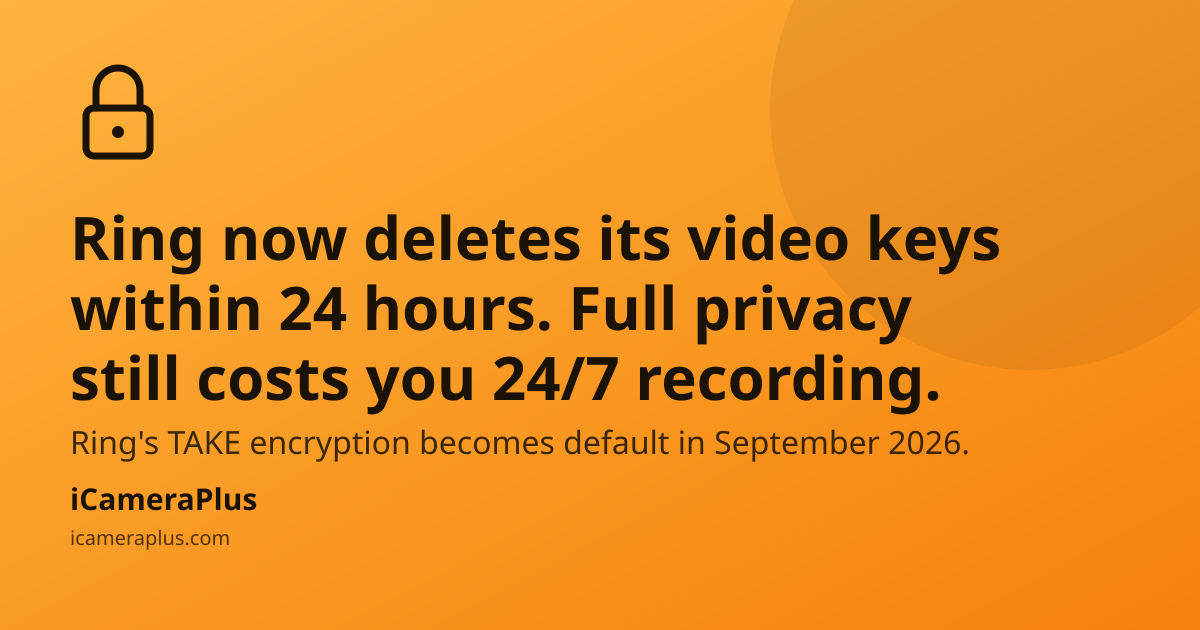
On August 26, 2026, Amazon's Ring announced a new default encryption system for its cameras and video doorbells called TAKE — short for "Throw Away the Key Encryption." The company is pitching it as a way to reassure the roughly 39% of American households that now own a video doorbell, according to a 2026 Reviews.org report, that their footage isn't sitting around indefinitely for Amazon, hackers, or law enforcement to access.
It's a real, meaningful change — but it's also a good moment to ask a broader question that applies no matter what brand of camera is watching your front door: who actually controls your footage, and for how long?
What Ring Announced on August 26, 2026
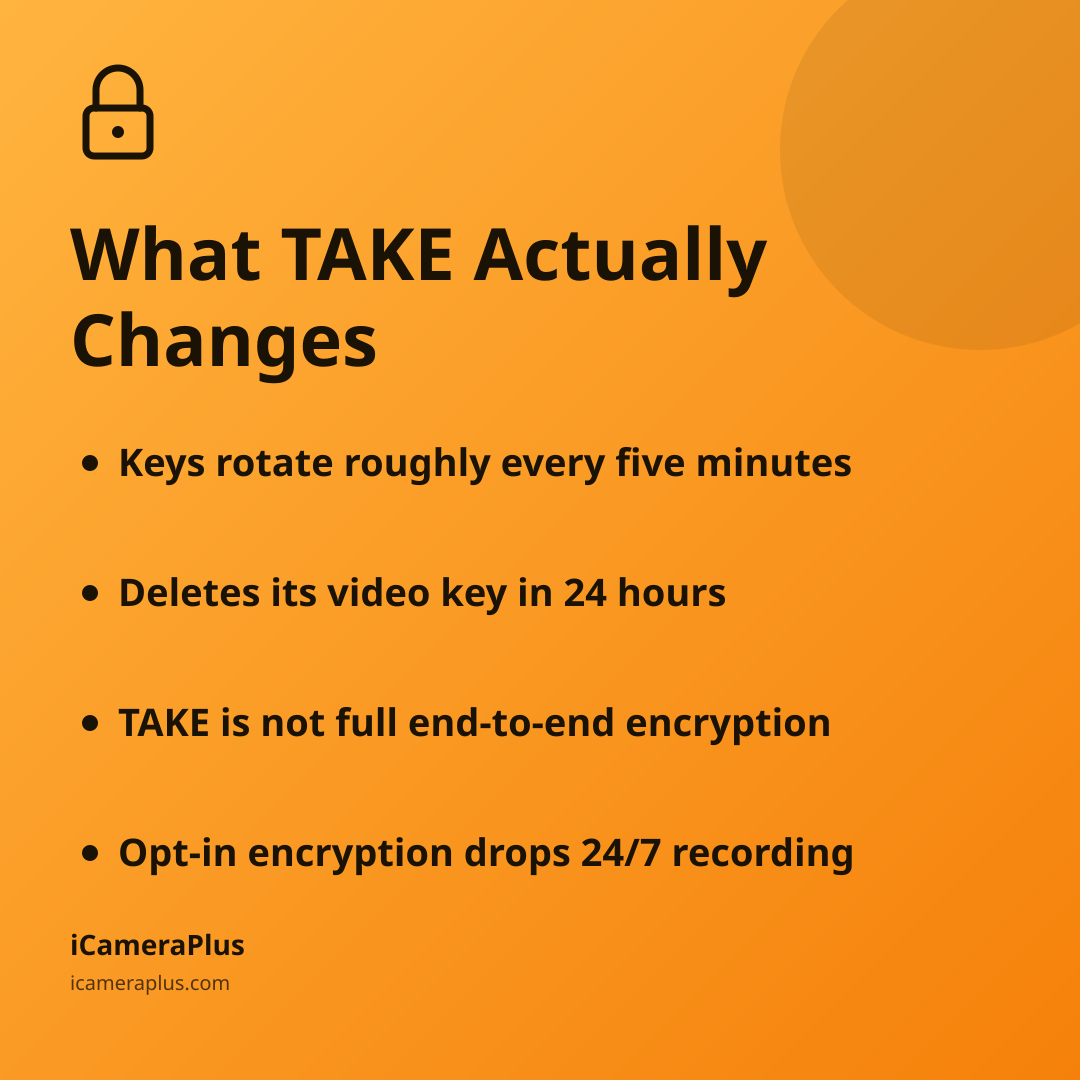
According to TechCrunch's report and Ring's own announcement on Amazon's newsroom, TAKE will become the default encryption setting on all Ring cameras starting in September 2026. Under this system, each camera encrypts its video with keys that rotate roughly every five minutes. A temporary copy of the key is held in what Ring calls a "secure enclave" in the cloud — just long enough to power features like Smart Alerts, video search, and video descriptions — and then Ring permanently deletes its copy within 24 hours, according to Gizmodo's August 2026 coverage.
The practical effect, as TechSpot reported in August 2026, is that once those 24 hours pass, Ring itself no longer has a way to decrypt older footage — even if asked to by police or by Amazon's own engineers.
Why This Matters for Law Enforcement Requests
Ring has a complicated history here. In January 2024, the company ended its practice of letting police request footage directly from users through its Neighbors app — a policy shift the Electronic Frontier Foundation called a "victory" for privacy advocates after years of criticism over Ring's relationships with local police departments.
TAKE goes a step further on the technical side. With the new default in place, Ring says it can only hand over non-video information (like basic account details) in response to a valid warrant, subpoena, or court order — because, after the 24-hour window, it simply doesn't hold a usable key anymore. Ring still maintains a page describing exactly how it handles law enforcement information requests, which is worth a read if you want to understand the legal side of who can compel access to footage.
The Catch: It's Not Full End-to-End Encryption
This is the detail that got buried under the celebratory headlines. TAKE is a middle ground, not maximum privacy. Because Ring needs to temporarily decrypt your video to run AI features — person detection, package alerts, searchable video history — it isn't the same as true end-to-end encryption, where only you hold the keys, period.
Ring does still offer full end-to-end encryption as an opt-in setting. But choosing it means giving up a substantial list of features, including shared user access, facial recognition, AI video search, and — notably — continuous 24/7 recording and pre-roll capture. In other words, the more privacy you want from Ring's cloud, the less of the camera's core recording functionality you get to keep.
That trade-off is the real story here. It's not that Ring did something wrong — rotating, short-lived keys are a genuine improvement over indefinitely stored footage. It's that the privacy and the functionality are still bundled together and controlled by the manufacturer, not by you.
The Bigger Question: Who Holds Your Archive?
Whatever brand of camera is on your door, it's worth separating two different questions:
- Who can technically decrypt my video, and for how long? (This is what TAKE addresses.)
- Where does my footage actually live, and who decides how long it's kept? (This is a separate, often bigger, question.)
Most cloud security camera systems — Ring included — store your footage on the company's servers under the company's retention rules, subscription tiers, and feature bundles. Even with better encryption, you're still trusting a third party's infrastructure and business decisions with your home's recordings.
An alternative worth knowing about: you can turn a phone you already own into a dedicated home security camera that monitors your own property with continuous recording and an off-device archive you control, rather than one bundled into a single company's encryption policy. iCameraPlus works this way — it repurposes an old phone for 24/7 recording, remote live view, and motion alerts, while keeping your archived footage separate from any one manufacturer's cloud terms. You're not choosing between "keep AI features" and "keep continuous recording" the way Ring's opt-in encryption forces you to; you get continuous recording by default, on hardware you already own.
What to Do Right Now, Regardless of Your Camera Brand
If you own a Ring device, or any cloud-connected camera, this news is a good prompt to actually check your settings rather than assume the defaults suit you:
- Check your encryption setting. When TAKE rolls out in September 2026, confirm whether you're on the new default or still want to opt into full end-to-end encryption — and understand which features you'd lose either way.
- Read the retention policy, not just the privacy headline. Ask how long footage is stored by default, and what happens to it if you cancel a subscription.
- Know your legal-request policy. Ring's law enforcement request page is public — the equivalent page for whatever brand you own should be too.
- Decide what "control" means to you. For some households, an encryption upgrade from a major brand is enough peace of mind. For others, keeping the archive off a third-party cloud entirely — for example, by using a spare phone with its own storage — is the more direct answer.
Encryption news like this tends to generate a lot of reassuring headlines. The useful exercise is to look past the headline and ask the two questions that actually determine your privacy: who can see this footage, and who decides how long it exists.

Sources
- Amazon: "Ring introduces TAKE, setting a new industry standard for default encryption and control" (August 2026)
- TechCrunch: "Ring introduces a new encryption standard, makes it the default for cloud features" (August 26, 2026)
- Gizmodo: "Ring Says Its New Encryption System Could Make It Harder for Police to Access Videos" (August 2026)
- TechSpot: "Ring rolls out new privacy-focused encryption that could limit what it can hand over to police" (August 2026)
- Electronic Frontier Foundation: "Victory! Ring Announces It Will No Longer Facilitate Police Requests for Footage from Users" (January 2024)
- Ring: Law Enforcement Information Requests (official policy page)
- PetaPixel: "39% of Americans Now Have a Video Doorbell at Home," citing Reviews.org's 2026 report (April 2026)