Weekly Tech & AI Roundup: Flock Camera Backlash Grows, ChatGPT Gets a Teen Mode, and This Week's Biggest Tech News (August 16–22, 2026)
This week brought a striking split-screen in how Americans feel about cameras: growing anger at networked surveillance systems that watch public spaces without much accountability, alongside quieter, steady progress on tools that let people monitor their own homes on their own terms. Here's what happened in AI, smart homes, and digital privacy between August 16 and August 22, 2026 — and what it means if you're the one deciding what gets recorded around your own property.
Smart Home & Security Cameras
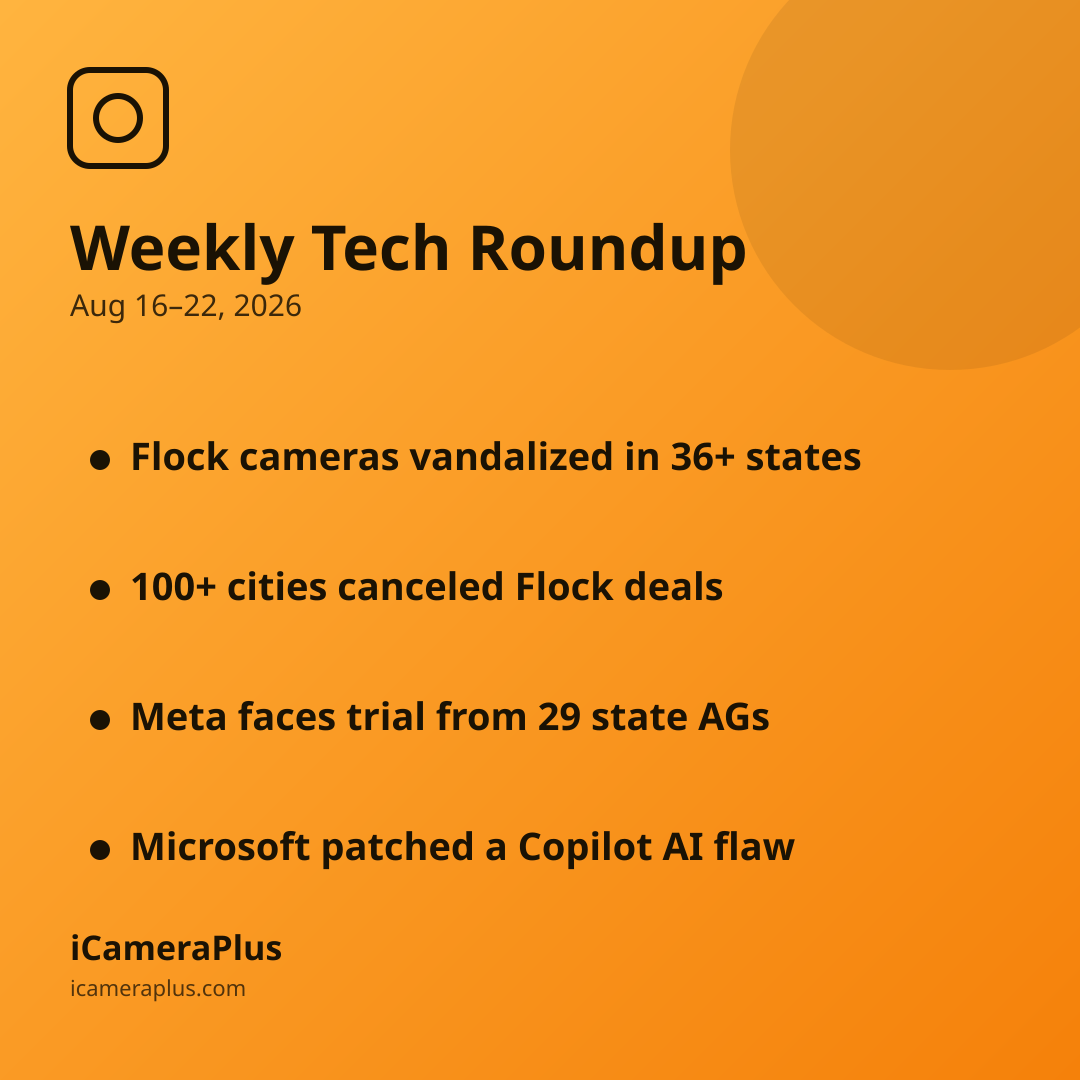
The biggest camera story of the week wasn't about a new gadget — it was about backlash to an old one. The Washington Post reported on August 18, 2026 that Americans are shooting, spray-painting, and sawing down Flock Safety's automatic license-plate reader cameras, more than 130,000 of which now dot U.S. roads according to the crowdsourced tracker DeFlock.org. A follow-up NPR review published August 21, 2026 found the cameras have been vandalized in at least 36 states, with how-to videos on how to disable them spreading on social media; DeFlock says at least 100 cities have since deactivated cameras or canceled their Flock contracts. The anger stems from how these networks work: local police departments deploy the cameras on public roads, and they can log and share the movements of every passing vehicle, whether or not that vehicle's owner is suspected of anything.
It's a useful contrast for homeowners to keep in mind. A license-plate reader network is designed to watch everyone, continuously, with the footage flowing to agencies you don't control. A camera pointed at your own porch, driveway, or backyard is the opposite: you decide where it points, who can view the feed, and how long the footage is kept. That distinction — a camera you own and control versus one you don't — is exactly why services like iCameraPlus, which turns a spare phone you already own into a home security camera with a private, off-device archive, are built around keeping the footage and the decisions in the homeowner's hands.
On the product side, cellular security-camera maker Tactacam announced on August 21, 2026 a batch of updates to its DEFEND app, moving features like recording live view, two-way audio, a security alarm, and a battery-health center into the standard (non-subscription) tier, while reserving AI object detection and tracking for its paid add-on. It's a small item, but it fits a pattern worth watching: as competition in the camera space intensifies, more baseline monitoring features are becoming standard rather than locked behind a subscription.
Privacy & Surveillance
A landmark youth-safety trial opened this week. On August 18, 2026, Meta went to trial in federal court in Oakland against a coalition of 29 state attorneys general, who allege the company designed its platforms to keep young users addicted while misleading the public about the risks, including claims that it improperly collected children's data. CNBC reported that an initial calculation submitted by the four states going first put potential maximum penalties as high as $1.4 trillion — though California Attorney General Rob Bonta has said the states aren't seeking that specific figure, and accused Meta of spotlighting the number to make the case look unreasonable. The trial is expected to run six to eight weeks, with Mark Zuckerberg and Instagram head Adam Mosseri both expected to testify. For families, it's a reminder that a lot of the data collection happening in kids' digital lives isn't from cameras or microphones at all — it's from the apps they use every day.
On the cybersecurity front, Microsoft patched a serious flaw in Microsoft Copilot Personal on August 18, 2026. Security firm Varonis Threat Labs, which disclosed the vulnerability (nicknamed "CoSnitch," tracked as CVE-2026-24301 with a CVSS severity score of 8.8), found that a single crafted link could trigger the AI assistant to auto-run a hidden instruction and exfiltrate data from connected accounts like Gmail and Google Drive. CSO Online reported Microsoft had known about the issue for roughly eight months before shipping the fix, and said no exploitation in the wild had been observed. It's a good prompt to check that any AI assistant tied to your email or cloud storage is running the latest version, and to be wary of links from unfamiliar senders that claim to "summarize" or "analyze" a document.
Artificial Intelligence
A new independent scorecard raised questions about how prepared major AI labs actually are for a worst-case scenario. Nonprofit evaluator GuideLight AI Standards published an assessment this week grading five frontier labs on how well they log AI system behavior, halt systems after flagged misbehavior, and have a concrete plan for containing a model that goes off the rails. Anthropic and OpenAI tied for the top grade at a C+ (2.50 out of 5), Google scored a D+ (1.50), xAI a D- (0.83), and Meta an F (0.67). As TechCrunch summarized on August 22, 2026, not one lab scored above "limited partial implementation" on prevention and containment measures — a sobering data point as AI systems get folded into more everyday products, including smart home apps.
On the infrastructure side, chipmaker Marvell disclosed that it granted Google a warrant to purchase up to $12.2 billion in Marvell stock, tied to a custom chip supply agreement covering Google's TPU ecosystem — inference accelerators, networking, storage, and memory controllers. CNBC reported the deal on August 19, 2026, noting the warrant vests as Google's chip purchases hit spending milestones and could be worth up to $120 billion by 2033 depending on future procurement. It's another sign of how much physical infrastructure is being built to support the AI features now showing up in phones, cars, and home devices.
Notable Releases
OpenAI rolled out a dedicated teen experience this week. Announced August 18, 2026, ChatGPT for Teens is aimed at users ages 13-17 and turns on stricter default protections around topics like self-harm, violence, and eating disorders, adds break reminders, and can trigger a parental notification in limited high-risk situations. OpenAI says parents won't see the content of their teen's conversations except in those narrow safety cases. For parents already using a spare phone as a way to check in on kids after school — whether through a dedicated baby monitor setup or a general home camera — it's a useful reminder that "monitoring" for a family increasingly spans both physical spaces and the apps on a kid's phone, and it's worth having a plan for both.
What It Means for Your Home
The throughline this week is control: who holds the footage, who can see it, and who decided the camera should be there in the first place. The Flock backlash is fundamentally a dispute over cameras that residents didn't choose and can't opt out of. The Meta trial and the Copilot vulnerability are both about data slipping outside the boundaries a person or family expected. None of that is an argument against home cameras — it's an argument for the kind you actually control. If you're using an old phone as a security camera, or considering it, that's the appeal of a tool like iCameraPlus: the footage is yours, the archive lives off the camera itself so a break-in or tampering can't erase it, and you're the only one deciding who gets to watch.

Sources
- The Washington Post — "Americans are destroying license-plate cameras as surveillance backlash grows" (Aug. 18, 2026)
- NPR — "Amid intense backlash, people are vandalizing Flock surveillance cameras" (Aug. 21, 2026)
- GlobeNewswire — "Tactacam DEFEND Launches Suite of In-App Updates" (Aug. 21, 2026)
- NPR — "'Profits won.' The child safety trial against Meta kicks off in federal court" (Aug. 18, 2026)
- CNBC — Meta child-safety trial coverage (Aug. 17, 2026)
- Varonis Threat Labs — "CoSnitch: When Your AI Assistant Becomes Its Own Whistleblower"
- CSO Online — Microsoft Copilot CoSnitch patch coverage (Aug. 2026)
- GuideLight AI Standards — "Control Assessment of Frontier AI Companies" (Aug. 2026)
- TechCrunch — "Frontier AI labs still won't say how they'd contain a rogue model" (Aug. 22, 2026)
- CNBC — "Marvell stock pops... on AI chip deal" (Aug. 19, 2026)
- OpenAI — "Introducing ChatGPT for Teens" (Aug. 18, 2026)