Airbnb and Vrbo's Camera Rules, Explained: What Hosts Can (and Can't) Watch
Earlier this month, a British couple celebrating their 39th wedding anniversary in a Madrid Airbnb found a camera with a blinking green light pointed directly at their bed. They fled the apartment, Airbnb pulled the listing, and the story went international within days. It's the kind of story that makes anyone nervous about the rental they just booked — but it's also a reminder that most hosts have no interest in doing anything like this, and don't need to guess at where the line is. Airbnb and Vrbo both publish exact rules about cameras, and state laws add a hard legal backstop on top. If you host, or you're just trying to keep an eye on your own property while guests are staying there, here's what's actually allowed.
What Happened in Madrid
According to coverage of the incident, the guests noticed a motion sensor in the living room on arrival, then found a second device facing the bed the next day. Airbnb suspended the listing, refunded the trip, and said it was investigating. It's an extreme, rare case — but it's also exactly the scenario Airbnb rewrote its rules to prevent back in 2024, which makes it a useful excuse to lay out what the actual policy says, because a lot of hosts (and guests) only know it secondhand.
Airbnb's Rule: Nothing Indoors, No Exceptions
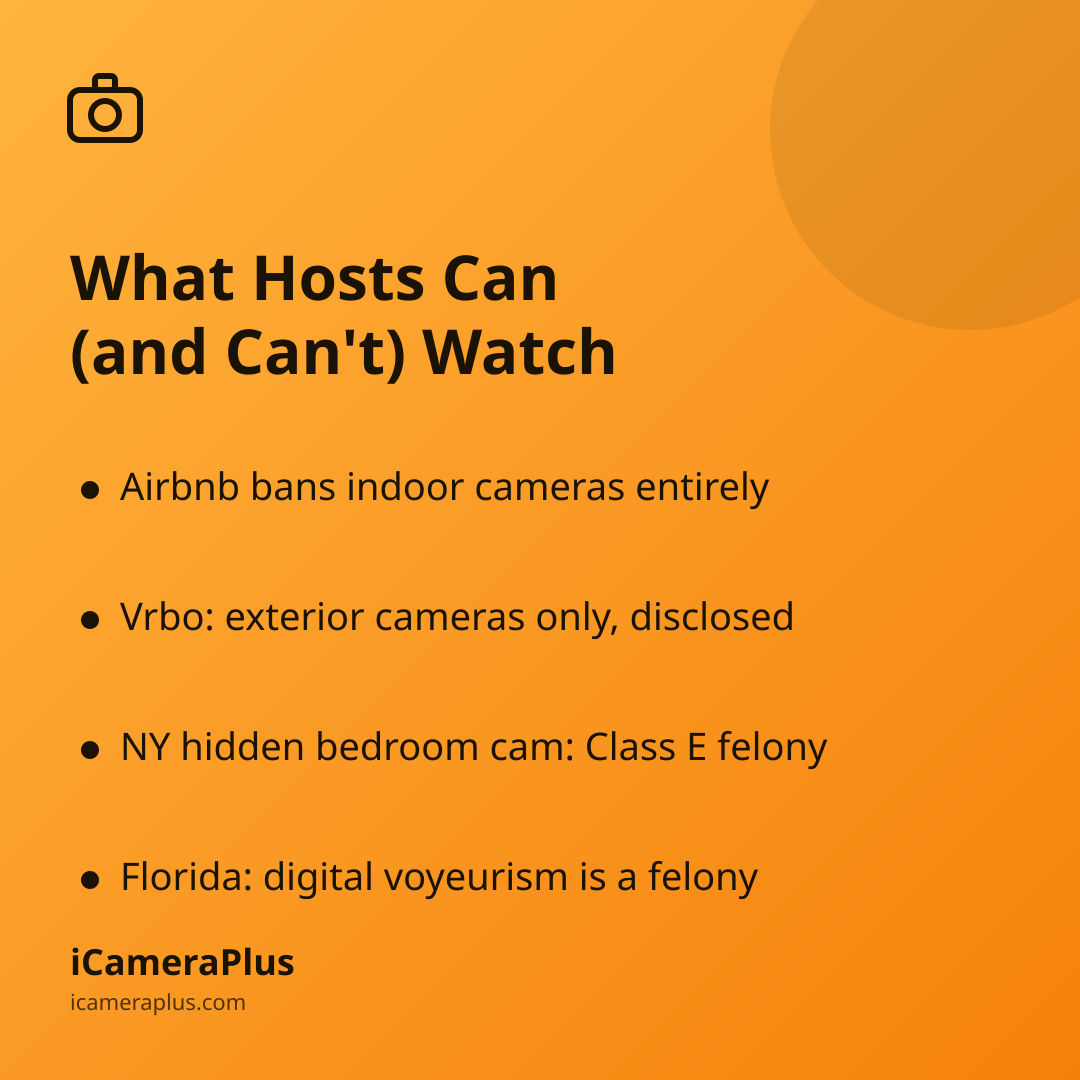
Airbnb's official policy, in effect since April 30, 2024, is unambiguous: security cameras and recording devices are not allowed anywhere inside a listing — not in common areas, not disclosed in advance, not turned off. That includes living rooms, hallways, and kitchens, spaces that were previously allowed with disclosure under Airbnb's older rules. Outdoors, cameras and doorbell cameras are still permitted, but they must be disclosed in the listing description, including where each device is located, and they can't be aimed at spaces where a guest would reasonably expect privacy, such as an enclosed outdoor shower or a sauna. Hidden or disguised devices are banned outright, indoors or out. You can read the full policy directly on Airbnb's help center.
Vrbo's Rule: Outdoors Only, With Specific Disclosures
Vrbo's surveillance policy lands in a similar place through a slightly different route: cameras and recording devices are never allowed to monitor the interior of a rental, including by pointing a camera in through a window from outside. Exterior devices are permitted for reasonable monitoring of the property, but their location and coverage area have to be disclosed on the listing page before a guest books. Vrbo calls out one detail Airbnb doesn't spell out as specifically: if an outdoor camera's field of view includes any part of a pool or hot tub, that has to be disclosed both in the listing and with a visible notice at the property itself. As with Airbnb, hidden or disguised devices are never allowed. The full policy is on Vrbo's Trust & Safety page.
The Law Goes Further Than Either Platform's Policy
Platform rules are enforced by suspending a listing — state law is enforced with criminal charges, and it applies whether or not a platform is even involved. Secretly recording someone in a space where they have a reasonable expectation of privacy, like a bedroom or bathroom, is a crime in nearly every state, independent of Airbnb's or Vrbo's terms of service. In New York, unlawful surveillance in the second degree — covering exactly this kind of hidden-camera scenario in a bedroom, bathroom, or "any room assigned to guests" in a rental — is a Class E felony under Penal Law § 250.45. In Florida, the offense is called digital voyeurism, and under Florida Statute § 810.145, using a device to secretly record someone in a place where they have a reasonable expectation of privacy is a third-degree felony for an offender age 19 or older, rising to a second-degree felony for a repeat offense or if the offender is a family or household member of the victim or holds a position of trust or authority over them. Every state handles this differently, but the pattern is consistent: a lease, a house rule, or "it was in the fine print" does not make a hidden bedroom or bathroom camera legal.
Why This Is Worth Knowing Right Now
Short-term rentals aren't a niche side hustle anymore, and the supply keeps growing: AirDNA's 2026 Midyear Outlook projects U.S. short-term rental supply will grow another 2.7% this year, on top of steady occupancy near pre-pandemic norms. More homes listed means more hosts figuring out camera rules for the first time, often around fall and holiday travel season when bookings pick up. Knowing the actual policy — not the version you half-remember — is the difference between a compliant exterior camera and a suspended listing.
If You're Hosting: How to Monitor Your Property the Right Way
The good news is that watching over your own place while it's rented out is entirely allowed — it just has to stay outside, and it has to be disclosed. A few practical rules of thumb:
- Keep it exterior-only. Front door, driveway, side gate, package drop area — never inside, and never in a covered outdoor space like a shower or sauna.
- Disclose the exact location before booking. Both platforms require specifics, not a vague "security cameras on site" line.
- Never disguise a device. A camera has to look like a camera.
- If it can see a pool or hot tub, say so explicitly — Vrbo requires this as its own disclosure line.
You don't need to buy dedicated hardware to do this well. A spare phone mounted facing the entrance or driveway, running as a dedicated home security camera, covers exactly this disclosed, exterior use case. That's the gap iCameraPlus is built for: it turns an old phone into a continuous-recording camera with footage saved off the device — so a guest can't delete your only copy — plus remote live view, so you can check the entrance between checkouts without needing to be on-site.
If You're a Guest: What to Do If You Find a Camera
Before you book, read the listing description for a camera disclosure — it's required, so it should be there if a host is following the rules. Once you arrive, a quick scan of smoke detectors, USB chargers, and shelf clutter in the bedroom and bathroom covers most common hiding spots. If you find an undisclosed device, or any camera indoors, document it with photos, leave if you're uncomfortable, and contact the platform immediately — both Airbnb and Vrbo will investigate and can rebook or refund you, as happened in the Madrid case. If the device was in a bedroom or bathroom, that's also worth reporting to local police, since it likely crosses from a policy violation into a criminal one.
The Bottom Line
Airbnb and Vrbo have converged on the same basic line: cameras stay outside, and guests get told exactly where. State law backs that up with real criminal penalties for anyone who crosses it. For the overwhelming majority of hosts who just want to know who's at the door or keep an eye on the driveway between stays, that's a low bar to clear — and a phone you already own is enough to clear it.
Sources
- Airbnb Help Center — Restrictions on security cameras and other devices in homes
- Vrbo — Use of Surveillance Policy
- New York Penal Law § 250.45 — Unlawful Surveillance in the Second Degree
- Florida Statute § 810.145 — Digital Voyeurism
- AirDNA — 2026 Midyear Short-Term Rental Outlook
- Euro Weekly News — British couple flee Madrid Airbnb after discovering camera pointing at bed (August 2026)