What the Data Says About Bus Stop Safety — and the Blind Spot Right Outside Your Door
Every school-day morning across the country, the riskiest part of a child's commute usually isn't the ride — it's the few unsupervised minutes spent standing at the curb, waiting for headlights to slow down. As the 2026-2027 school year settles in, national crash and traffic-violation data offer a clear, if sobering, picture of where that risk actually concentrates — and a reminder that the patch of sidewalk or driveway where your child waits for the bus is worth watching as closely as any other part of your property.
What the Numbers Actually Show
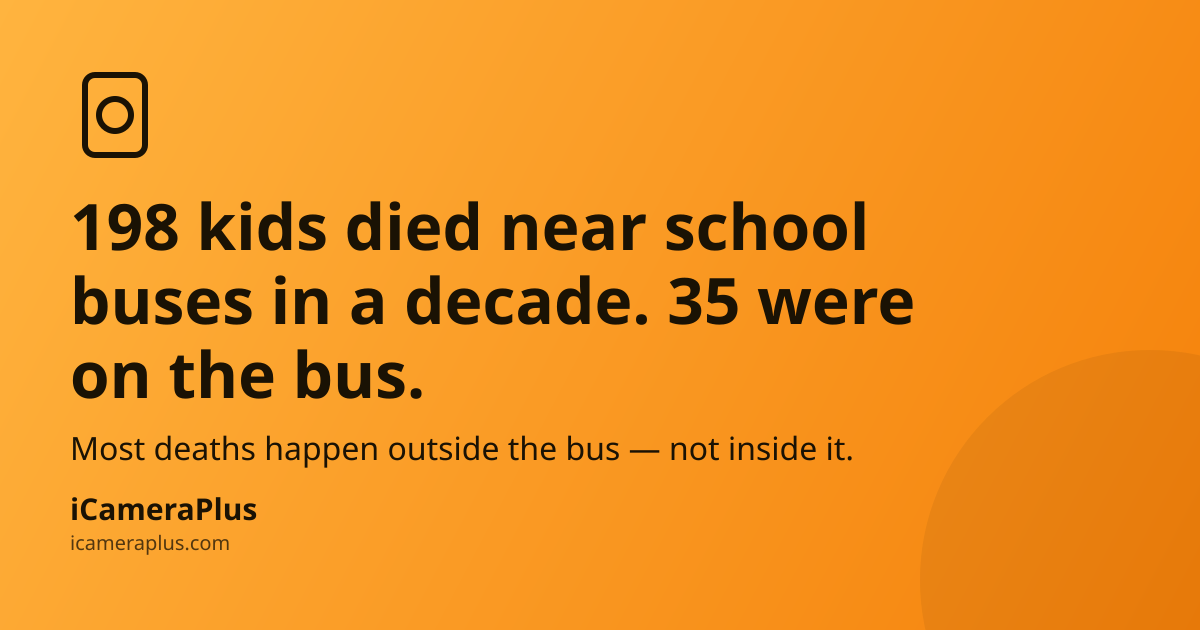
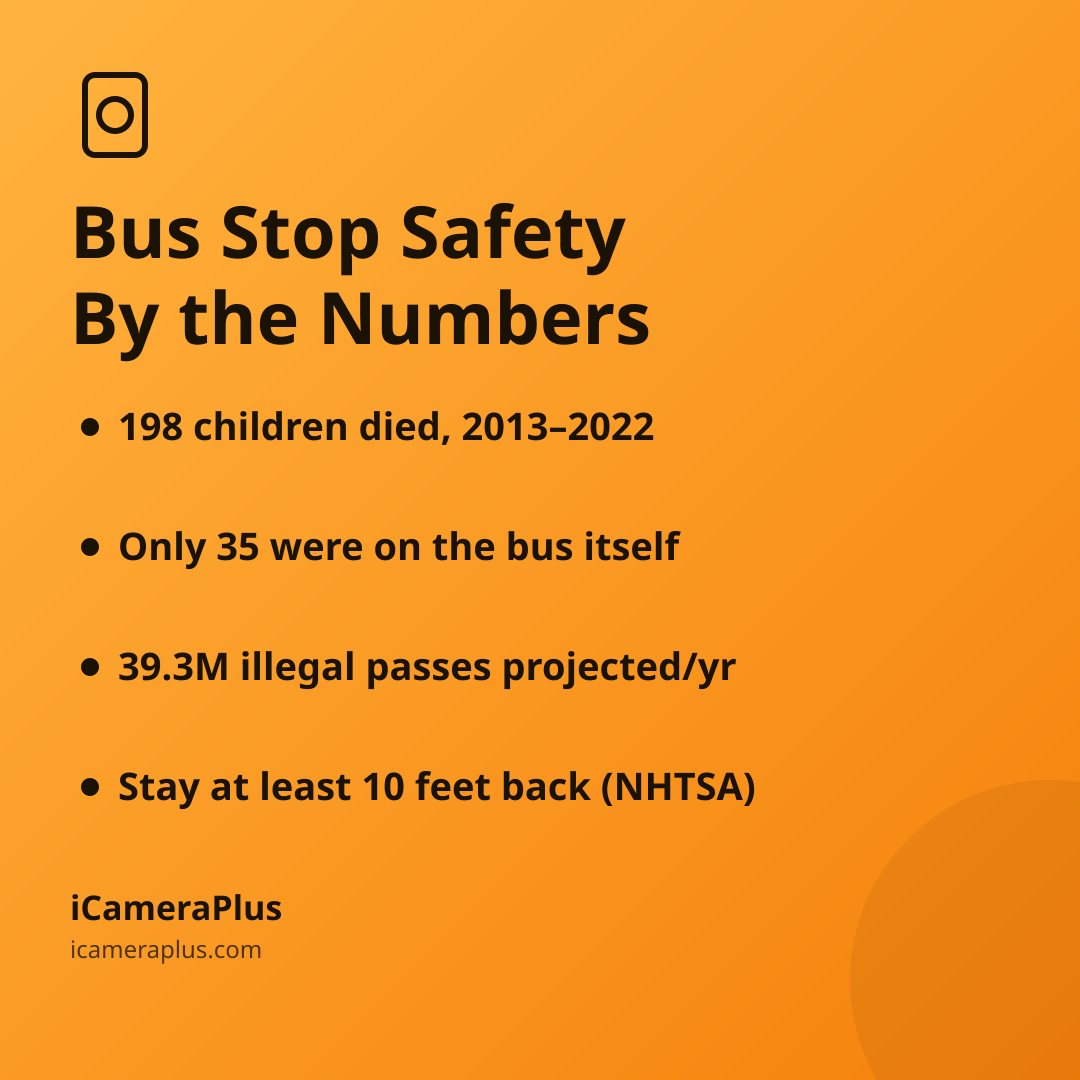
School bus travel is, by the numbers, one of the safest ways to get a child to class. But the danger that does exist is concentrated in a very specific place: not inside the bus, but around it. The National Highway Traffic Safety Administration (NHTSA) reports that 198 school-age children died in school-transportation-related traffic crashes between 2013 and 2022 — an average of roughly 20 a year. Only 35 of those children were occupants of the school bus or van itself; the rest were pedestrians (76), occupants of other vehicles involved in the crash (80), or cyclists (5) — meaning the large majority of these deaths happen outside the bus, not inside it. Over half of the school-age pedestrians killed — 55% — were between the ages of 5 and 10, the group most likely to dart out unexpectedly or slip into a driver's blind spot, according to NHTSA's School-Transportation-Related Traffic Crashes report.
Most pedestrian deaths near buses happen in the ten feet immediately surrounding a stopped bus — an area NHTSA calls the "danger zone," where the driver's sightlines are blocked and a child can easily go unseen. NHTSA's guidance is specific: stay at least 10 feet back until the doors open, take five giant steps before crossing in front of the bus, and make eye contact with the driver before stepping into the road (NHTSA, Planning Safer School Bus Stops and Routes).
The other source of risk is drivers who don't stop at all. The National Association of State Directors of Pupil Transportation Services (NASDPTS) runs an annual one-day national count in which bus drivers log every vehicle that illegally passes their stopped bus. In its 13th annual survey, released July 22, 2025, 114,239 drivers across 36 states and Washington, D.C. — roughly 31% of the nation's school bus drivers — logged 67,258 illegal passes in a single day. Extrapolated across a typical 180-day school year, that comes to a projected 39.3 million illegal passes nationwide. It's actually down from 45.2 million the year before, but still, in NASDPTS's own words, "simply too many" (NASDPTS, National Stop-Arm Survey).
Stop-Arm Cameras Cover the Bus. What Covers Your Curb?
A growing number of school districts have responded by mounting automated stop-arm cameras directly on buses, capturing video and license plate images of vehicles that pass illegally so citations can be issued afterward — Austin Independent School District's program is one public example of how these systems work (Austin ISD, Stop-Arm Camera Program). These systems are a genuine deterrent, but they're built to catch one specific moment: a car passing a stopped bus. They don't see what happens before the bus arrives, after it pulls away, or on the stretch of driveway, sidewalk, or curb that's actually part of your own property — which is exactly where kids tend to wait, fidget, chase a ball, or wander while watching for headlights.
That gap is worth closing with something you control directly. Placing a camera so it covers your own driveway or curb — the same basic placement principle covered in our guide to choosing and positioning a home security camera — lets you see that stretch of ground the way a stop-arm camera never will: continuously, and from your own property outward.
A Simple Way to Watch the Spot That Matters Most
You don't need new hardware to do this. Most households already have an old phone sitting in a drawer with a perfectly usable camera in it. An app like iCameraPlus turns that phone into a dedicated camera you can prop on a windowsill facing the curb — recording continuously, archiving footage off the device so nothing is lost if the phone loses power or gets knocked over, and sending a motion alert to your current phone if your child steps outside before the bus arrives or lingers at the curb longer than expected. If you're running behind making breakfast, you can pull up a live view instead of guessing what's happening outside.
It's a modest habit, but it directly fills the blind spot the national data points to: the minutes before and after the bus, on the piece of ground that belongs to you.
A Bus-Stop Safety Checklist
- Practice the 10-foot rule. Kids should stand at least 10 feet back from where the bus stops — NHTSA's "danger zone" — until the doors open.
- Five giant steps. Before crossing in front of a stopped bus, kids should take five big steps away from it so the driver can see them, then make eye contact before crossing.
- Never chase a dropped item near the bus. NHTSA recommends telling the driver rather than reaching for something that falls — the driver may not be able to see a child bent down near the wheels.
- Watch the waiting, not just the crossing. Most attention goes to the moment kids board or exit; the minutes spent simply standing at the curb deserve a watchful eye too.
- Report illegal passes. If you see a vehicle pass a stopped bus with its arm extended, most districts and states have a non-emergency line or online form for reporting the plate, location, and time.
The Bigger Picture
None of this is about creating fear around a routine that, for the overwhelming majority of kids, ends the same safe way every single day. It's about recognizing that a small, well-placed camera on your own property — whether it's a dedicated security camera or an old phone repurposed with an app like iCameraPlus — can close a gap that no bus-mounted system, crossing guard, or driver can fully cover: the few unsupervised minutes right outside your own front door.
Sources
- NHTSA, National Center for Statistics and Analysis — School-Transportation-Related Traffic Crashes: 2013–2022 Data
- NHTSA — School Bus Safety
- NHTSA — Planning Safer School Bus Stops and Routes: Planning for Safety
- National Association of State Directors of Pupil Transportation Services (NASDPTS) — National Stop-Arm Survey
- Austin Independent School District — Stop-Arm Camera Program