Can a Baby Monitor Prevent SIDS? What the FDA and CDC Say in 2026
This article was produced with AI assistance. Sources are listed at the end.
No baby monitor — not a wearable sock, not a "smart" bassinet sensor, and not a phone propped on a dresser — has been proven to prevent Sudden Infant Death Syndrome (SIDS). The U.S. Food and Drug Administration has said plainly that no infant monitor is authorized to prevent or reduce the risk of SIDS or Sudden Unexpected Infant Death (SUID), and the American Academy of Pediatrics has told parents the same thing since 2022. What actually lowers the risk, according to new 2026 federal data, has nothing to do with electronics at all.
What Has the FDA Actually Said About Baby Monitors and SIDS?
In a safety communication, the FDA warned caregivers not to rely on unauthorized infant monitors that claim to track vital signs like heart rate, oxygen saturation, breathing rate, or temperature (FDA, 2025). The agency's position is unambiguous: no infant monitor has been cleared or approved to prevent or reduce the chance of SIDS or SUID, and readings from unauthorized devices can be inaccurate enough to trigger unnecessary panic or, worse, a false sense of security.
"No devices, including infant monitors, have been authorized to prevent SIDS or SUID," the FDA states in its consumer safety communication on unauthorized infant devices.
The scrutiny hasn't let up in 2026. In June, the FDA sent a warning letter to Happiest Baby, Inc., maker of the SNOO smart bassinet, over product changes — including sleep sack sizing and hospital-use marketing — that the agency said were introduced without the required regulatory clearance (FDA, June 2026). It's a reminder that "smart" infant sleep products are facing real regulatory pressure this year, not just skepticism from pediatricians.
What Does the New 2026 CDC Data Say Actually Lowers the Risk?
About 3,400 babies died suddenly and unexpectedly in the United States in 2024, according to the CDC (CDC, 2026). In a report published September 10, 2026, the CDC analyzed 4,861 of these deaths from 2020 through 2024 across 31 jurisdictions and found that 73% involved at least one unsafe sleep factor (CDC MMWR, 2026).
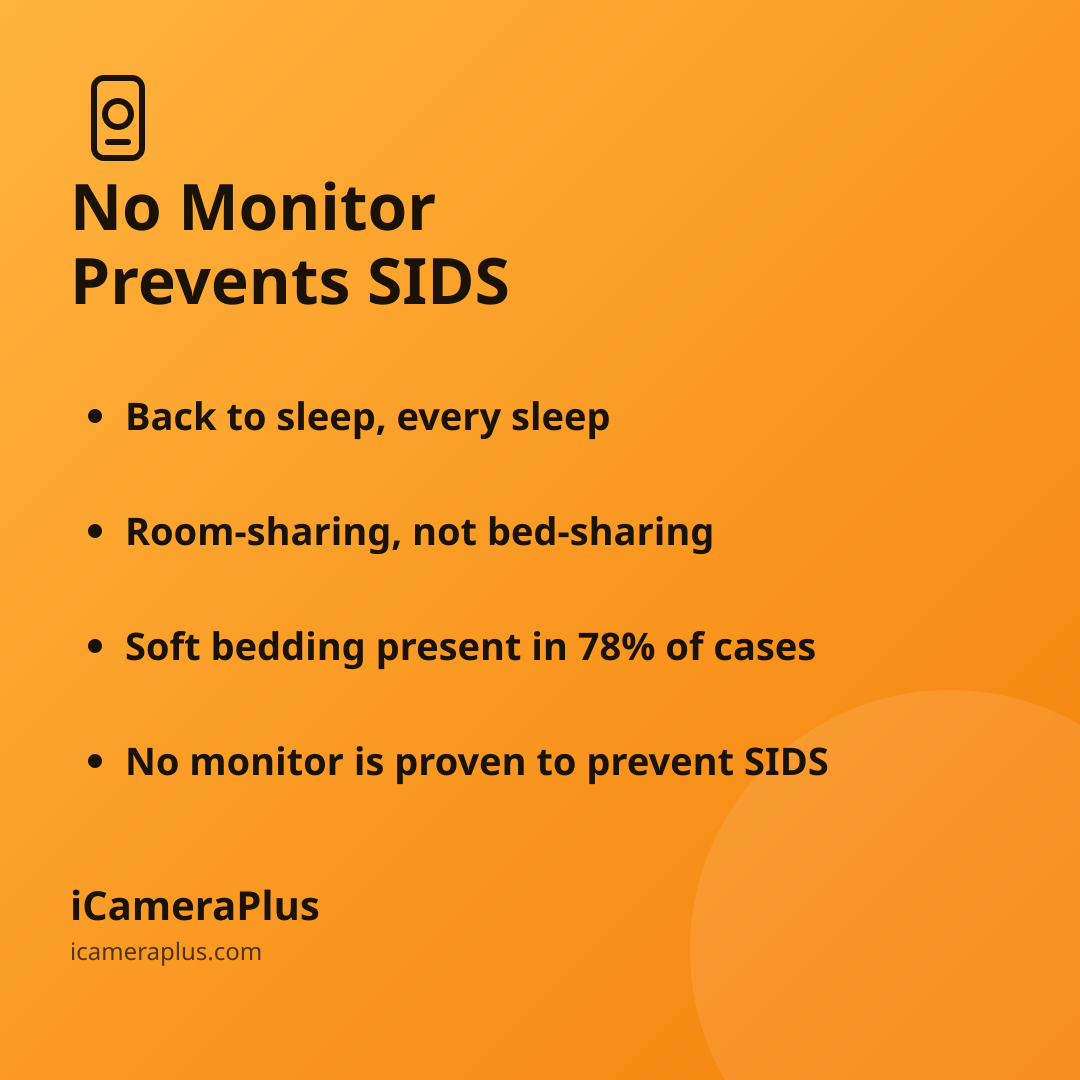
Within those cases, soft bedding was present in 78%, the infant was on a sleep surface other than a crib or bassinet in 75%, the infant was sharing a sleep surface with another person in 59%, and the infant was found on their stomach or side in 46% of deaths (CDC MMWR, 2026). None of those are things a monitor can fix after the fact — they're things a safe sleep setup prevents from happening in the first place.
No baby monitor, smart or simple, has ever been proven to prevent SIDS. The AAP's 2022 safe sleep policy statement goes further, giving home cardiorespiratory monitoring a top-level ("Level A") recommendation against using it as a SIDS-prevention strategy, because no study has shown it reduces the risk (AAP, 2022).
The CDC's and AAP's safe sleep guidance comes down to a short list (CDC, 2026):
- Back to sleep, every sleep
- Firm, flat mattress — no soft bedding
- Bare crib or bassinet, no loose blankets or toys
- Room-sharing, not bed-sharing
Is Your Current Baby Monitor Even Safe to Use?
Hardware risk is also on the table in 2026. The Consumer Product Safety Commission recalled about 81,800 Babysense Max View baby monitors on February 26, 2026, after the display unit was found to overheat or spark while charging, posing a fire hazard (CPSC, 2026). The manufacturer, Hisense, had logged 11 incident reports before the recall. If you own one, the CPSC's guidance is to stop using the display unit immediately and contact the manufacturer for a free replacement — and not to toss the lithium-ion battery in regular trash or curbside recycling.
So What Are Monitors Actually Good For?
None of this means a monitor is useless — it just means you should buy and use one for what it honestly does: letting you see and hear your own child from another room, not detecting a medical emergency before it happens. A simple video-and-audio check-in has real value for peace of mind and for keeping an eye on an older crawling toddler, a napping sibling, or a pet while you're in another part of the house — it's just not a substitute for safe sleep basics.
If you already have an old phone sitting in a drawer, it can do that same job without buying new hardware: apps like iCameraPlus turn a spare iOS or Android phone into a continuously recording camera with a private cloud archive you can browse from the web, live view, remote start/stop, audio and video, and screen dimming so the display doesn't light up a dark nursery. It makes no claims about vital signs or SIDS risk, because, per the FDA and AAP, no consumer monitor legitimately can. For placement and setup basics, see our guide to using a phone as a baby monitor, and always keep cords, mounts, and the phone itself well outside the crib and out of reach.
Quick answers
Do wearable "smart" baby socks or sensors that track oxygen levels prevent SIDS? No. The FDA says these unauthorized vital-sign monitors aren't cleared for that purpose, and inaccurate readings can cause unnecessary alarm or false reassurance (FDA, 2025).
What's the single biggest thing that actually reduces SIDS/SUID risk? Consistent safe sleep practices — back sleeping, a firm flat surface, a bare crib, and room-sharing without bed-sharing. CDC's 2026 analysis found an unsafe sleep factor in 73% of the deaths it studied (CDC MMWR, 2026).
Is it still worth using a video monitor if it can't prevent SIDS? Yes, for convenience and peace of mind — just don't let it change how you set up the crib. A video/audio check-in is a parenting tool, not a medical device.
Sources
- FDA Safety Communication: Do Not Use Unauthorized Infant Devices for Monitoring Vital Signs (2025)
- FDA Warning Letter to Happiest Baby, Inc. (June 15, 2026)
- CDC: About SUID and SIDS (2026)
- CDC MMWR: Characteristics of Sudden Unexpected Infant Deaths (September 10, 2026)
- American Academy of Pediatrics: Sleep-Related Infant Deaths, Updated 2022 Recommendations
- CPSC Recall: Babysense Max View Baby Monitors (February 26, 2026)