Can an App Listen Through Your Phone's Camera Without Microphone Access? 2026 Study
This article was produced with AI assistance. Sources are listed at the end.
Yes, under narrow lab conditions. A study published November 20, 2026 found that on dozens of Android phones, an app that only has camera permission — not microphone permission — can partly reconstruct loud speakerphone speech by reading ultra-fast motion-sensor data that leaks through the camera's own video-stabilization metadata. It only works while the camera is actively recording, needs the speaker turned up, and is nowhere close to clear, real-time listening — but it exposes a real gap in how Android's permission system is supposed to work.
What did the study actually find?
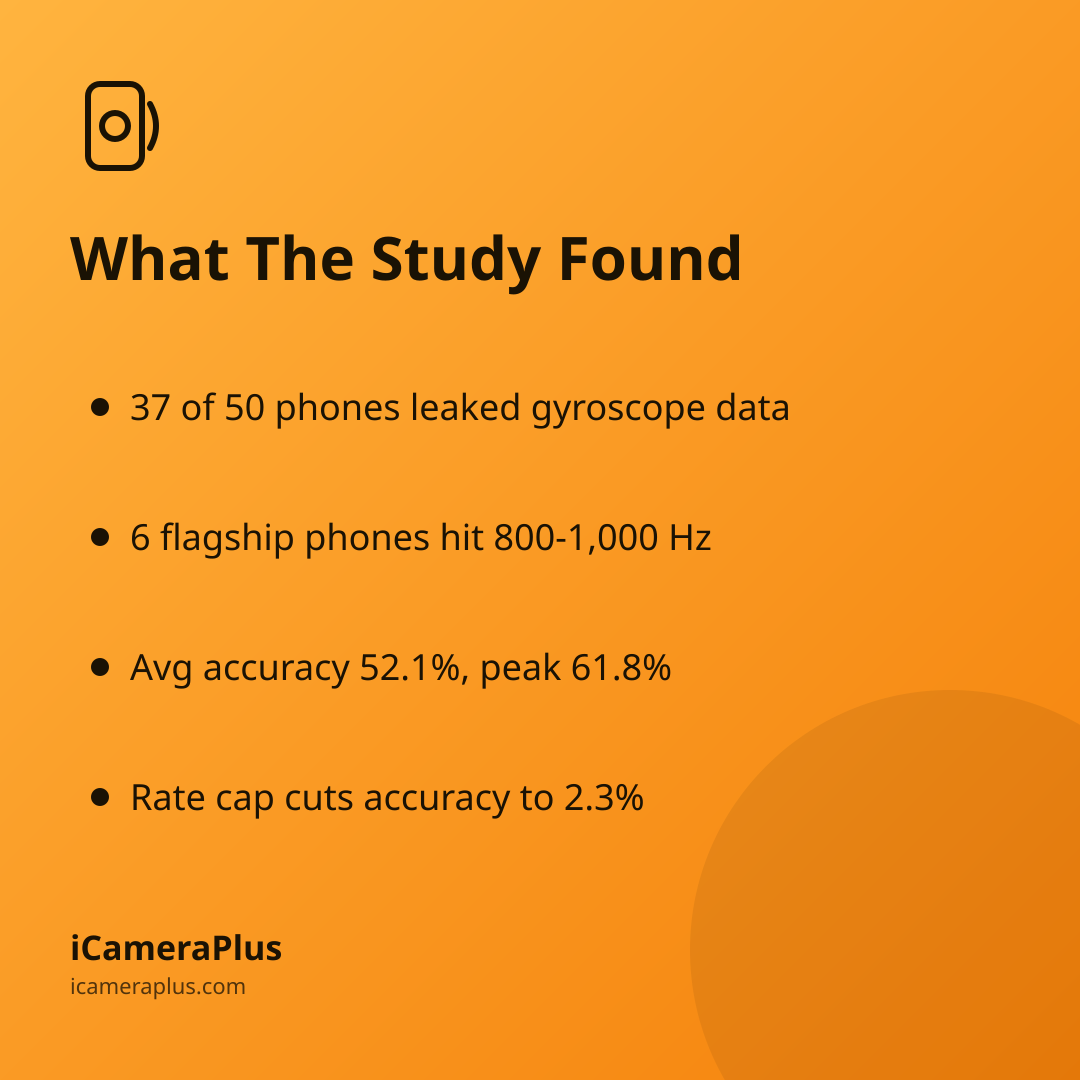
Researchers Guangyuan Ji and Bingsheng Zhang of Zhejiang University, together with Wenjing Wang of the Electric Power Research Institute of Guangdong Power Grid, described the technique in a preprint titled "Your Camera Can Hear You: Side-Channel Acoustic Eavesdropping via Android Camera2 Metadata", posted to arXiv on November 20, 2026. The team tested 50 Android phones from 10 vendors released between 2020 and 2026, and found that 37 of them exposed gyroscope readings through the Camera2 interface while recording, according to the paper and reporting by CyberInsider (2026).
The gyroscope data is meant to feed video-stabilization software, but it's fast enough on some phones to also pick up tiny vibrations from a loudspeaker. Twenty-six of the tested phones streamed that data faster than 200 Hz, and six flagship models — the vivo X300s, X300 Pro, and X200 Ultra, the Xiaomi 17T Pro, the Redmi K90 Max, and the Honor Magic8 Pro Air — hit 800 to 1,000 Hz, more than double the 200–500 Hz ceiling Android normally enforces for standard motion-sensor access, per the study and CyberInsider's 2026 reporting.
Using a recognition tool they built called CamEar, the researchers reconstructed speakerphone speech with an average word accuracy of 52.1%, peaking at 61.8% on the best-performing device, according to the arXiv paper. Accuracy fell sharply as volume dropped. It dropped to 19.2% once the speakerphone volume fell to 60%, CyberInsider reported — so this is a loud-speaker, close-range scenario, not a way to pick up a quiet room.
Does this mean your security camera app is listening in?
No — and this is the distinction that matters most. The leak doesn't come from the camera app you're actually using to record. It requires a separate app on the same phone that already has ordinary camera permission, running in the background while another app's camera session is active, and pulling the gyroscope data out of that session's metadata. CyberInsider (2026) notes the researchers disclosed the issue to the affected vendors; as of publication, there was no public confirmation from those vendors of a phone-wide fix.
That's exactly why app hygiene on any phone you point at your own home matters — including one you've repurposed into a dedicated camera. A phone running nothing but a single-purpose camera app has far fewer apps positioned to even request camera permission in the first place, which narrows this kind of side-channel risk considerably compared with a daily-driver phone loaded with social, shopping, and game apps. That's part of the appeal of turning an old phone you already own into a standalone camera with iCameraPlus: it records continuously, archives footage to a private cloud you browse yourself, and gives you remote start/stop and live view from the web — with nobody but you holding the keys to what it sees. It's worth pairing that setup with the same permission housekeeping described below, on whichever phone — old or new — you use for monitoring your own property. For a broader look at how smart-home devices actually get compromised, see which smart home device is most likely to get hacked in 2026 — the camera usually isn't the weak link.
What can you actually do about it?
The fixes here are the same basic permission hygiene security researchers have recommended for years — this study just gives a concrete reason to actually do it.
- Revoke camera permission from unused apps
- Use headphones for sensitive calls
- Keep Android and apps updated
- Dedicate one phone to one job
CyberInsider (2026) reports that capping the gyroscope's sampling rate down to Android's standard sensor limit cut the attack's accuracy to just 2.3% — which is why keeping phones current on security updates matters once vendors ship a fix. A phone's camera isn't supposed to double as a microphone. Most of the time it still doesn't — but it can, on specific devices, under specific conditions.
Why does Android's permission model allow this?
Android requires apps to request the RECORD_AUDIO permission before accessing the microphone, and separately caps how fast third-party apps can read motion sensors like the gyroscope — both are meant as privacy backstops. The researchers found that camera hardware pipelines, which exist to stabilize video, aren't bound by that same sensor-rate cap, so gyroscope data moving through a camera session's metadata can exceed the limit Android enforces everywhere else. That's a gap between two systems — camera stabilization and sensor privacy — that were never designed with each other in mind, not a flaw in the camera permission itself.
Quick answers
Can this attack hear everything I say? No. It only picked up loud, speakerphone-level audio in testing, and accuracy fell sharply as volume dropped — to 19.2% at 60% volume, per CyberInsider's 2026 reporting on the study. Normal-volume, phone-to-ear conversations weren't the scenario tested.
Which phones are affected? Thirty-seven of the 50 phones tested leaked gyroscope data through Camera2 at all, and six flagship models — from vivo, Xiaomi, Redmi, and Honor — were fast enough to produce usable speech reconstruction, according to the November 2026 arXiv paper. If you're concerned, check your phone model against the study and watch for a security update.
Should I stop using my old phone as a security camera because of this? No — this isn't a flaw in camera-as-security-camera apps; it's a side channel that needs a separate malicious app with camera permission already installed. Reviewing which apps have camera access, on any phone you own, is good practice either way.