Can Security Camera Footage Be Faked? What 2026's Deepfake Evidence Debate Means for Homeowners
Yes — with today's AI tools, video can be convincingly faked, and that has courts, insurers, and camera makers rethinking what counts as trustworthy footage in 2026. In a 2024 meta-analysis of 56 studies, people correctly told real video from deepfake video only 57.31% of the time — barely better than a coin flip. For homeowners, the realistic risk isn't that a stranger fabricates your footage; it's that if you ever need to prove what your own camera actually recorded, you need to know how to keep that proof credible.
How convincing are deepfakes right now?
A systematic review and meta-analysis published in 2024, pooling data from 56 papers and more than 86,000 participants, found that human accuracy at spotting deepfake video was just 57.31%, with 95% confidence intervals that crossed the 50% "chance" line for several content types tested (Diel et al., 2024). In plain terms: even attentive viewers often can't reliably tell the difference, especially on lower-resolution footage like a typical home camera feed.
Courts are already running into this. In a February 2026 report, the National Center for State Courts described judges who had to personally spot manipulated video in their own courtrooms — one judge, reviewing testimony, noted the witness's face was "nearly motionless" with "strange cuts and apparent repetition of her mannerisms" before realizing it was fabricated (National Center for State Courts, 2026).
Are courts actually changing the rules because of this?
Federal rulemakers tried. The Advisory Committee on Evidence Rules proposed a new Federal Rule of Evidence 707, which would require "machine-generated evidence" offered without an expert witness to meet the same reliability standard as expert testimony. But it isn't settled law. At its June 2026 meeting, the Standing Committee on Rules of Practice and Procedure reported that it "does not recommend action on the proposed Rule 707 at this time," sending it back for revision and pairing it with a separate, dedicated study of deepfakes at its next meeting (U.S. Courts, Standing Committee agenda book, June 2026).
So as of today, there's no single new federal rule that governs whether your home camera's footage is "admissible." What's changed is the mindset: judges, adjusters, and juries are being trained to ask "how do we know this wasn't altered?" — a question that used to be reserved for exotic cases and is now becoming routine.
Why are phone and camera makers adding "content credentials"?
Hardware makers are responding with cryptographic proof of origin, not just better lenses. The Coalition for Content Provenance and Authenticity (C2PA) maintains an open standard, Content Credentials, that attaches a signed record to a photo or video showing when and how it was captured and whether it's been edited since. As the coalition puts it, "any modification — intentional or accidental — will break this cryptographic linkage, signalling tampering" (C2PA, 2026).
Google made this mainstream in September 2025, when the Pixel 10 became the first phone to sign every photo from its camera app with Content Credentials by default, using keys generated inside a dedicated security chip (Google, 2025). It's an early sign of where the industry is headed: provenance and an intact chain of custody are becoming part of what makes footage trustworthy, not an afterthought.
What does this mean for the camera watching your own home?
Your doorbell clip or backyard recording almost certainly isn't headed to federal court. But the same "can we trust this?" instinct now shows up in smaller, everyday moments: an insurance adjuster reviewing a claim, a police report after a break-in, an HOA dispute, or a disagreement with a neighbor. A single cropped clip or a screen-recording of a screen-recording is easy to dismiss as cherry-picked. An unbroken, timestamped recording that you can trace back to the original file is much harder to wave away.
This is one of the quieter advantages of running a phone you already own as a dedicated camera with continuous recording and an off-device archive, which is exactly what iCameraPlus is built to do: instead of a single motion-triggered snippet living only on the device someone could tamper with, you have a continuous timeline stored separately, with the moment in question sitting in context rather than isolated. That context — what happened just before and after — is often what makes footage convincing to another person, long before anyone starts talking about cryptographic signatures.
A few habits matter regardless of what camera you use:
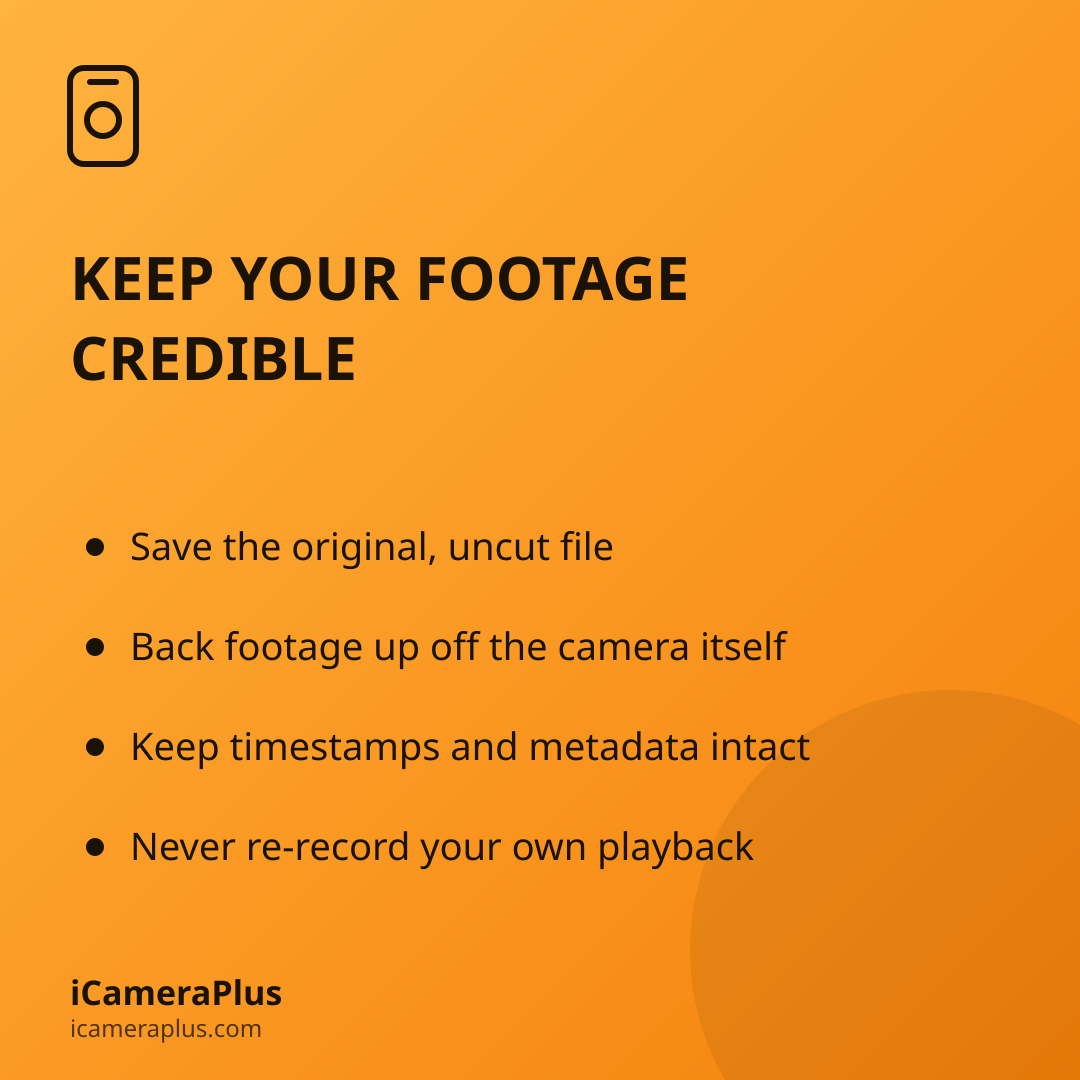
- Save the original, uncut file
- Back footage up off the camera itself
- Keep timestamps and metadata intact
- Never re-record your own playback on a second device
People correctly identified deepfake video only 57% of the time in 2024 research — barely better than a coin flip.
Quick answers
Does my security camera need C2PA support to be believed? No. Almost no home security cameras support it yet. What matters far more today is preserving the original recording and its metadata rather than handing over a screenshot or a re-recorded clip, which strips out the details that make footage verifiable.
Will Federal Rule of Evidence 707 apply to my home camera footage? Not directly, and it isn't even in effect — the Standing Committee sent it back for more study in June 2026. It's aimed at machine-generated analysis (like AI-based enhancement or reconstruction tools), not the raw video your camera records. Its bigger effect is cultural: it signals that scrutiny of video evidence is rising across the board.
Is this only a problem for lawsuits? No. Insurance claims, HOA hearings, and even friendly neighbor disputes increasingly involve someone asking whether a clip has been edited. Keeping full, unedited, well-timestamped footage protects you in all of these situations, not just in court.
Sources
- Diel, A. et al. (2024). "Human performance in detecting deepfakes: A systematic review and meta-analysis of 56 papers." ScienceDirect / Computers in Human Behavior Reports.
- National Center for State Courts (2026). "AI-generated evidence is a threat to public trust in the courts."
- Committee on Rules of Practice and Procedure, U.S. Courts (June 2026 meeting agenda book).
- Coalition for Content Provenance and Authenticity (C2PA), FAQs (2026).
- Google (2025). "How Pixel and Android are bringing a new level of trust to your images with C2PA Content Credentials."