Can Security Camera Footage Get You a Refund for a Stolen Package in 2026?
This article was produced with AI assistance. Sources are listed at the end.
Security camera footage can support a stolen-package claim with a carrier or retailer, and it can be used as evidence if a dispute ends up in small claims court — but it almost never decides the outcome on its own. Amazon, UPS, FedEx, and USPS each approve or deny stolen-package claims under their own policy and timeline, usually based on tracking data and account history, long before anyone asks to see a clip. Footage matters most as backup: proof to fall back on if a claim is denied, disputed, or challenged later.
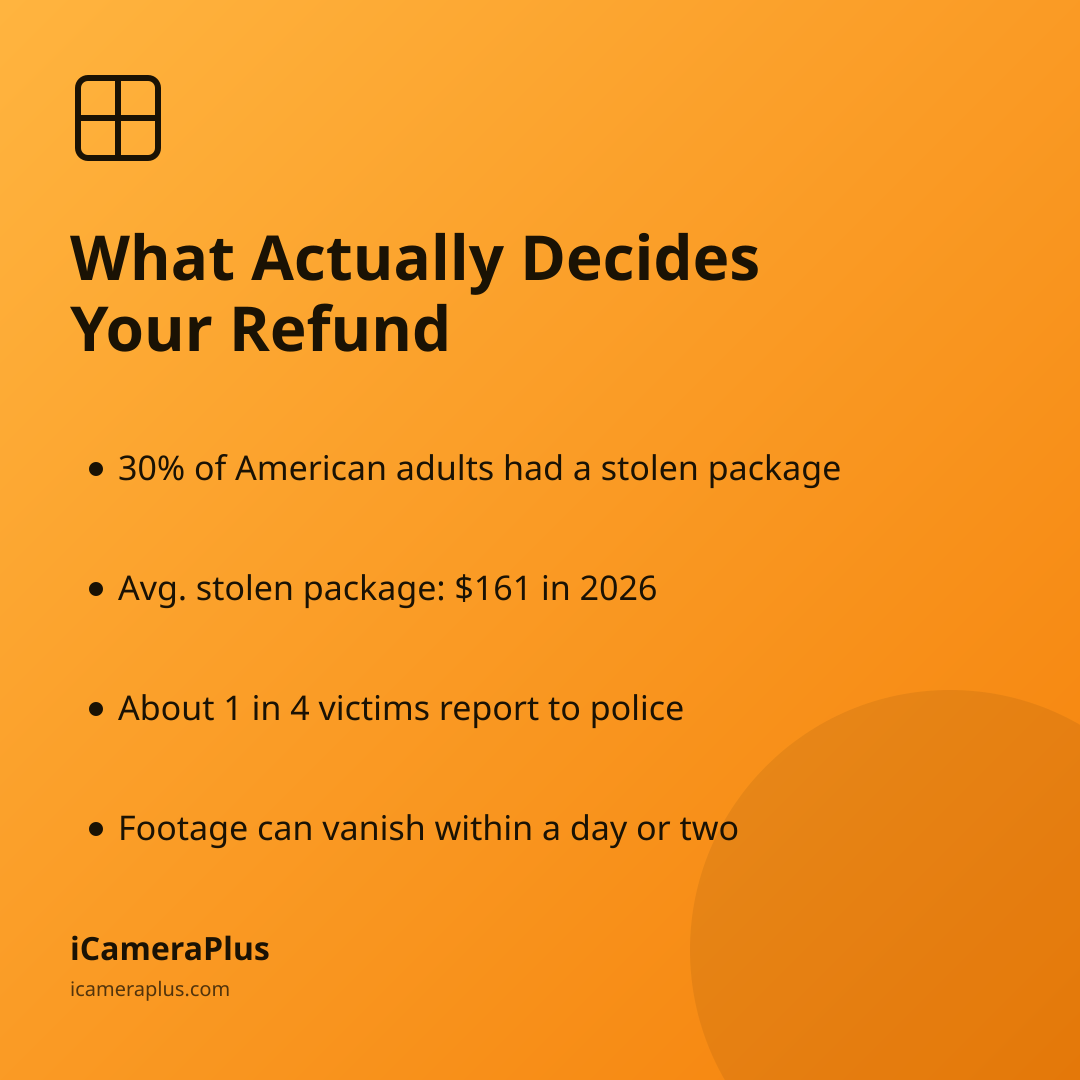
That question is worth answering now. Holiday shipping volume is ramping up, and Security.org's 2026 Package Theft Annual Report, published October 28, 2026, found that 30% of American adults have had a package stolen at some point — up from 24% in 2025 — and that stolen packages cost U.S. households an estimated $7.7 billion a year. The same report found the average stolen package was worth $161 in 2026, down 27% from $222 in 2025, and that 49% of people worry more about package theft specifically during the holidays.
Does Footage Actually Change Whether You Get Paid Back?
Usually not directly. Most retailers and carriers approve a refund or replacement based on delivery-confirmation data, your order history, and whether the item was insured — not on whether you can produce video. Footage becomes useful in the minority of cases: when a claim is flagged for review, when a retailer suspects a pattern of repeated "not received" reports, or when you need to escalate a denied claim.
Only about 1 in 4 package-theft victims ever report it to police. That's from the same Security.org 2026 report, which found reporting rates below 23% among recent victims — meaning most people absorb the loss or handle it through the retailer alone, without ever creating a paper trail that footage could reinforce.
How Do USPS, FedEx, UPS, and Amazon Actually Handle These Claims?
Each company's process is different, and none of them list camera footage as a requirement to open a claim:
- USPS only pays claims on mail that was insured — Priority Mail Express, other insured mail classes, or Registered Mail — and requires proof of value such as a receipt or invoice, filed within strict windows described on the official USPS claims page. Uninsured First-Class or standard Priority Mail generally isn't eligible for a claim at all; USPS offers a Missing Mail Search instead.
- FedEx gives customers up to nine months from the shipment date to file a claim for a lost or undelivered shipment, per FedEx's claims page, and may request an inspection report or photos as part of its investigation — not upfront to start the claim.
- UPS asks customers to start a claim within 60 days of the scheduled delivery date, with a decision typically issued in 8–10 business days, according to UPS's claims page.
- Amazon and other retailers often run their own buyer-protection policies for items marked "delivered" but never received, separate from the shipping carrier's claims process — check the specific order's help options, since terms vary by seller and item value.
In practice, footage rarely speeds any of this up. What it can do is give you something concrete to attach if a claim is denied, if a retailer asks follow-up questions, or if you decide to pursue the loss through renters/homeowners insurance or small claims court instead.
When Does Footage Actually Matter — and Where?
Footage carries the most weight once a claim moves outside the carrier's automated system: insurance disputes, a denied retailer claim, or a small claims case tied to a specific delivery dispute. The California Courts Self-Help Center lists photos, receipts, and business records among the kinds of proof you can bring to a small claims hearing — but evidence rules and procedures vary by state and even by county, so check your local small claims court's rules before assuming a clip will be accepted the way you expect.
None of this is legal advice — if a case is complicated enough to need a real strategy, talk to your local court's self-help center or a licensed attorney in your state.
What Should You Actually Do the Moment You Notice a Package Is Gone?
- Download the clip right away
- Save extra buffer before and after
- Keep the tracking number and receipt
- Check the carrier's filing deadline
Cheap doorbell cameras often overwrite local storage within a day or two unless you're paying for extended cloud storage, and a denied claim or a court date can land weeks or months after the theft itself. If the clip is gone by then, none of the rest matters.
How Do You Make Sure the Footage Is Still There When You Need It?
This is really a retention problem more than a camera problem. A phone you already own, set up as a dedicated porch or entry camera, can solve it cheaply: apps like iCameraPlus turn an old iOS or Android phone into a continuous recorder that archives footage to a private cloud you can browse from a web panel — so a clip from the day a package disappeared is still there if a claim gets denied two months later, not just overwritten after 48 hours. For a wider look at camera placement that actually covers your porch and driveway, see our guide to setting up a home security camera.
If you're weighing whether footage-backed claims are worth the hassle at all, it helps to remember that holiday package theft is seasonal and predictable — our breakdown of whether break-ins really spike during the holidays digs into when risk actually peaks.
Quick answers
Do I need a police report to get a refund for a stolen package?
Usually not for the carrier's or retailer's own claims process. A report becomes more useful if a claim is denied, if you're filing a homeowners or renters insurance claim, or if you plan to pursue the theft in small claims court.
What if a package arrives that I never ordered?
That's likely a "brushing" scam, where a seller ships cheap items to real addresses to post fake reviews under your name, according to a 2026 FTC consumer alert. You can keep or discard the item, and the FTC recommends reporting it at ReportFraud.ftc.gov.
Can I use a neighbor's doorbell footage as evidence for my claim?
Only with their cooperation — you can ask them to share or preserve a clip, but you generally can't compel it outside of a formal legal process like a subpoena, which is a step beyond a routine carrier claim.