Can You Really Repurpose an Old Phone? What 2026 Research Says About the Hardware Lock
This article was produced with AI assistance. Sources are listed at the end.
Yes, you can repurpose an old phone — but not always the way people expect. A 2026 study from Université Libre de Bruxelles found that the same hardware security built into every modern smartphone, meant to protect your data, also ties the device to its original operating system and makes most "install something new on it" reuse projects fail or require specialist skills. The stakes are bigger than one drawer: the WEEE Forum estimated that 5.3 billion mobile phones became electronic waste in 2022 alone. The good news: you don't need to defeat any of that hardware to put an old phone back to work using the apps and operating system it already has.
What Did the 2026 Research Actually Find?
Researchers Adelin Roty, Jan Tobias Mühlberg, and Jean-François Determe published "Opportunities and Challenges in Securely Reusing and Repurposing Mobile Devices" in June 2026, presented at the Workshop on Computing within Limits (LIMITS 2026). Their central finding: vendor-locked security mechanisms "hinder the repurposing of a majority of discarded devices," because features designed to protect a phone during its first life actively resist being changed during a second one.
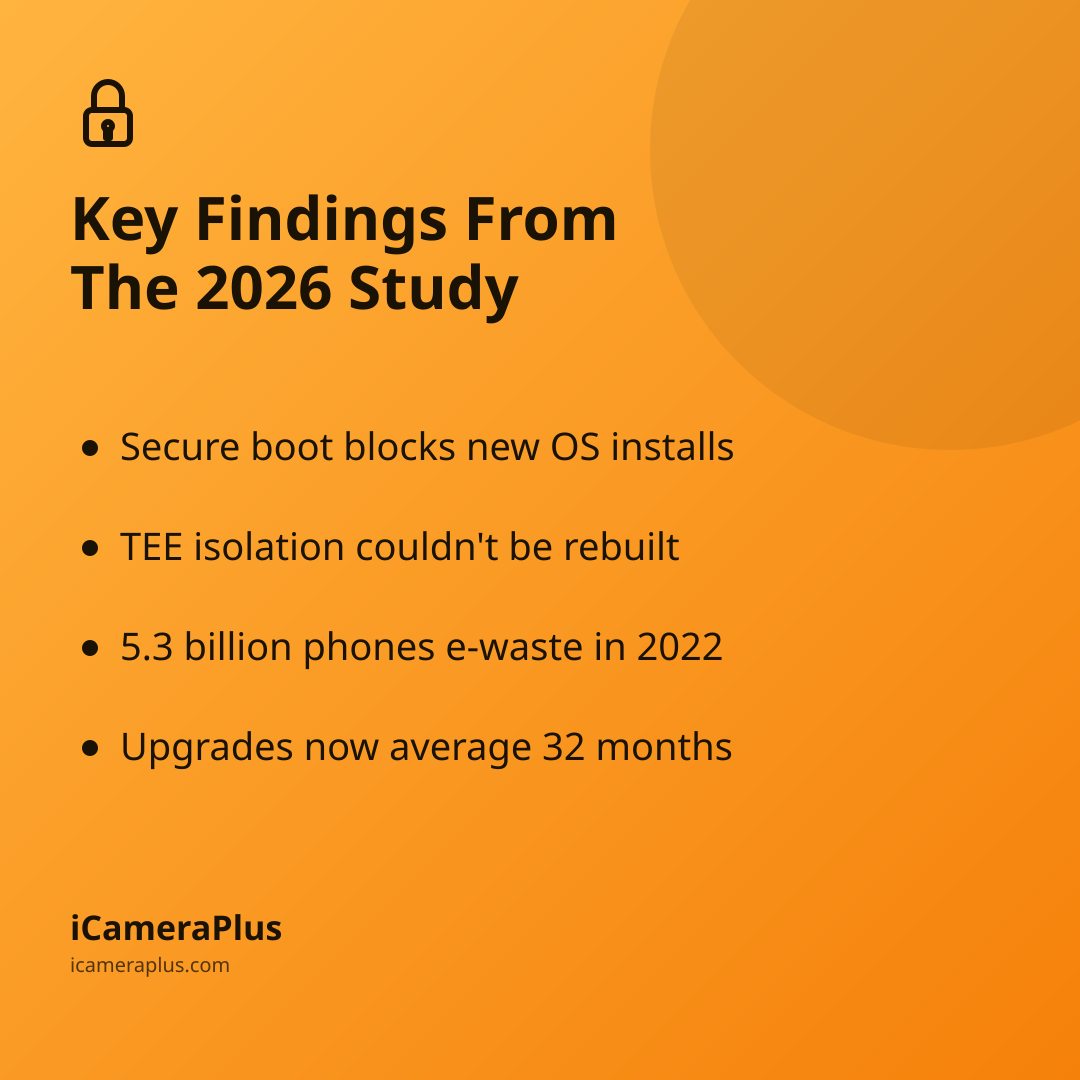
As Help Net Security reported on the study, three components do most of the blocking: secure boot (which only lets the manufacturer's approved software start the phone), the Trusted Execution Environment or TEE (an isolated chip region that guards sensitive operations), and hardware-fused cryptographic keys unique to that one device. All three assume a single owner and a fixed lifecycle — not a second owner installing a different operating system.
What Happened When Researchers Tried to Repurpose a Phone Themselves?
The team tested their findings on a PinePhone, a device built with open hardware specifically to be more reuse-friendly than a typical flagship. They succeeded in flashing a custom bootloader and installing a working Linux system. But they could not fully rebuild the phone's TEE isolation — the configuration work needed to restore secure memory mapping was too specialized for a typical reuse project to replicate.
That matters because it shows the barrier isn't laziness or a lack of right-to-repair access — it's architectural. A professional team using open hardware still couldn't fully restore a phone's security after reuse. If trained researchers couldn't do it on hardware built for tinkering, a home user with a locked-down flagship almost certainly can't either.
Why Are So Many Old Phones Just Sitting in Drawers?
The hardware lock is only part of the story — people also simply aren't replacing phones as often. The 2026 Reviews.org Smartphone Lifespan Report, based on an August 2026 survey of 1,000 U.S. adults, found the average American now goes 32 months between upgrades, up from 29 months in 2025 — a 10% jump in a single year. Rising device prices are accelerating that trend; as iCameraPlus covered in our look at 2026's memory chip crisis, new phones are getting pricier even as people hold onto old ones longer.
Globally, the scale is enormous. The WEEE Forum estimated in 2022 that 5.3 billion mobile phones would become waste that year alone — and that figure doesn't even count the phones people keep but never use. Every one of those idle phones still has a working camera, microphone, screen, and Wi-Fi radio. The hardware isn't the problem; what you try to do with it is.
What's the Easiest Way to Actually Repurpose an Old Phone?
The research is specifically about projects that fight the phone's security architecture: installing a different OS, rooting it, or rebuilding low-level protections from scratch. None of that applies if you use the phone the way it's designed to be used — running an ordinary app inside its existing, manufacturer-supported operating system. That's the approach behind turning a retired phone into a home security camera: no bootloader unlocking, no TEE rebuilding, just an app using the camera and microphone the phone already has.
iCameraPlus works this way on both iOS and Android: it turns a phone you already own into a continuously recording camera, with a private cloud archive you can browse from a web panel, live viewing, remote start and stop, audio and video capture, and a screen-dimming option so the phone isn't a bright rectangle sitting in your living room overnight. If you've already confirmed your old phone is in good enough shape to leave running, our guide on buying a refurbished phone for a security camera walks through what to check first.
- Skip custom OS installs
- Use the phone's built-in OS
- Pick a simple, single-purpose app
- Check battery health before 24/7 use
Quick answers
Can I install a new operating system on an old phone to repurpose it?
Sometimes, but 2026 research from Université Libre de Bruxelles found that secure boot and Trusted Execution Environment protections block full functionality on most devices, even with technical expertise. It's realistic on hobbyist, open-hardware phones; much harder on a typical locked-down flagship.
Is it safe to use an old phone as a security camera instead?
Yes — because you're using the phone's own operating system and an ordinary app rather than trying to override its security hardware, there's nothing to defeat. You're relying on the same security the manufacturer already built in.
Does factory resetting an old phone remove this hardware lock?
No. A factory reset clears your data and settings, but secure boot, the TEE, and hardware-fused keys are built into the chip itself — they stay in place no matter how many times you reset the phone.
Sources
- Roty, Mühlberg, Determe — "Opportunities and Challenges in Securely Reusing and Repurposing Mobile Devices," LIMITS 2026 (arXiv, June 2026)
- Help Net Security — "The security in smartphones is helping send them to landfills" (June 2026)
- Reviews.org — Smartphone Lifespan Report 2026
- WEEE Forum / UNITAR — "~5.3 billion mobile phones will become waste in 2022" (EurekAlert, 2022)