Can You Send Live Video to 911 From Your Phone? What Works in 2026 (and What Doesn't)
Yes — if you have an iPhone 14 or later running iOS 18 or newer, or a recent Android phone, you can now stream live video directly to a 911 dispatcher during an emergency call. The catch is that the feature only works if your local 911 center has upgraded its systems to receive it, and as of the most recent nationwide survey, fewer than 1 in 5 did. It's a real capability, not vaporware — but it's not yet something every homeowner can count on.
What Is "Live Video to 911," Exactly?
Emergency Live Video is a dispatcher-initiated feature, not something a caller triggers on their own. During an active 911 call, if the local dispatch center supports it, a telecommunicator can send a request to the caller's phone asking to see live video or a photo of the scene. The caller gets a prompt explaining that sharing is optional, and can accept with one tap, decline, or stop sharing at any moment. The video travels over an encrypted connection.
Apple built this into iPhone as Emergency SOS Live Video, available on iPhone 14 and later running iOS 18, which launched in the U.S. in September 2024 and expanded to Brazil on August 24, 2026 — its first market outside the U.S., according to Apple's August 2026 announcement. Google brought an equivalent capability to Android in partnership with RapidSOS, announced on December 10, 2025 and built on a network spanning more than 600 million connected devices and over 22,000 U.S. public safety agencies, per the Google/RapidSOS press release.
How Many 911 Centers Can Actually Receive It?
This is the part most coverage of the feature skips. Having a phone that can send video means nothing if the 911 center on the other end can't display it. According to the 2023 "Pulse of 911" State of the Industry Survey by the National Emergency Number Association (NENA) and Carbyne, fewer than 20% of U.S. 911 centers could accept video from a caller, as reported by Government Technology in July 2023.
Text messaging — a much older and simpler capability than live video — tells a similar story. The FCC's 17th Annual Report to Congress on the 911 Fee (February 2026) found that 3,967 emergency call centers across 47 states, D.C., and Puerto Rico reported being text-capable by the end of 2024, out of roughly 6,000 call centers nationwide, even as the volume of texts sent to 911 jumped 89.1% year-over-year, from 1.19 million in 2023 to 2.24 million in 2024. If texting still isn't universal, live video — which demands far more bandwidth and newer infrastructure — has further to go.
Your phone can now show 911 what's happening — but only if the dispatcher on the other end can see it.
Which Phones Are Actually Covered?
Coverage depends less on your phone and more on the network behind it. RapidSOS, the data platform both Apple and Google rely on, says it connects 23,500+ first responder agencies and that 99.99% of the U.S. population is covered by Emergency Communication Centers that use RapidSOS in some capacity, handling over 171 million emergencies a year, according to RapidSOS's own published figures. Being "covered by RapidSOS" is not the same as that center being able to display live video — RapidSOS also supplies far more basic data, like caller location. Apple states its Live Video integration is built to reach about 99% of the U.S. population, per Apple's own documentation for public safety agencies, but actual video capability at the dispatch console still depends on that agency's separate technology upgrades.
Should This Change How You Think About a Home Camera?
Live video to 911 is genuinely useful in the right moment — a dispatcher watching a break-in, fire, or medical emergency unfold in real time can make faster, better-informed decisions. But it has hard limits worth knowing before you need it:
- It only activates during an active 911 call, and only if the dispatcher requests it
- It needs a live cellular or Wi-Fi connection at that exact moment
- It shows what's happening from the second you connect — not what happened 20 minutes, or two days, earlier
- It depends entirely on your local 911 center's technology, which the data above shows is still catching up
A few practical takeaways worth acting on now:
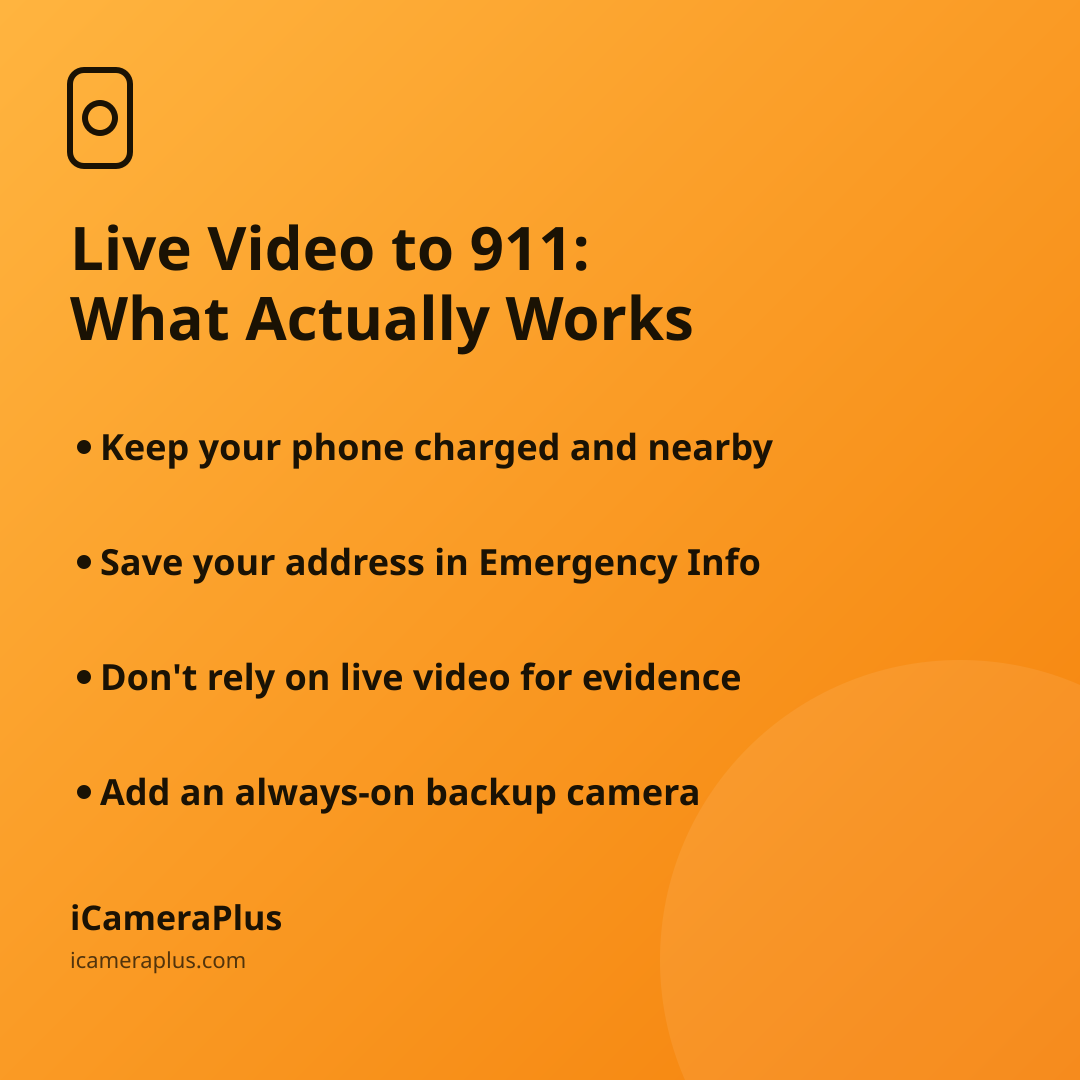
- Keep your phone charged and nearby
- Save your address in Emergency Info
- Don't rely on live video for evidence
- Add an always-on backup camera
That last point is exactly where an always-on home security camera earns its keep. A phone you already own, repurposed as a continuously recording camera, doesn't wait for a dispatcher to ask for footage — it already has it, saved off the device, from before anyone dialed 911. Apps like iCameraPlus turn an old phone into that kind of always-on witness: continuous recording, an off-device archive, and a live view you can pull up yourself, on your own timeline, whether or not your local 911 center has caught up to the newest video technology.
Is Live Video to 911 Available Everywhere Yet?
No. The feature is rolling out gradually as individual 911 centers modernize onto Next Generation 911 (NG911) infrastructure, a multi-year, agency-by-agency process. Even in areas where it works, dispatchers are trained to use it selectively — the official guidance from Apple notes video sharing should only be requested "if the responder determines that seeing the scene would be helpful and it's safe to do so." In practice, that means most 911 calls today still proceed exactly as they always have: voice only.
Quick Answers
Can I just send 911 a video without them asking first?
Generally no. Both Apple's and Google's implementations are dispatcher-initiated — the request has to come from the call center's software before your phone offers the option to share.
What if my phone or area doesn't support live video to 911?
Text-to-911 is more widely available and a reasonable fallback where voice calling isn't possible; check the FCC's registry for your area, since support still varies by county.
Does sharing video with 911 mean they can now see my house whenever they want?
No. Sharing is opt-in per incident, encrypted, and the caller can stop it at any time — it isn't an ongoing connection to your phone's camera after the call ends.
Sources
- Google and RapidSOS Enable Emergency Live Video on Android for 911 (PR Newswire, December 2025)
- Apple Emergency SOS Live Video Now Available in Brazil (PR Newswire, August 2026)
- Emergency SOS Live Video — Apple resources for public safety agencies
- RapidSOS FAQs: coverage and agency statistics
- NENA Reveals Sobering Results From 911 Call Center Survey (Government Technology, July 2023, citing NENA/Carbyne Pulse of 911)
- FCC 17th Annual Report to Congress on the 911 Fee (February 2026)