New 2026 Data: A Third of Camera Owners Are One Skipped Payment Away From Losing Their Own Footage
Most people assume that if their security camera catches something, the footage is simply there when they need it. A new 2026 survey suggests that assumption is wrong for roughly a third of camera owners — not because their camera failed, but because of how the footage was ever going to be stored in the first place.
The Footage You Assume Is There Might Not Be
According to SafeHome.org's 2026 Home Security Market Report, published April 1, 2026 from a nationally representative survey of 2,435 U.S. adults conducted January 29–February 11, 2026, 32% of security camera owners rely solely on cloud storage for their footage. The report is blunt about what that means in practice: on major platforms including Ring, Blink, and Nest, a paid plan is required to actually save video. Without one, you generally only get a live feed, and any recorded motion clips are overwritten as new events come in.
In other words, the camera works. The recording happens. But if the subscription lapses, gets forgotten, or is never set up correctly, there may be nothing left to pull up after the fact — even though the moment you cared about was captured on camera.
A High-Profile Case Put the Gap on the Map
This isn't a hypothetical. In February 2026, investigators searching for missing Arizona resident Nancy Guthrie initially said no video was available from a doorbell camera at her home because the account had no active subscription, according to NPR's reporting on the case. Recovering any footage required investigators and the device maker to work through backend systems in a forensic process that isn't available to ordinary users trying to check their own camera history.
The technical detail worth taking from that case, independent of how it resolves, is simple: for most consumer camera brands, "no subscription" doesn't just mean fewer features. It can mean the footage effectively doesn't exist for anyone trying to retrieve it through normal means — including the camera's own owner.
What the 2026 Numbers Show
The SafeHome.org report breaks down how people actually store their footage:
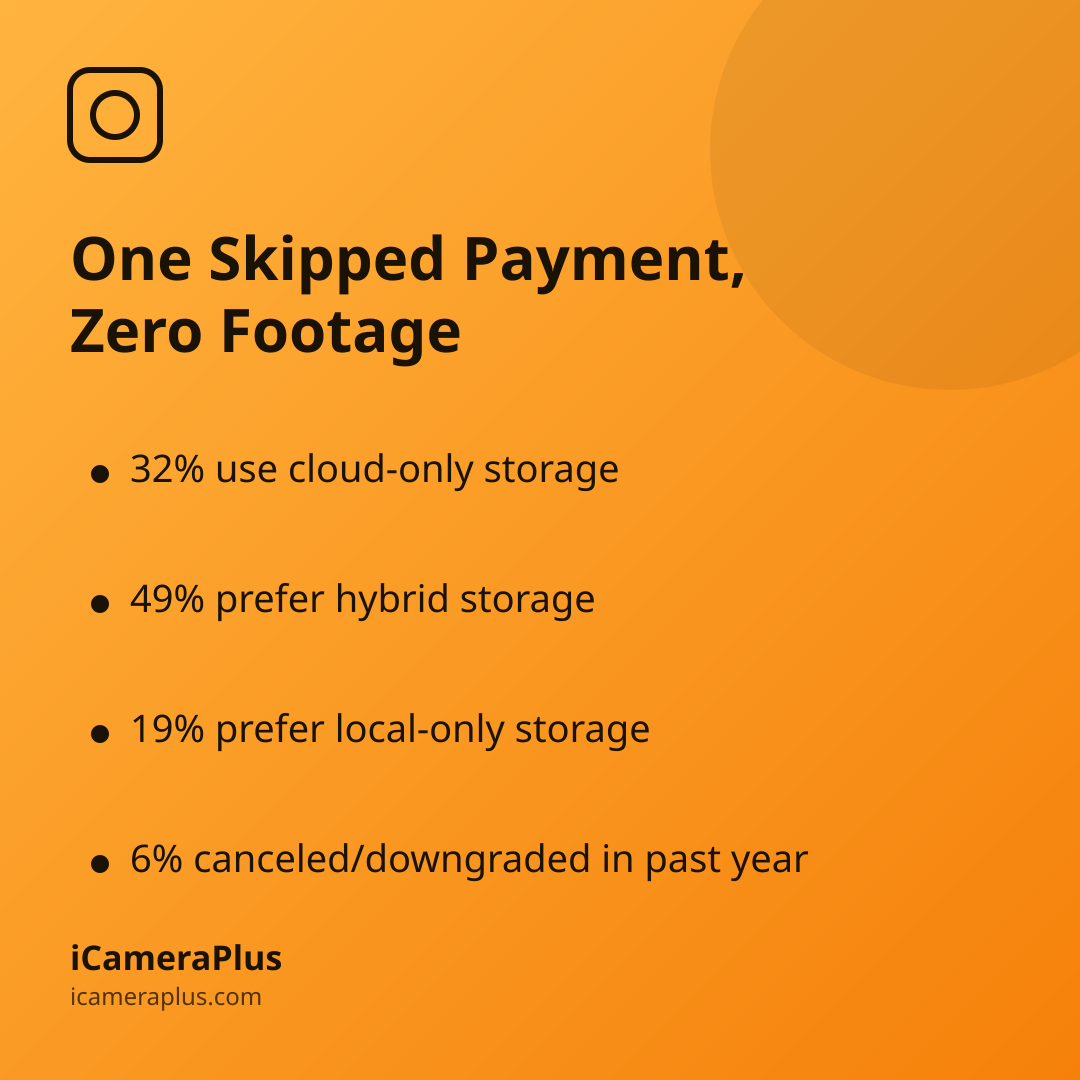
- 32% use cloud-only storage, dependent entirely on an active subscription.
- 49% say they prefer a hybrid cloud-and-local approach.
- 19% prefer local-only storage, such as an SD card, NVR, or NAS device.
- 6% of all respondents canceled or downgraded a paid camera subscription in the past year — rising to 8% among renters affected by rising costs.
The report also found that adults age 18–29 were significantly more likely than those 60 and older to have canceled, downgraded, or considered canceling a subscription, a pattern consistent with tighter discretionary budgets among younger renters and first-time homeowners (SafeHome.org, 2026).
Why People Cancel — and Why It's a Quiet Risk
Canceling or downgrading a camera subscription is a rational, individually small decision. A monthly fee stacks up, priorities shift, or a household simply decides the cost isn't worth it right now. The problem is that the decision doesn't feel like a security decision in the moment — it feels like a budget decision. Nobody cancels a plan thinking "I am now choosing not to have a video record of my property." But functionally, for a cloud-only setup, that's what happens.
This is different from simply paying more for a bigger plan. It's a structural gap: the camera keeps recording motion, keeps showing a live view, and looks like it's working right up until the moment someone needs to look back and finds nothing there.
What "Cloud-Only" Actually Means, Technically
Cloud-based storage itself isn't the problem — it's convenient, off-site, and protects footage if a camera is damaged or stolen. The risk is having only that single path, with no independent copy. If the subscription lapses, the account is mismanaged, or the provider changes its policy, there's no fallback. That's the same single-point-of-failure logic that applies to any important file: one copy isn't a backup.
A home security camera setup that keeps working under this kind of gap generally does one of two things: stores locally as well as (or instead of) in the cloud, or records continuously to an archive that isn't tied to a recurring plan staying current. This is part of why some people set up a spare phone as an additional or backup camera rather than relying on a single device and a single subscription. Apps like iCameraPlus, for example, turn a phone already sitting in a drawer into a camera with continuous recording and an off-device archive by default — not as an add-on that's easy to let lapse, and not dependent on any one storage method being the only copy that exists.
A Five-Minute Audit Worth Doing
Whatever cameras you currently rely on, it's worth checking the basics rather than assuming:
- Confirm which plan you're actually on. Open the app for each camera you own and check subscription status directly — don't rely on memory.
- Ask what happens with zero subscription. Does the camera still save any clips locally, or does it drop to live-view only?
- Check for a local storage option. Many cameras support an SD card or local hub as a second, subscription-free copy.
- Consider a backup device for key areas. A second camera on a different storage path — including a repurposed phone with its own recording and archive — means one lapsed subscription doesn't leave you with a total blind spot.
- Set a reminder to re-check annually. Subscription terms and default plans change; the SafeHome.org data suggests a meaningful share of people find out the hard way.
None of this requires replacing a system you already like. It just means not letting a single monthly charge be the only thing standing between "we have this on camera" and "we don't."