Do Police Need a Warrant for Your Security Camera Footage in 2026?
This article was produced with AI assistance. Sources are listed at the end.
In most cases, no — police cannot simply take your security camera footage just because they ask or show up at your door. They generally need a warrant, a subpoena, or your voluntary consent to get it, with a narrow exception for genuine life-threatening emergencies. That rule hasn't changed in 2026, but a 6-3 Supreme Court ruling this year reinforced why it exists.
Do police need a warrant to see your camera footage?
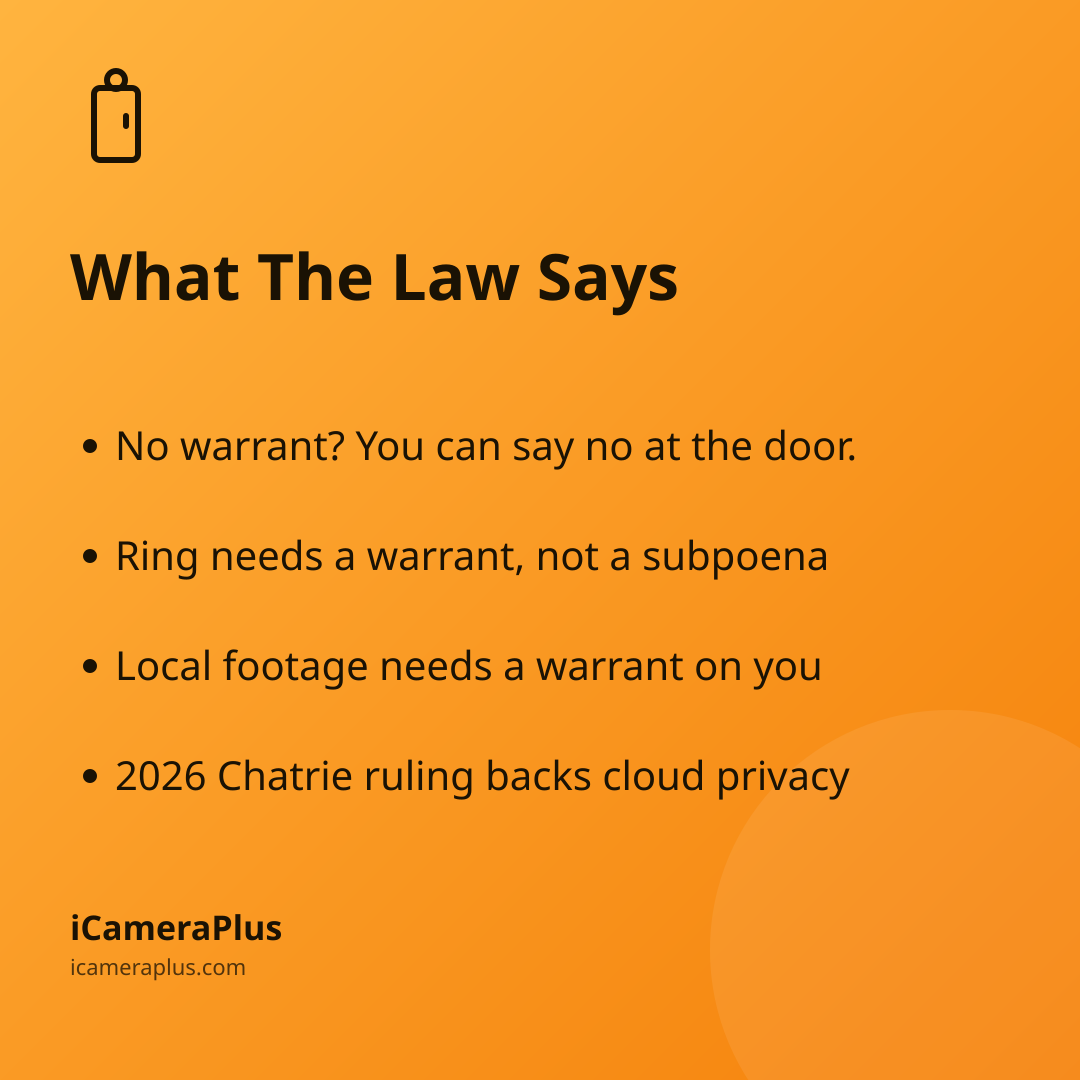
If an officer simply knocks and asks to see your footage, you are not required to say yes. You can decline, and nothing about owning a security camera obligates you to hand anything over without legal process. To actually compel footage from you or from a camera company, law enforcement typically needs a search warrant signed by a judge, a subpoena, or a court order — unless you choose to share it voluntarily.
Police asking nicely is not the same as police with a warrant.
What changed with Ring in 2024 — and is it still true in 2026?
Amazon's Ring announced on January 24, 2024 that it would retire its "Request for Assistance" tool, which had let police departments request doorbell footage directly from users through the Neighbors app, according to PBS NewsHour (2024). Electronic Frontier Foundation senior policy analyst Matthew Guariglia said at the time that the change meant Ring would be "out of the business of platforming casual and warrantless police requests for footage."
That policy still stands in 2026. Ring's current Law Enforcement Guidelines state: "We do not produce content information in response to subpoenas. We may produce non-content and content information in response to valid and binding search warrants." In plain terms, a subpoena alone isn't enough to get your video — officers need an actual warrant.
Does it matter if your footage lives on your device or in the cloud?
Yes. Footage stored only on a local device inside your home generally requires a warrant directed at you personally, since it never left your property. Footage stored in the cloud on a company's servers can instead be requested from that company directly, through a warrant, subpoena, or an emergency disclosure the company decides to grant — as Ring's guidelines above describe.
This is true no matter whose app is holding the footage. If you turn an old phone into a camera with a service like iCameraPlus, your clips land in a private cloud archive that only you can browse from the web — but the general legal framework is the same as any other provider: you decide whether to share a clip voluntarily, and compelling it otherwise still requires a warrant, subpoena, or court order served on the account holder or the company.
How does the 2026 Chatrie ruling change the picture?
On June 29, 2026, the Supreme Court ruled 6-3 in Chatrie v. United States that police conduct a Fourth Amendment "search" when they obtain someone's location history from a tech company through a geofence warrant, according to SCOTUSblog (2026). Writing for the majority, Justice Elena Kagan held that "an individual has a reasonable expectation of privacy in records about his cell phone's location," even though that data is held by a third-party company rather than the person themselves.
The ruling builds on Carpenter v. United States (2018) and signals that courts are increasingly unwilling to treat data held by a cloud provider as fair game just because a company, not you, physically stores it. That logic extends naturally to cloud-stored camera footage: the fact that your clips sit on a server doesn't strip away your expectation of privacy in them.
What about license-plate readers and public-facing cameras?
It's worth separating your own property's footage from network surveillance tools that scan public streets. On October 1, 2026, a federal judge in Oklahoma ruled that a warrantless search using an automated license-plate-reader network — the kind of technology sold by Flock Safety — violated the Fourth Amendment, calling the practice "indiscriminate mass surveillance," as reported by TechCrunch (2026). That case involved tracked vehicle movements across public roads, not a homeowner's own camera footage, but it's part of the same broader trend: judges are drawing tighter lines around warrantless access to tech-company-held records.
What should you actually do if police ask for your footage?
- Ask to see the warrant first
- You can refuse informal requests
- Check: on-device or cloud storage
- When unsure, call a local attorney
State laws on recording, consent, and disclosure vary, so if a request feels unusual or high-stakes, a quick call to a local attorney is worth it before you hand anything over. For the recording side of this — what you're legally allowed to capture in the first place — see our 2026 state-by-state guide to audio recording laws.
Quick answers
Can police watch my camera's live feed without asking? No. Live access requires either your permission, a warrant, or (for cloud systems) a legal request to the company — an officer cannot tap into your live camera feed on their own.
Does it matter which camera brand or app I use? Not much. The legal standard — warrant, subpoena, consent, or emergency exception — applies regardless of brand, whether it's a dedicated security camera or an old phone running an app like iCameraPlus.
What happens if I just ignore a police request? Ignoring an informal request carries no legal penalty by itself. If officers want to compel the footage, they'll need to come back with a warrant, subpoena, or court order rather than a simple ask.