Do Security Cameras Actually Deter Burglars? What the Research Says
It's a fair question, and a slightly uncomfortable one: does a security camera actually stop a break-in — or does it just give you something to watch after your things are already gone? Cameras are everywhere now, but "everyone has one" isn't evidence. So let's skip the marketing and look at what the research actually shows, including surveys of the one group whose opinion really matters here: convicted burglars themselves.
Ask the burglars — the most direct evidence
The most direct way to learn what deters a burglar is to ask one. That's what criminologists at the University of North Carolina at Charlotte did in a widely cited study, surveying more than 400 convicted offenders about how they picked targets and what made them walk away.
The findings are hard to ignore:
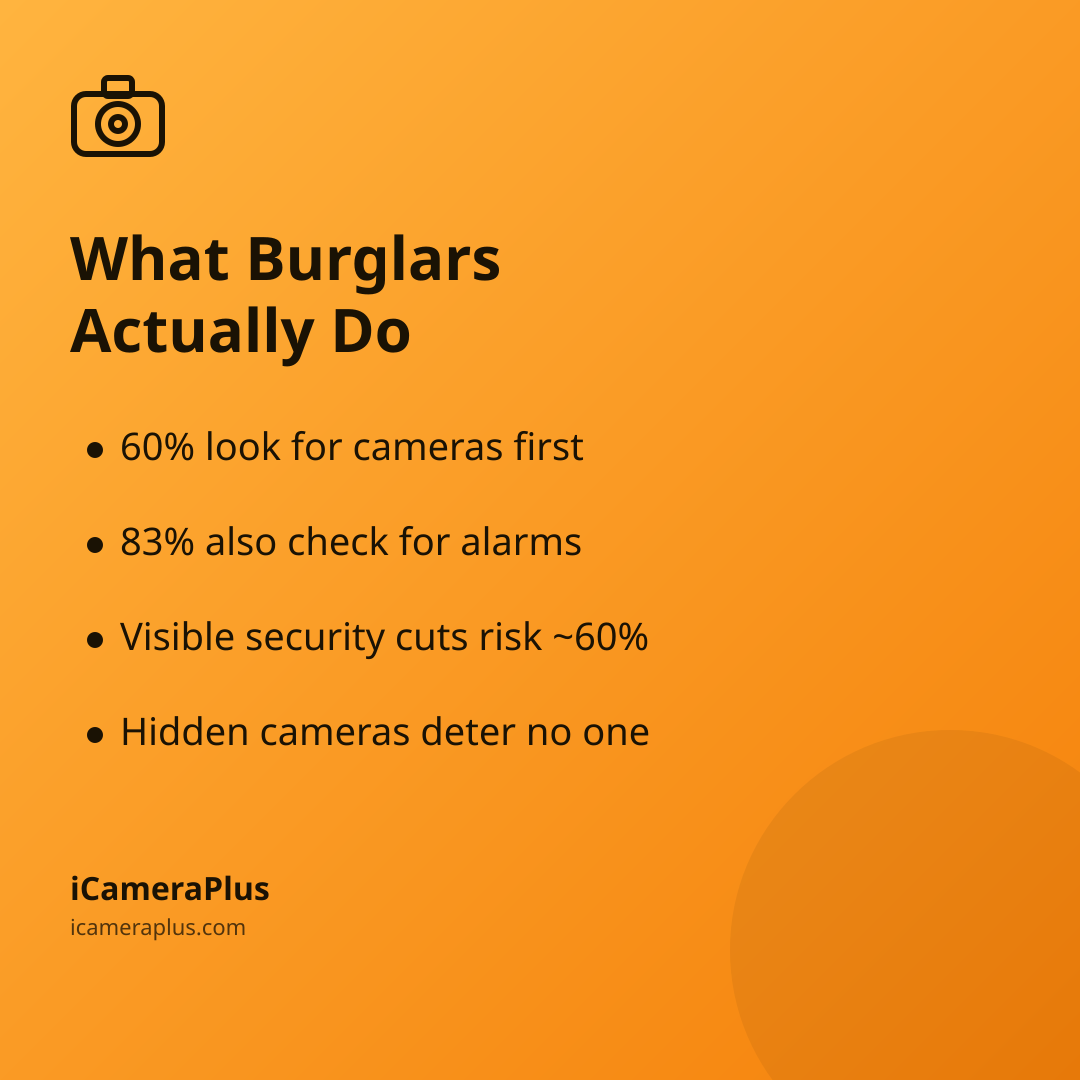
- About 60% said they look for visible security cameras before approaching a house.
- Around 40% said that if they spotted a camera, they would choose a different target altogether.
- 60% deliberately took note of security features — cameras, alarms, dogs, signs — before deciding whether to break in.
- Roughly 83% tried to work out whether an alarm was present, and more than half would abandon the attempt if they found one.
In plain terms: the people who actually commit burglaries treat a visible camera as a reason to move on. Burglary is overwhelmingly a crime of opportunity, and a camera raises the two things a burglar wants to avoid most — the risk of being identified, and the effort of a harder target.
A burglar makes the decision to skip your house in the first few seconds, from the sidewalk — long before they ever touch a door. A visible camera is aimed squarely at that moment.
How much does it actually cut the risk?
Offender interviews tell you about intent; outcome studies tell you about results. Research from the Rutgers School of Criminal Justice found that homes with visible security measures were meaningfully less likely to be broken into — reporting that security systems can reduce the likelihood of a break-in by around 60%. Put the two kinds of evidence together and the story is consistent: visible deterrence changes behaviour.
Where cameras are weaker — the honest part
It would be dishonest to stop there, because not every study is a clean win. The largest body of evidence comes from public-area CCTV, and there the effect is more modest. In a landmark systematic review, criminologists Welsh and Farrington found CCTV was linked to a statistically significant but relatively small 16% drop in crime overall — with the biggest effect by far, a 51% reduction, in car parks, and much weaker results in busy city centres and on public transport.
The takeaway isn't "cameras don't work." It's that they work best under specific conditions: when they are visible, when they target property crime (exactly the category burglary falls into), and when they watch a defined space someone is actively deciding whether to enter — a driveway, an entryway, a front door. That is a remarkably good description of a home security camera, and a poor description of a camera bolted high on a crowded city street.
Visibility is the whole game
Here is the single most important thing to understand: a camera only deters if the burglar can see it. A perfectly hidden camera is great for gathering evidence, but it does nothing to send someone to a different house — because deterrence happens in the offender's head while they size up your home, before anything is touched.
So if prevention is the goal, do the opposite of hiding it:
- Place it where it's obvious from the approach — at eye level near the front door, or clearly visible in a window.
- Cover the real decision points: the front door (the single most common entry point), ground-floor windows, and the back door.
- Make sure it plainly reads as a camera. A visible lens pointed at a visitor does the psychological work on its own.
A deterrent, not a force field
None of this turns a camera into a magic shield. A determined intruder set on your specific home may not be stopped by a camera alone — which is exactly why security professionals think in layers rather than single gadgets. A camera is your "deter" and "detect" layer; solid locks are the "delay" layer; alerts and a plan are the "respond" layer. We broke down all five in Home Security 101. Cameras are at their most powerful as one visible part of that stack — not as a lone fix.
The cheapest visible deterrent is already in your drawer
Here's the practical punchline. Because deterrence depends on a burglar simply seeing a camera, you don't need to spend hundreds to get the effect. An old smartphone does the job: running iCameraPlus turns it into a live security camera you can stand in a window or mount by the door — plainly visible to anyone casing your home — while it also records 24/7 to your archive in case anything actually happens.
It's the rare situation where the free option and the effective option are the same one. To set it up, start with our step-by-step guide on turning an old phone into a security camera, then see where to place it for the most visible coverage.

Sources & further reading
- University of North Carolina at Charlotte — Through the Eyes of a Burglar (survey of 400+ offenders)
- Deep Sentinel — Home Burglary Statistics (Rutgers 60%, alarm findings)
- Welsh & Farrington — Public Area CCTV and Crime Prevention: A Systematic Review & Meta-Analysis
- Security.org — Do Home Security Cameras Deter or Prevent Crime?