Does an Old Phone Work as a Security Camera at Night? What 2026 Data Shows
This article was produced with AI assistance. Sources are listed at the end.
No, not in total darkness — but that matters less than you'd think. An old phone's camera has a permanent infrared-blocking filter built into its lens, so without some ambient or added light it will record black or near-black video at night. Add even a small light source, though, and a repurposed phone can monitor a room, porch, or driveway just as usefully as many entry-level dedicated cameras.
Why Can't a Phone Camera See in True Darkness?
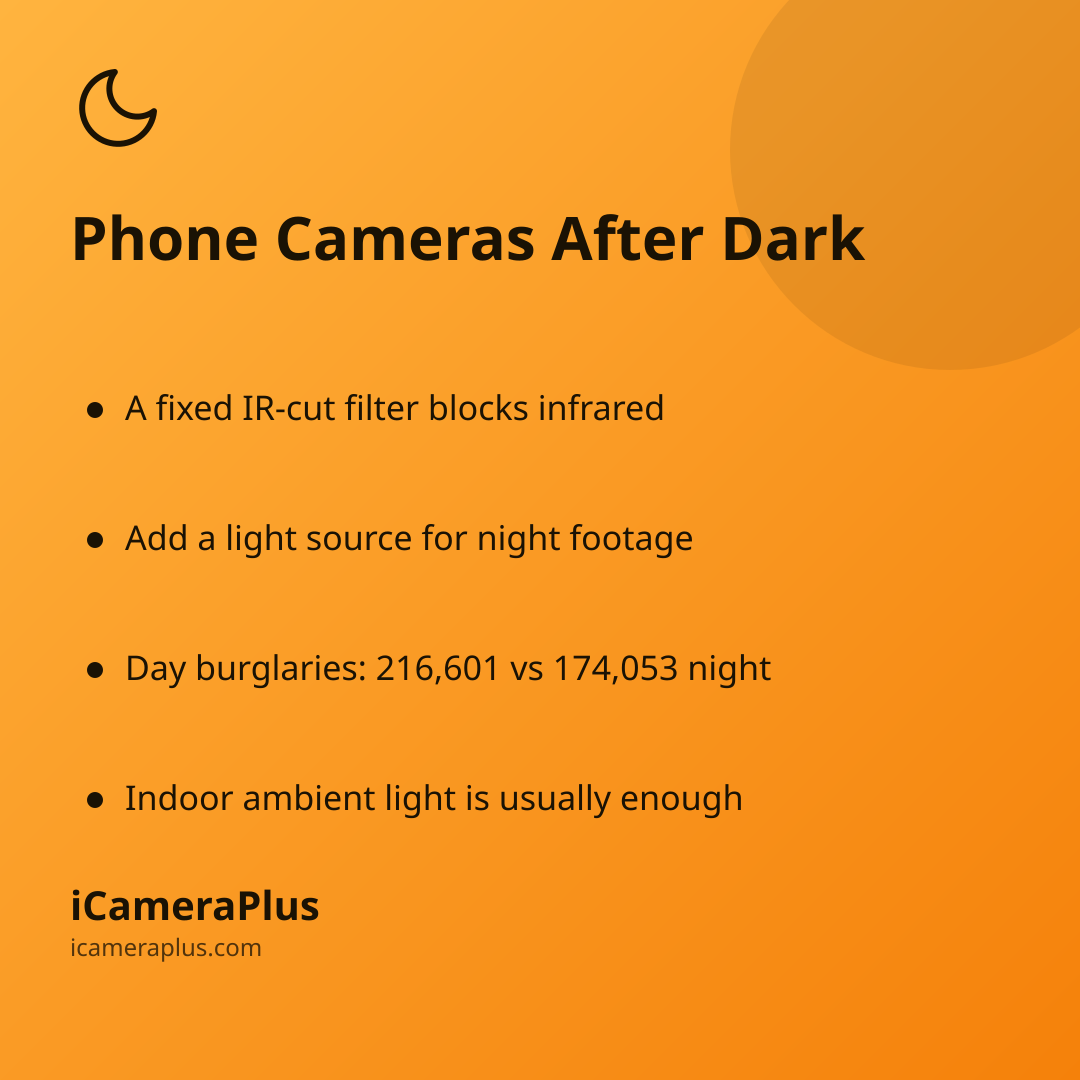
Every phone camera sensor sits behind an infrared-cut (IR-cut) filter that is permanently bonded into the lens stack during manufacturing. That filter exists so daytime photos and videos show accurate colors instead of a pink or washed-out tint caused by infrared light leaking into the sensor. The tradeoff is that the same filter blocks the near-infrared light that true night-vision systems rely on, and there's no app or setting that removes it.
Dedicated security cameras solve this differently. According to a 2026 technical whitepaper from camera manufacturer Axis Communications, surveillance cameras use a mechanical IR-cut filter that physically moves out of the way as light fades, letting the sensor pick up infrared light from built-in LEDs. A phone's filter can't move — it's fixed in place for the life of the device.
How Do Dedicated Cameras Handle Low Light Instead?
Consumer Reports' 2026 lab testing of outdoor security cameras found that infrared LEDs remain "the standard baseline feature across most home security cameras because it is reliable and works even in complete darkness," but that newer models increasingly pair larger image sensors with a built-in spotlight or ambient-light amplification to produce full-color night video instead of the classic black-and-white IR look, per Consumer Reports. Either approach — infrared or a spotlight — adds light the lens can actually use. A phone camera needs the same thing; it just has to come from somewhere other than the camera itself, like a porch light, a plugged-in nightlight, or a lamp on a timer.
Does the Dark Even Matter for Home Security?
Possibly less than the "night vision" marketing suggests. The FBI's 2024 Uniform Crime Report data on reported residential burglaries shows more happened during the day (216,601 incidents) than at night (174,053 incidents), according to the FBI's Uniform Crime Reporting Program. Burglars generally want an empty house, not a dark one, which is why daytime hours — when people are at work or school — see more break-ins than the middle of the night.
Most home burglaries happen in daylight, not darkness — FBI 2024 data says so.
That doesn't make nighttime footage worthless. Porch piracy, car break-ins, and decoration theft often happen after dark specifically because fewer witnesses are around. But it does mean a phone's daytime camera quality — which is excellent on nearly any phone made in the last several years — is doing more of the real security work than most people assume.
How Do You Get the Best Night Results From a Phone Camera?
A few low-effort adjustments close most of the gap between a phone and a dedicated night-vision camera:
- Add a small light source nearby
- Keep the lens clean and unobstructed
- Point the camera away from direct glare
- Don't expect infrared in true darkness
A porch light, a motion-activated fixture, or even a cheap plug-in nightlight pointed indirectly at the scene gives the sensor something to work with. For an indoor room — a nursery, a living room, an entryway — ordinary ambient light from a hallway or a dim lamp is usually enough for a modern phone's camera to produce a usable, if grainy, picture.
Where This Limitation Matters Least
Indoor monitoring is where a repurposed phone's lack of true infrared tends to be least noticeable, because most homes already have some ambient light at night — a hallway fixture, a streetlight through a window, a charging-cable LED. That makes an old phone a reasonable option for watching a sleeping pet, keeping an eye on a room while a baby monitor setup covers a nursery, or checking a pet camera feed from another room, rather than for unlit stretches of a backyard.
This is one area where an app like iCameraPlus is useful without needing infrared: it turns a phone you already own into a continuously recording camera with a private cloud archive you can browse later, live viewing from a web panel, remote start and stop, and a screen-dimming option — handy specifically at night, since it keeps a bright phone screen from lighting up a dark room while it keeps recording whatever ambient light is available.
For cameras positioned where true darkness is common — an unlit side yard, a detached garage — a dedicated infrared camera will outperform any phone, repurposed or new. For more on matching camera type to location, see our guide on whether a security camera works through a window, and on how exterior lighting itself affects risk, see what 2026 data says about leaving lights on before you travel.
Quick Answers
Can you add real night vision to an old phone? Technically, yes — hobbyists can physically remove a phone's IR-cut filter and add infrared LEDs, but this permanently alters the camera, isn't reversible, and isn't something most owners should attempt on a phone they still want to use normally.
Does a security camera need night vision if it's only watching an indoor room? Usually not. Most indoor spaces have enough ambient light — a hallway light, a streetlight, a nightlight — for a phone's low-light mode to produce a workable picture without infrared.
What's the cheapest fix for grainy night footage from a phone camera? Add light before you add equipment. A $10 plug-in nightlight or an existing porch fixture does more for nighttime footage quality than any camera app setting.