Does Parking in Your Driveway Actually Protect Your Car From Theft in 2026?
Yes, but only partly. A driveway is statistically safer than a street parking spot, mostly because it takes a thief a few extra seconds and a bit more visibility risk to approach. But a driveway is not a safe zone: modern keyless-entry relay attacks work just as well on a car parked ten feet from your front door as one parked at the curb, and roughly a third of U.S. homes don't even have a garage to fall back on. A camera aimed at the driveway closes most of that gap.
How Many Cars Are Actually Being Stolen in 2026?
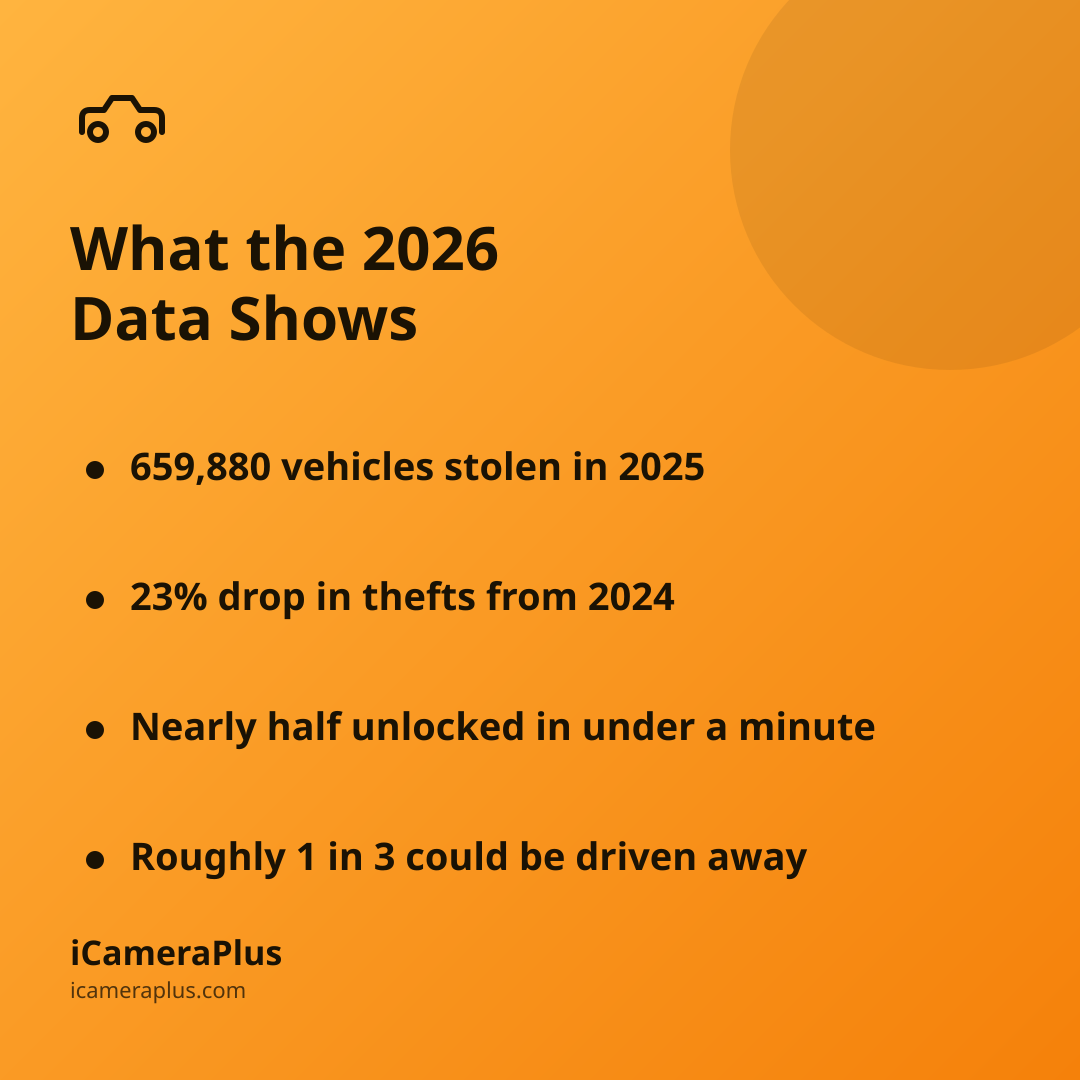
Nationally, vehicle theft is improving. According to the National Insurance Crime Bureau's report on full-year 2025 data, published March 18, 2026, 659,880 vehicles were reported stolen across the U.S. in 2025 — a 23% drop from 2024 and one of the lowest annual totals in years. Even so, that still works out to roughly one vehicle stolen every 48 seconds nationwide, according to the same NICB report.
So the trend line is good news for owners. But a national decline doesn't mean your specific driveway is immune, especially given how theft methods have changed.
What Is a Relay Attack, and Why Doesn't a Driveway Stop It?
Most modern thefts of newer cars no longer involve smashed windows or hot-wired ignitions. They involve a relay attack: one person stands near your front door holding a device that captures and amplifies the signal from your key fob sitting on a table inside the house, while a second person holds a receiver next to your car in the driveway. The car reads the boosted signal as the real key and unlocks — often in under a minute, with no alarm and no forced entry.
Germany's ADAC auto club, which has run the largest independent test of this vulnerability for a decade, published its latest results on August 18, 2026, after examining more than 850 keyless-entry vehicles. Nearly half could still be unlocked using cheap radio-signal-relay equipment, and roughly one in three of all vehicles tested could also have their engine started and driven away.
A car parked steps from your front door can be unlocked in under a minute — with no alarm and no broken glass.
That's the part a driveway doesn't fix. Distance from the street helps against opportunistic theft, but a relay attack only needs your fob to be somewhere inside the house — which it almost always is.
What if You Don't Even Have a Garage?
A locked garage is the strongest physical layer, but it's not an option for everyone. A U.S. Department of Energy analysis of Census Bureau American Housing Survey data found that only about two-thirds of U.S. housing units have a garage or carport at all — meaning roughly a third of households park in a driveway or on the street every single night with no structure around the vehicle whatsoever. For renters, the gap is even wider: the same data shows only 39% of rental units have a garage or carport, compared with 81% of owner-occupied homes.
If you're in that group, the driveway isn't a fallback option — it's the only option, which makes visibility and deterrence do more of the work that a garage door would otherwise handle.
How Do You Actually Protect a Car Parked in the Driveway?
- Store your key fob away from entryways
- Add motion-sensor lighting
- Keep the driveway visible from the street
- Record the driveway, not just the door
The National Insurance Crime Bureau's own prevention guidance recommends installing motion-sensor security lighting for any vehicle that must be parked in a driveway rather than a garage, on the theory that sudden light is often enough to make an opportunistic thief move on before they've even tried the door handle. NICB also recommends never leaving a fob or spare key inside the car and reporting a theft immediately, since faster reporting improves recovery odds.
Lighting and habits help, but they don't produce evidence, and most doorbell cameras are aimed at your porch, not your parking spot — so a car parked in a driveway is often just outside the frame. This is one of the more overlooked, genuinely useful jobs for a phone you're not using anymore: propped in a window or mounted to face the driveway, it can run continuous recording around the clock, send a motion alert the moment someone approaches the car, and — because the footage is a bigger asset than the phone itself if the car window gets smashed — keep an off-device archive so a break-in doesn't erase its own evidence. That's the core idea behind iCameraPlus: it turns an old phone into exactly that kind of always-on, remotely viewable camera without buying new hardware.
Does Footage Actually Help After a Break-In or Theft?
Footage doesn't stop a relay attack in progress, but it does two things a locked door can't: it gives police and your insurer a timestamped record of who approached the vehicle and when, and it often settles disputes over how a break-in happened at all. NICB notes that reporting a theft as soon as it's discovered — which is much easier when an alert reaches your phone the moment it happens — measurably improves the odds a vehicle is recovered.
Quick answers
Is a car in a locked garage still at risk? Far less so. Relay attacks and opportunistic theft both depend on easy physical access to the vehicle, which a closed garage door removes. If you have a garage, using it is still the single strongest step you can take.
Can a security camera stop a relay attack? No — a camera doesn't block the radio signal. What it does is create a visible deterrent and a timestamped record, which matters for police reports and insurance claims even when the theft itself can't be physically prevented.
Does a Faraday pouch for my key fob actually help? Yes, in principle — blocking the fob's signal from being captured is the most direct countermeasure to a relay attack, which is why ADAC's testing specifically singles out signal-blocking as one of the few reliable defenses alongside vehicles built with UWB technology.
Sources
- National Insurance Crime Bureau, "U.S. Vehicle Thefts Experience Historic Decline" (March 18, 2026)
- ADAC, "Zehn Jahre Keyless-Test: Oft noch unsicher" (August 18, 2026)
- National Insurance Crime Bureau, "Prevent Vehicle Theft" prevention guidance (2026)
- U.S. Department of Energy, "Two-Thirds of All Housing Units Had a Garage or Carport in 2017," Fact of the Week #1058