Your Doorbell Camera Can Be "Secure" and Still Not Private — Here's What Consumer Reports Found
Most people shopping for a video doorbell ask one question: is it secure? Fewer ask the second, more important question: secure from whom? Those turn out to be different problems with different answers, and a camera can score well on one while quietly failing the other.
That distinction is exactly what Consumer Reports set out to measure when it tested a wide field of video doorbell brands — and the results are a useful reality check for anyone deciding how to watch their own front door.
Two Different Questions: "Can It Be Hacked?" and "Who Else Can See It?"
Consumer Reports' Digital Lab evaluates connected cameras using The Digital Standard, an open testing framework that scores each product on more than 70 separate indicators grouped into three buckets: security (can a hacker get in), privacy (what the company itself collects, uses, and shares), and governance (how transparent the company is about it). Those are graded separately on purpose, because a device can lock hackers out effectively while the manufacturer still collects far more data than it needs, shares it with third parties, or makes it hard to request a copy or a deletion.
In a 2023 investigation, Consumer Reports found that only 5 of the 16 doorbell brands it tested offered two-factor authentication — Arlo, August, Google Nest, Ring, and SimpliSafe — and that most manufacturers did not minimize the data they collect or make it easy for customers to access or delete their own information. In its ongoing 2026 doorbell ratings, that split between "secure" and "private" still shows up model by model: Consumer Reports' review of the Arlo Video Doorbell 2K, for instance, gives it top marks for keeping out hackers, but flags data privacy as a weak spot, with several smart features gated behind a subscription that requires handing over more account data to use them.
A Real-World Example of Why the Distinction Matters
The gap between "hacker-proof" and "company can't see it either" isn't theoretical. In 2023, the Federal Trade Commission charged Ring with giving employees and contractors sweeping, unsupervised access to customers' private camera footage. The FTC's complaint detailed how one employee viewed thousands of video recordings belonging to at least 81 women, searching out cameras labeled things like "Master Bedroom" over a period of months before a supervisor noticed. Ring settled for $5.8 million in customer refunds and agreed to build in stronger internal controls, including multi-factor authentication for both employee and customer accounts. No outside hacker was involved — the footage was accessed exactly the way the system was designed to allow, by people inside the company.
The lesson isn't that any one brand is uniquely risky; it's that "who can see my footage besides me" is a separate question from "is my footage encrypted," and it's worth asking both before you decide where your home video lives.
What to Check Before You Buy (or While You Own One)
The FTC's consumer guidance on home security cameras, updated in June 2026, lays out a practical checklist that applies no matter which camera you choose:
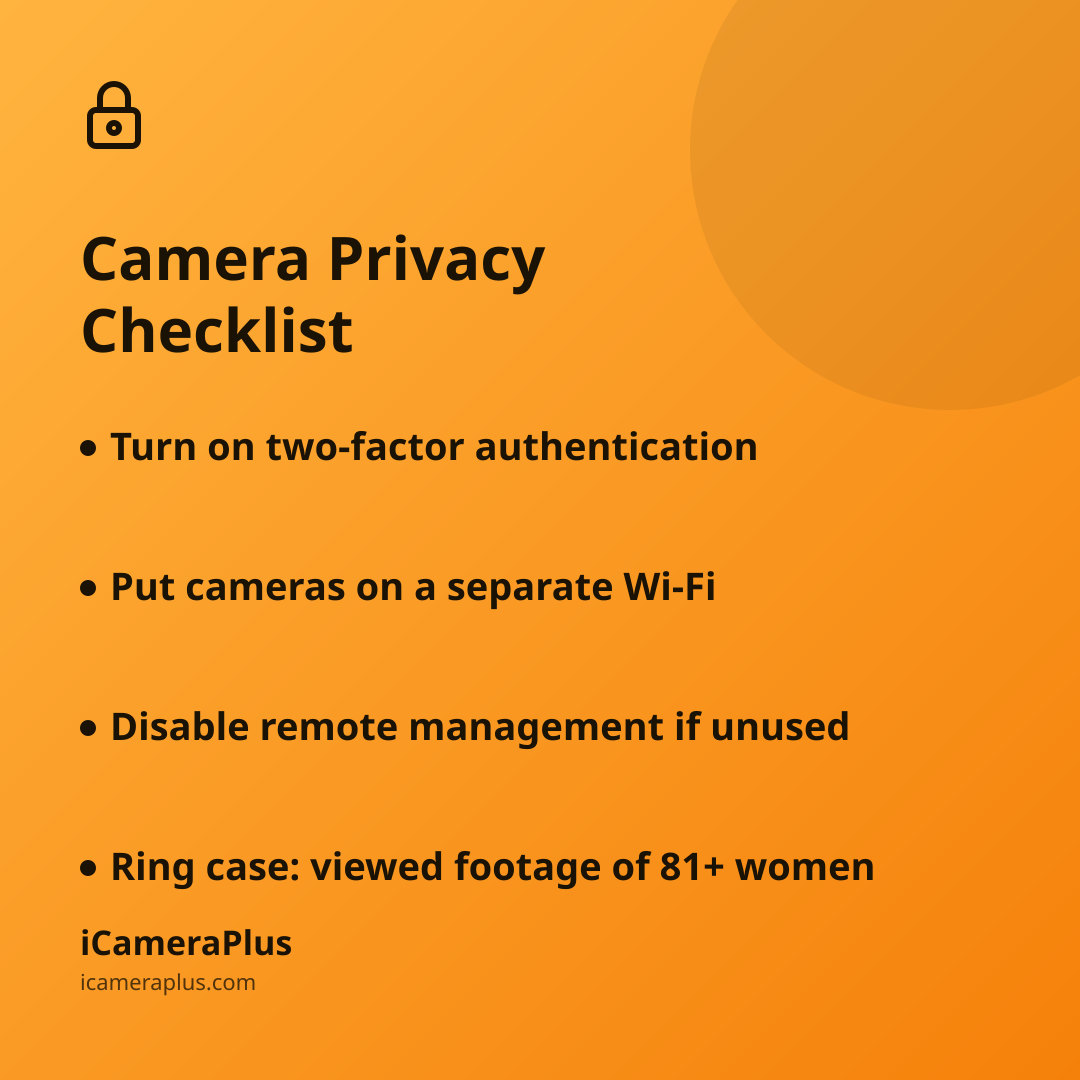
- Confirm encryption is built in — for both live streams and archived video, not just the account login page.
- Turn on two-factor authentication if the brand offers it, so a leaked password alone can't unlock your camera.
- Put cameras on a separate Wi-Fi network from your computers and phones, so a breach on one doesn't expose the other.
- Disable remote management if you don't actually use it, and check who besides you has access to the account.
- Disconnect and retire old devices you're no longer using — outdated firmware on a forgotten camera is a common weak point.
It's also worth spending five minutes with the privacy policy before you buy: does the company say it sells or shares footage-derived data with third parties? Can you request your data be deleted? Those answers vary a lot more between brands than the marketing copy suggests.
Where a Phone You Already Own Fits In
One reason a growing number of people are reusing an old phone instead of buying a new camera is that it sidesteps part of this equation. An app like iCameraPlus turns a spare phone into a continuously recording camera for your own home security setup, with footage archived off the device and available for remote live view and motion alerts — but there's no shared customer database sitting behind it for an employee to browse, and no bundled subscription unlocking basic features. You're still responsible for the same fundamentals — a secured Wi-Fi network, a strong device passcode, keeping the app updated — but the footage is yours, stored under your control, for watching your own property.
That's not a claim that any self-hosted setup is automatically immune to every risk above; good Wi-Fi hygiene and account security still matter. It's a narrower point: fewer parties in the chain means fewer places for a "who else can see this" answer to go wrong.
The Bottom Line
A high security score tells you a camera is hard to hack. It doesn't tell you what the company behind it does with your footage once it's safely inside their systems. Consumer Reports' testing shows those can pull in opposite directions even for well-reviewed, popular brands. Before you buy — or before you keep paying for the one you have — it's worth asking both questions, not just one.
Sources
- Consumer Reports: "Data Security and Privacy Gaps Found in Video Doorbells" (2023)
- The Digital Standard: Video Doorbells case study and testing methodology
- Consumer Reports: "10 Best Video Doorbell Cameras of 2026, Lab-Tested and Reviewed"
- FTC: "FTC Says Ring Employees Illegally Surveilled Customers, Failed to Stop Hackers from Taking Control of Users' Cameras" (2023)
- FTC: "FTC Sends Refunds to Ring Customers Stemming From 2023 Settlement" (2024)
- FTC Consumer Advice: "How To Secure Your Home Security Cameras" (updated 2026)