The FCC's Smart-Device Security Label Is Moving Again — What the Cyber Trust Mark Means for Your Next Camera
If you've shopped for a smart camera, baby monitor, or video doorbell recently, you've probably noticed there's no easy way to tell which ones take security seriously and which ones don't. The federal government has been trying to fix that for three years with a label called the U.S. Cyber Trust Mark — and after a rocky stretch that nearly derailed it, the program just got a restart.
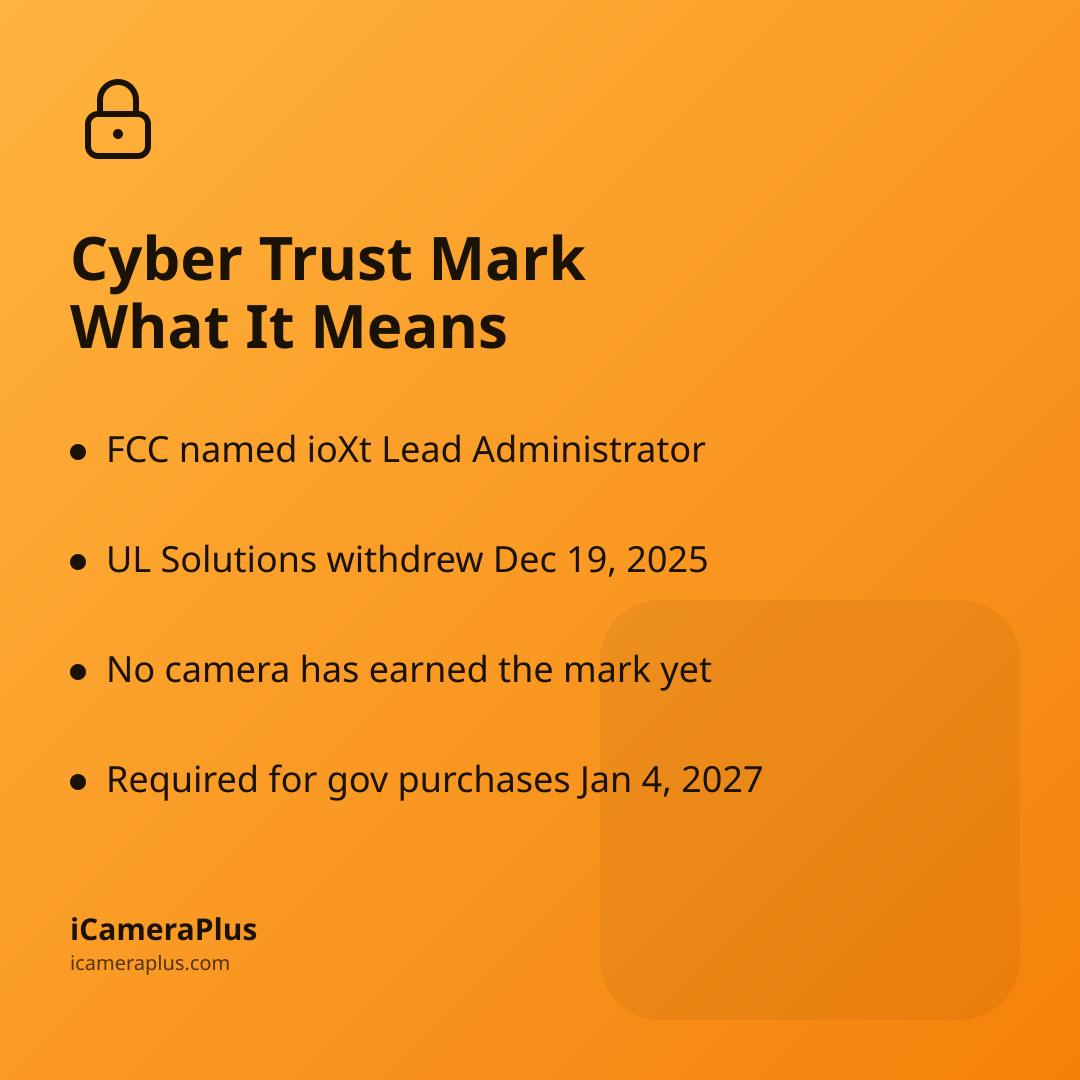
On April 13, 2026, the Federal Communications Commission named the ioXt Alliance as the new Lead Administrator of the Cyber Trust Mark program, following the abrupt withdrawal of its original administrator, UL Solutions, in December 2025. For homeowners and renters trying to figure out whether a given camera is actually safe to put on their home network, here's what the label is supposed to do, why it stalled, and what's worth checking in the meantime.
What the Cyber Trust Mark Actually Certifies
The Cyber Trust Mark is a voluntary certification logo the FCC created for wireless consumer "Internet of Things" (IoT) products — the category that includes internet-connected home security cameras, baby monitors, video doorbells, smart appliances, fitness trackers, and garage door openers. Devices that pass testing against security standards based on NIST guidance can display the mark alongside a QR code that links to a public registry with plain-language details: how long the manufacturer will keep issuing security updates, whether those updates install automatically, and how to change the device's default password.
Notably, the program does not cover personal computers, smartphones, or routers — it's aimed specifically at the newer wave of connected gadgets, cameras included, that don't have the decades of security scrutiny that phones and laptops already get.
Why the Program Almost Fell Apart
The Cyber Trust Mark launched in January 2025 with UL Solutions as its Lead Administrator, the organization responsible for coordinating testing labs and approving products for the label. That arrangement collapsed on December 19, 2025, when UL withdrew after facing scrutiny over its ties to China — a development that left the entire labeling program in limbo for nearly four months. The FCC's April 2026 selection of ioXt Alliance, an existing IoT security standards body, was widely read by industry groups, including the Consumer Technology Association, as a sign the program is back on a credible path rather than being shelved.
Even with a new administrator in place, there's still no confirmed date for when the FCC will start accepting product applications, which means labeled cameras aren't yet sitting on store shelves. There is, however, a firm deadline pushing manufacturers to move faster: a June 2025 executive order directs federal agencies to require the Cyber Trust Mark on any consumer IoT product the government purchases starting January 4, 2027. That procurement pressure is expected to nudge manufacturers toward certification well before most consumers ever see the logo in a store aisle.
The Trust Gap Behind the Push
The label exists because consumer confidence in connected home devices has been sliding, not improving. A 2026 Copeland survey of 2,000 U.S. homeowners — the third year of its Smart Home Data Privacy research series — found that surveillance-related concerns rose from 16% to 19% of homeowners between 2022 and 2026, while worry about how manufacturers use device data climbed even faster among smart thermostat owners, from 26% to 37% over the same period. The same study found 55% of respondents say they have little to no understanding of how their device data is actually used. In other words, people are buying more connected devices while trusting the companies behind them less — exactly the information gap the Cyber Trust Mark is designed to close.
What to Do While You Wait for the Label
Since certified products aren't available yet, the practical move is to apply the same questions the label will eventually answer whenever you're shopping for a camera today:
- Does the manufacturer publish a security update policy? Look for a stated commitment to patch vulnerabilities, not just marketing copy about "bank-level encryption."
- Can you set a unique password immediately? Devices that ship with a fixed default password (or worse, no login at all) are the exact failure mode the Cyber Trust Mark's password guidance targets.
- Does the company have a track record? A quick search for the brand name plus "data breach" or "vulnerability" tells you more right now than a future logo will.
- Where does the footage actually go? Understand whether recordings live only on the device, in the company's cloud, or somewhere you control.
One Way to Sidestep the Guesswork
There's a simpler option that neatly avoids most of this uncertainty: the phone already in your drawer. Smartphones are explicitly excluded from the Cyber Trust Mark program for a reason — they already go through far more rigorous, ongoing security patching than most standalone smart cameras, backed by Apple's and Google's established update pipelines. Turning that phone into a dedicated home security camera with an app like iCameraPlus means you're recording your own property on hardware and software you already know, with continuous recording, an off-device archive, remote live view, and motion alerts — instead of trusting an unfamiliar IoT brand's security promises before the label system that's meant to vet them is even up and running.
The Bottom Line
The Cyber Trust Mark is a genuinely useful idea that's had a rough rollout: a January 2025 launch, a December 2025 administrator collapse, and an April 2026 restart, with no firm date yet for when labeled products reach consumers — only a January 2027 deadline forcing federal suppliers to comply first. Until certified cameras are actually on shelves, the safest approach is the one homeowners have always needed: check the update policy, set your own password, know where your footage lives, and if you'd rather skip an unknown brand entirely, put a device you already trust to work watching your own home.
Sources
- U.S. Cyber Trust Mark — Federal Communications Commission
- Certification Mark — U.S. Cybersecurity Labeling Program for Smart Devices, FCC
- FCC Names ioXt Alliance Lead Administrator for U.S. Cyber Trust Mark Program (April 13, 2026)
- FCC signals continued commitment to Cyber Trust Mark program — Cybersecurity Dive
- Sustaining Select Efforts to Strengthen the Nation's Cybersecurity — Executive Order, The White House (June 2025)
- Copeland Study Warns: U.S. Homeowners' Trust in Smart Home Data Practices Has Reached a Critical Low (2026)
- FCC Launches 'Cyber Trust Mark' for IoT Devices to Certify Security Compliance — The Hacker News