Fire Prevention Week 2026's Theme Is "Safe Charging" — What It Means for Every Camera in Your Home
Every October, the National Fire Protection Association (NFPA) picks a theme for Fire Prevention Week to focus the country's attention on one specific fire risk. For 2026, that theme isn't cooking, candles, or space heaters — it's the charger sitting on your nightstand right now.
NFPA has named "Charge into Fire Safety: Safe Charging Is a Superpower" as the official theme for Fire Prevention Week 2026, running October 4–10. It's the second year in a row the organization has built the campaign around lithium-ion batteries, following 2025's "Lithium-Ion Batteries in Your Home" theme. That's a notable repeat — NFPA doesn't usually revisit a topic back-to-back unless the underlying problem is still growing.
Why Batteries Became a National Fire-Safety Headline
The concern isn't hypothetical. The U.S. Consumer Product Safety Commission (CPSC) reports more than 25,000 fire or overheating incidents involving lithium-ion batteries between 2017 and 2022, spanning more than 400 types of consumer products — everything from e-bikes to phones, laptops, and battery-powered home devices. CPSC has been moving toward mandatory federal rules for the highest-risk category first: in June 2026 it proposed the first federal safety standard specifically for lithium-ion batteries used in e-bikes, scooters, and other micromobility products, which would require tamper-resistant battery enclosures and stronger labeling.
Security cameras run on the same kind of battery, and the risk isn't just theoretical. In June 2026, Wyze recalled more than 321,000 Solar Cam Pan security cameras after CPSC found that incorrect assembly instructions could let consumers accidentally puncture the battery casing — leading to 13 overheating reports, six units catching fire or exploding, and six reports of minor burns. It's a useful reminder that any battery-powered camera, doorbell, or sensor in your home is a charging device first and a security device second.
The Charging Devices You Probably Aren't Thinking About
Fire Prevention Week's messaging is aimed at everyday habits, not just exotic e-bike batteries. Walk through a typical home and the list of lithium-ion devices adds up fast: phones, tablets, laptops, wireless earbuds, power banks, robot vacuums, video doorbells, and battery-operated security cameras. Many of these are plugged in around the clock, often in a bedroom or a spot near flammable material like bedding or curtains — exactly the pattern CPSC's guidance is trying to change.
This is also where an older phone repurposed as a home security camera has a real advantage. Unlike wireless battery cameras that cycle through repeated charge-and-discharge loops (a pattern that accelerates battery wear), a phone running as a continuous camera — the approach iCameraPlus is built around — typically stays connected to standard wall power the same way it did every night as your daily phone. That doesn't remove the need for good charging habits, but it does mean you're managing one familiar device and one cable, not a separate battery pack with its own charging quirks.
CPSC's Safe-Charging Rules, Applied to Your Setup
Whatever is charging in your home — a security camera, a phone, a laptop — CPSC's core guidance is the same:
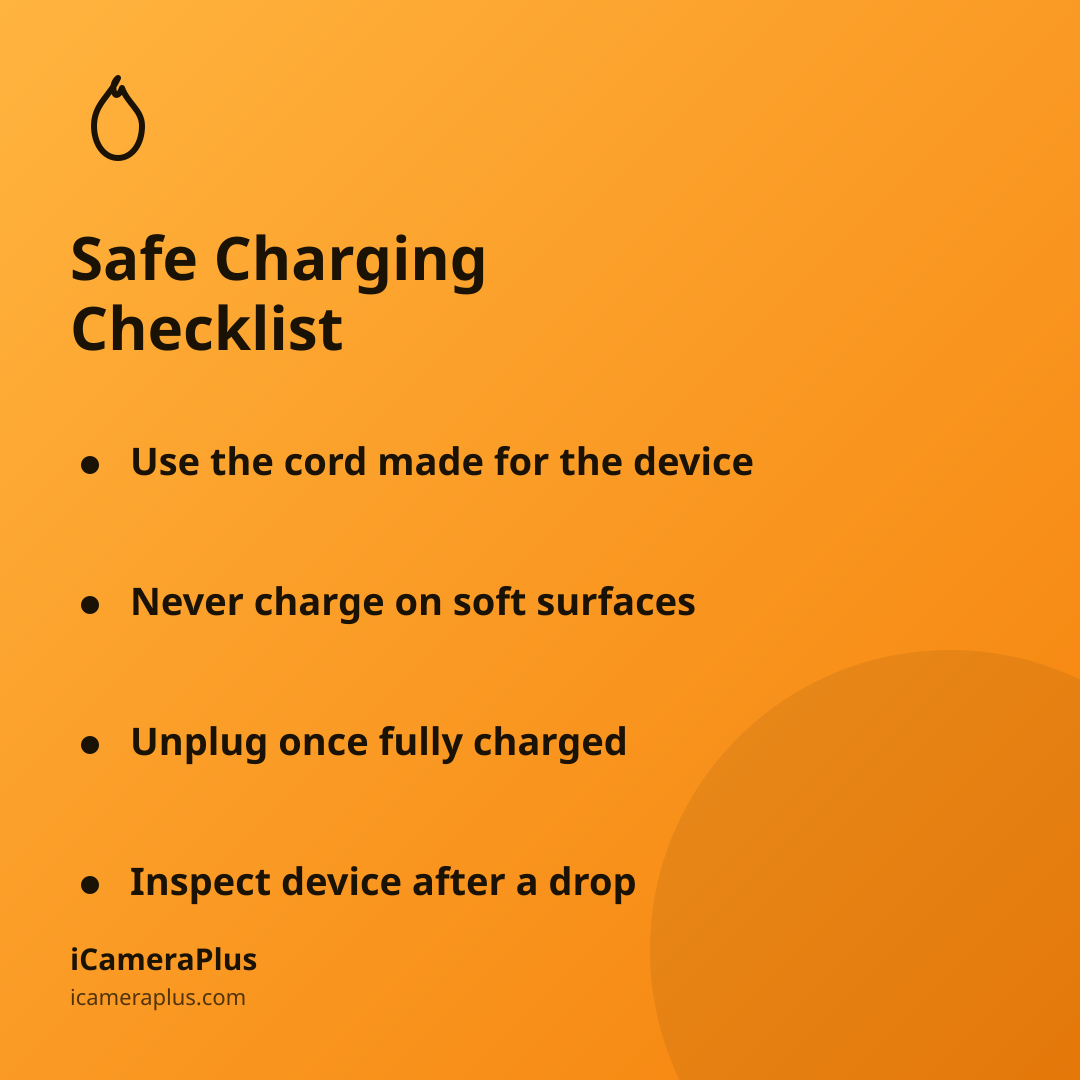
- Use the cord and charger made for the device. Off-brand or mismatched chargers can deliver the wrong voltage and damage the battery.
- Don't charge on soft surfaces. Charging under a pillow, on a bed, or on a couch traps heat and blocks airflow around the battery.
- Unplug once it's fully charged when the device isn't designed for continuous power, to avoid overcharging.
- Inspect after a drop. A cracked case or swollen battery is a sign to stop using the device and recycle it, not keep charging it.
If you're running a phone as a dedicated, always-on security camera, place it on a hard, ventilated surface — a shelf or mount, not a stack of fabric — and use the manufacturer's cable rather than whatever charger happens to be nearby.
Don't Let the Battery Story Overshadow the Smoke Alarm
Fire Prevention Week's battery focus is new, but its original purpose — working smoke alarms — hasn't gone away. In a national survey coordinated by CPSC with the Fire Protection Research Foundation and NIST, 99% of U.S. households reported having at least one smoke alarm, up from 88% in 1994. NFPA research shows a working smoke alarm cuts the risk of dying in a home fire by more than half. Yet the same CPSC survey found 61% of households test their alarms less often than the recommended monthly check, and a third never test them at all.
A security camera — including a repurposed phone watching your living room or hallway — can help you notice something is wrong sooner if you're away, but it isn't a substitute for a working, interconnected smoke alarm. Treat it as a second layer, not a replacement.
When a Battery Reaches the End of Its Life
NFPA's broader message for lithium-ion products is "buy safely, charge safely, recycle safely" — and that last part matters more than most people realize. The U.S. Environmental Protection Agency (EPA) warns that lithium-ion batteries should never go in household trash or curbside recycling bins, since damage during collection or transport can start fires. Instead, tape the terminals or bag the battery separately, then take it to a certified collection point — EPA points to programs like Call2Recycle or recyclers certified under the R2 or e-Stewards standards.
That's also a good moment to think about the phone itself, not just its battery. A retired phone with a healthy battery doesn't have to become e-waste at all — turning it into a continuous security camera is one of the more practical ways to keep it in service, as long as you charge it the way CPSC recommends.
A Simple Checklist for Fire Prevention Week 2026
- Test every smoke alarm in your home and replace batteries or units as needed.
- Check that any always-on camera or device is on a hard surface with clear airflow, not tucked under fabric.
- Confirm you're using the original or a manufacturer-approved cable for each charging device.
- Inspect battery-powered cameras and doorbells for swelling, cracks, or heat, especially after a drop.
- Set aside any dead batteries or retired devices for certified recycling instead of the trash.
None of this requires new equipment. It's mostly about applying the same charging discipline to your security devices that fire officials are now asking everyone to apply to their phones and power banks — which, conveniently, is often the exact same device.
Sources
- NFPA: 2026 Fire Prevention Week Theme Announced
- FireRescue1: NFPA Announces Fire Prevention Week 2026 Theme: Safe Charging
- NFPA: 2025 Fire Prevention Week Theme (Lithium-Ion Batteries in Your Home)
- CPSC: Learn More About Lithium-Ion Battery Fires and How to Keep Your Family Safe
- CPSC: Wyze Labs Recalls Solar Cam Pan Security Cameras (2026)
- Federal Register: CPSC Proposed Safety Standard for Lithium-Ion Batteries in Micromobility Products (June 2026)
- NFPA: Smoke Alarms in US Home Fires
- EPA: Lithium-Ion Battery Recycling