Google Just Turned 2,000 Old Pixels Into a Data Center — What That Means for the Phone in Your Drawer
This fall, a university computer lab in San Diego will boot up a data center unlike almost any other in the world. Instead of racks of purpose-built servers, it will run on roughly 2,000 retired Google Pixel phones — stripped down to their motherboards, networked together, and put to work grading code for computer science students. It's a strange-sounding project, but it's also a pointed answer to a question a lot of us avoid: what should actually happen to a phone once you're done with it?
What Google and UC San Diego Actually Built
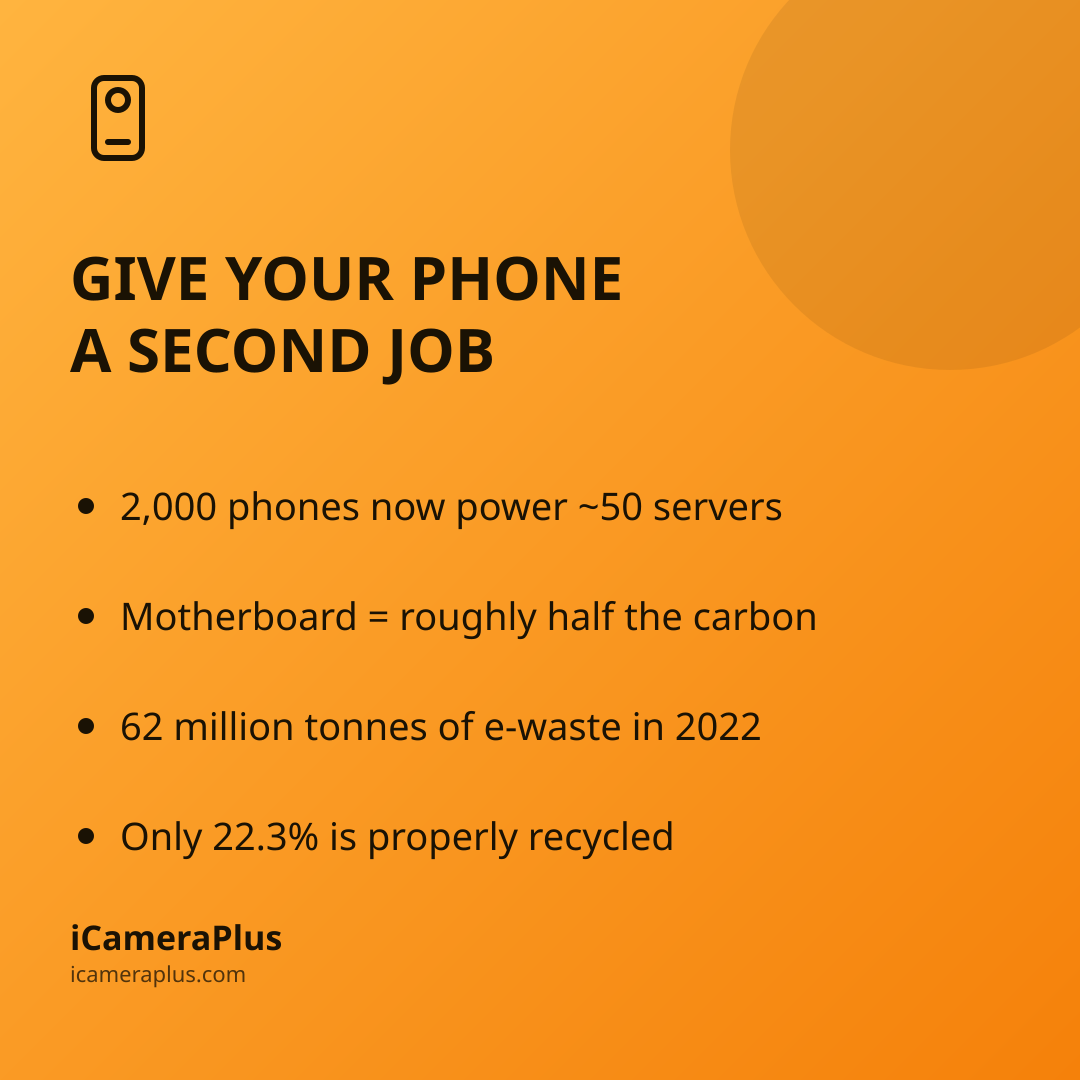
The project, detailed in a Google Research blog post published June 12, 2026, pairs Google researchers — including Google Fellow David Patterson and postdoctoral researcher Jennifer Switzer, a UC San Diego PhD graduate — with UC San Diego professors Ryan Kastner and Patrick Pannuto. The idea is called "phone cluster computing": take retired Pixel phones, remove the battery, display, and camera, and keep only the motherboard. Groups of 20 to 50 of those boards are networked into a cluster that performs roughly like one conventional server. The full 2,000-phone system is expected to deliver the equivalent of about 50 servers, and the team's early pilot — a 20-phone cluster — already handled peak submission rates for a class of 75-plus students with grading latency below a default cloud-computing baseline.
Why phones instead of new hardware? According to the researchers, a phone's motherboard accounts for roughly half of its total embodied carbon — the emissions baked in during manufacturing, before the device is ever switched on. Reusing that board, rather than mining and fabricating a new server chip, avoids re-triggering that cost. It also turns out modern phone processors are simply good at this: in the team's benchmarking, the Pixel's performance cores beat the per-core performance of the baseline data center server on most tests, since phone chips have spent a decade being optimized for efficiency under real-world battery constraints.
The E-Waste Problem This Is Actually Trying to Solve
The Pixel project is a research curiosity, but the problem behind it is not small. The Global E-waste Monitor 2024, published by the International Telecommunication Union and the UN Institute for Training and Research (UNITAR), found the world generated a record 62 million tonnes of electronic waste in 2022 — up 82% from 2010 — and is on pace to hit 82 million tonnes by 2030. Only 22.3% of that e-waste was documented as properly collected and recycled, meaning the world is generating e-waste roughly five times faster than it's managing to recycle it, per the same report.
Phones are a meaningful slice of that pile, and most of what's discarded doesn't get formally processed at all — it sits in a landfill, or in a drawer. That second option matters more than it sounds: a phone doing nothing in a drawer isn't polluting, but it also isn't recovering any of the value locked inside it. The U.S. Environmental Protection Agency, citing a 2006 U.S. Geological Survey estimate, notes that every million recycled cell phones can yield about 35,000 pounds of copper, 772 pounds of silver, 75 pounds of gold, and 33 pounds of palladium — materials that otherwise have to be freshly mined.
You Don't Need a Data Center — You Need a Better Second Life
Almost nobody reading this is going to strip a phone down to its motherboard and wire it into a computing cluster. But the underlying logic of the UC San Diego project scales down just fine: the most sustainable version of a device is usually the one you already own, doing a new job, rather than a new device built from scratch. Google's own researchers frame the motivation in exactly those terms — the average phone is replaced roughly every four years, long before its hardware is actually worn out.
For a household, the most practical version of "give the old phone a second job" isn't computing — it's watching the place you live. A retired phone already has everything a dedicated security camera has: a camera, a network connection, and enough processing power to detect motion and stream video. What it's usually missing is software that keeps it recording reliably, stores footage somewhere other than the device itself, and lets you check in remotely. That's the specific gap iCameraPlus is built to close — it turns a phone you already own into a continuously recording camera for your own property, with an off-device archive and remote live view, without requiring new hardware or adding another gadget to the eventual e-waste pile.
Putting an Old Phone to Work
If you've got a phone sitting unused, here's a realistic way to think about repurposing it:
- Check what you actually have. Most phones from the last six to seven years still have a functional camera, Wi-Fi, and enough battery life (or an outlet nearby) to run continuously.
- Pick a job it's actually good at. A stationary phone plugged into power near a door, driveway, or living room is a strong fit for a home security camera that watches your own property — it's the same hardware logic Google's researchers are betting on, just applied at the scale of one household instead of 2,000 phones.
- Make sure footage lives somewhere safe. A camera that only stores video on the device itself loses everything if that device is stolen, damaged, or simply runs out of storage — which is why an off-device archive matters as much as the camera itself.
- Don't let "eventually" become "never." The UC San Diego project only works because someone committed to actually building it. The same is true at home — a phone that "could" become a camera someday is functionally identical to a phone that's just e-waste in progress.
If You Do Decide to Recycle Instead
Not every old phone is a good camera candidate — a cracked screen or dead battery can still make a device worth recycling rather than repurposing. If that's the route, look for a certified electronics recycler (e-Stewards or R2-certified programs are widely recognized) rather than the regular trash, so the materials the EPA and USGS describe actually get recovered instead of landfilled. Either path — a second life as a camera, or responsible recycling — beats the default of an old phone sitting untouched in a drawer, which is where 39% of retired phones, tablets, and smartwatches end up in the US, according to a 2026 survey of 4,000 consumers by researchers at the Rochester Institute of Technology and the University of Waterloo.
The Real Takeaway
Google and UC San Diego didn't build a phone-powered data center because it's the cheapest way to buy compute — new servers are still easier to acquire in bulk. They built it to prove a point about embodied carbon and hardware reuse, and to give students affordable, low-carbon computing in the process. The lesson scales down cleanly: the phone in your drawer isn't waiting for a data center project. It's waiting for you to decide it's still useful.
Sources
- Google Research: "A low-carbon computing platform from your retired phones" (June 12, 2026)
- UNITAR: Global E-waste Monitor 2024 press release
- ITU: The Global E-waste Monitor 2024
- U.S. EPA: Electronics Donation and Recycling (citing 2006 USGS material recovery estimates)
- The Conversation: "The drawer problem: Why so many of us can't let go of our old electronics" (Williams, Saeedi & Watson, 2026)