Hurricane Season 2026: How to Protect Your Home — and Document It — Before You Evacuate
Hurricane season runs from June through November, and by late July, coastal and inland communities alike are watching the tropics. Whether or not a storm ever reaches your zip code this year, the weeks before landfall are the best time to do two things most people put off: prepare your home to be left empty, and document what's inside it. Here's what the current data says, and a realistic checklist for getting ready.
What NOAA's 2026 outlook actually means for your home
On May 21, 2026, the National Oceanic and Atmospheric Administration (NOAA) issued its seasonal outlook, predicting a below-normal Atlantic hurricane season: 8 to 14 named storms, of which 3 to 6 are forecast to become hurricanes, including 1 to 3 major hurricanes (Category 3 or higher). NOAA puts the odds at 55% for a below-normal season, 35% for near-normal, and just 10% for an above-normal one, and the agency plans to issue an updated outlook in early August, ahead of the historical peak of the season in mid-September through October.
"Below-normal" is a statistical forecast for the basin as a whole, not a guarantee for any single home. It only takes one storm making landfall near you to matter. NOAA's National Hurricane Center still recommends every coastal and near-coastal household have a plan in place regardless of how quiet the season is projected to be.
The insurance step most homeowners and renters skip
According to the Insurance Information Institute (III), a home inventory is one of the most important — and most frequently skipped — parts of storm preparation, because it's what determines whether you're fully reimbursed for what you lose. The III recommends a visual walkthrough: film or photograph every room, narrating or noting the make, model, and approximate value of higher-cost items, and storing a copy somewhere other than the house itself — with a friend, in a safe-deposit box, or online — so it survives even if your home doesn't.
This is one of the places a spare phone earns its keep. If you already have an old phone mounted as a home security camera, you likely have weeks of continuous footage of your rooms already recorded and stored off-device — a running visual record of your belongings that updates itself, instead of a one-time walkthrough you have to remember to redo every year. Apps like iCameraPlus are built around exactly this: continuous recording with an off-device archive, so the footage isn't lost if the phone itself is damaged, loses power, or is left behind in a fast evacuation.
What actually happens to empty homes after a storm
Evacuation orders are issued to protect people, not property, and property crime is a documented risk in the aftermath. After Hurricane Katrina, researchers comparing burglary reports the month before and the month after the 2005 flooding found sharply elevated burglary activity across Louisiana before levels returned to normal. During Hurricane Ida in 2021, the New Orleans Police Department received 235 business burglary reports and 180 home burglary reports in the week following the storm, and the Orleans Parish Sheriff's Office logged 118 looting incidents between August 29 and September 3, resulting in 72 arrests. A separate academic analysis of Hurricanes Irma and Maria found a 4% increase in reported burglaries across the U.S. Virgin Islands in the four months after landfall, before declining in the months that followed.
The takeaway isn't to panic — most evacuated homes are never touched. It's that an empty house, especially one with visible storm damage, is a slightly softer target for the weeks immediately after a storm, which is exactly when many residents are still displaced and unable to check on it in person.
Before you evacuate: a practical checklist
Ready.gov, FEMA's public preparedness site, recommends building your plan around a few core steps well before a storm is bearing down:
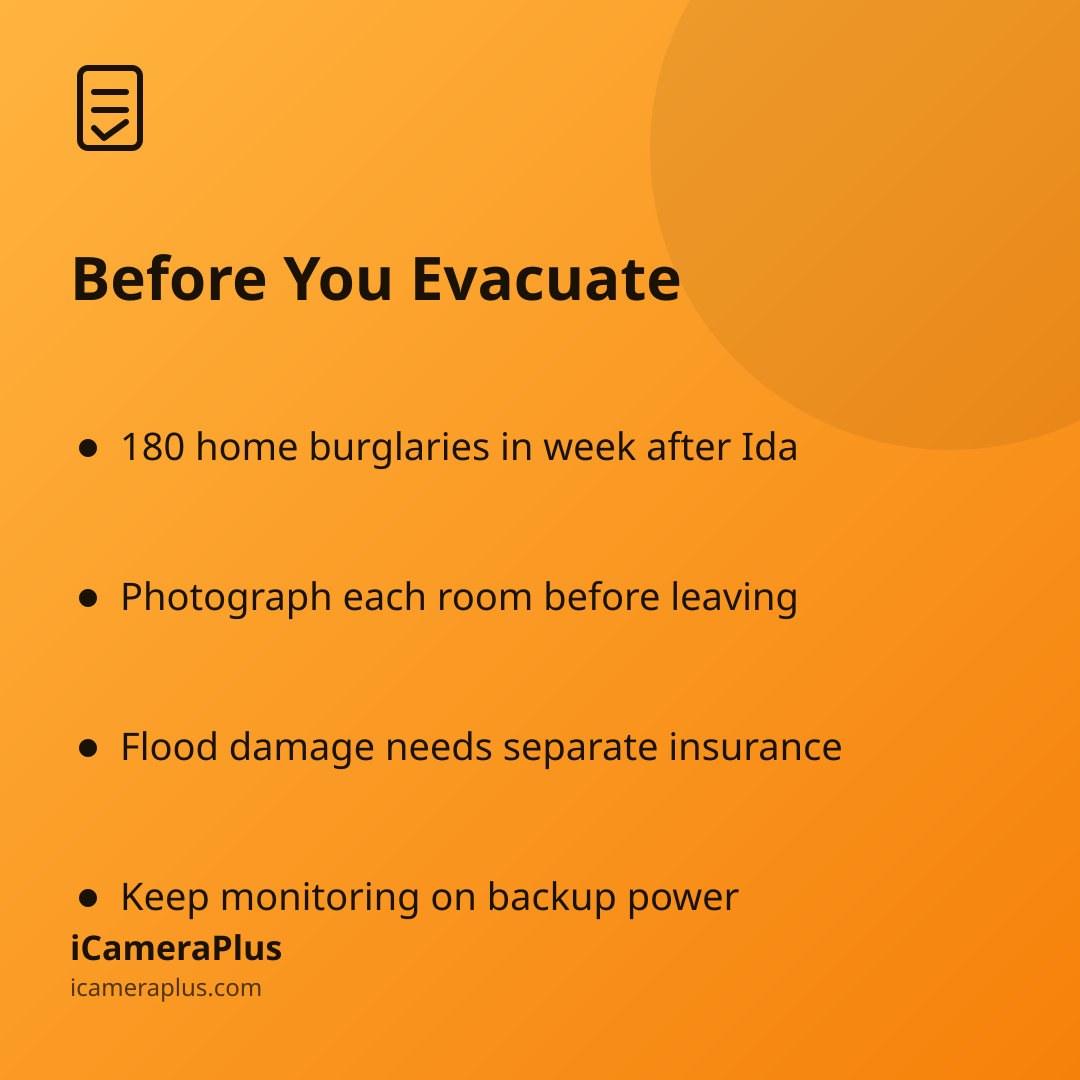
- Know your evacuation zone and route. Sign up for local emergency alerts and confirm your zone with your county or parish emergency management office — zones and routes can change year to year.
- Check your insurance coverage now. Standard homeowners and renters policies typically don't cover flood damage; that requires separate flood insurance, and there's usually a waiting period before a new policy takes effect.
- Document your home before you go. Photograph or film each room and any pre-existing damage, and store the record somewhere other than the house.
- Secure the outside. Bring in or tie down loose furniture, trim dead branches, and move vehicles under cover if you're not using them to evacuate.
- Build a go-kit. Water, medications, chargers, copies of important documents, and a battery-powered or hand-crank radio, since cell networks and power are often the first things to go down.
- Keep monitoring running on backup power if you can. A camera on battery or a small power bank can keep recording — and, connectivity permitting, keep sending alerts — even after the grid goes out.
Can you actually keep an eye on your home during a storm?
Be realistic about this one: during an active hurricane, cell towers and home internet routinely go down, and no camera — dedicated hardware or a repurposed phone — can send you a live alert over a network that isn't there. What a continuously recording setup does give you is a record that's waiting once connectivity returns, rather than a gap. If you're using an old phone as a security camera and it stores footage to an off-device archive, that history survives even if the phone loses signal, loses power, or is damaged by the storm itself — a scenario a one-time photo inventory can't handle nearly as well.
After the storm
Ready.gov advises returning home only when local officials say it's safe, watching for downed lines and standing water, and documenting any new damage with photos before touching or moving anything, since insurers rely on that documentation to process claims. If your camera kept recording through the event, that footage can be a useful supplement to your inventory and claim — timestamped evidence of what was there before, and what changed.
None of this requires new equipment. A spare phone, a shared cloud folder, and twenty minutes before the season's next name gets attached to a storm will put most households ahead of where they were last year.
Sources
- NOAA — "NOAA predicts below-normal 2026 Atlantic hurricane season" (May 21, 2026)
- Insurance Information Institute — "Making a Home Inventory"
- NOLA.com — "Looting reports spike in the city after Hurricane Ida, 911 call data shows" (2021), citing New Orleans Police Department and Orleans Parish Sheriff's Office data
- National Institutes of Health / PMC — "Conflict or consensus? Re-examining crime and disaster," citing Frailing & Harper (2016) analysis of post-Katrina burglary rates
- Ready.gov (FEMA) — "Hurricanes: Prepare, Stay Safe, Recover"