Is Halloween Dangerous for Pets? What 2025 ASPCA Poison Control Data Shows
This article was produced with AI assistance. Sources are listed at the end.
Yes — Halloween is genuinely riskier for pets than an average night, for two specific reasons: toxic candy and a front door that opens over and over. The ASPCA's Animal Poison Control Center logged more than 376,000 toxic exposure cases in 2025, and chocolate was the fourth most common toxin on the list. Separately, the American Veterinary Medical Association warns that the constant stream of trick-or-treaters is one of the most common ways pets slip out of the house unnoticed.
How risky is Halloween for pets, really?
The ASPCA's Top 10 Toxins of 2025 report shows its Poison Control Center fielded calls on over 376,000 exposure cases that year, helping more than 334,000 animals — a 3.7% increase over the previous year. Chocolate made up 13.6% of those exposures, landing at No. 4 on the list, with dogs far more likely than cats to eat enough to cause a problem.
Veterinary toxicologists have been tracking this pattern for years. Dr. Tina Wismer, medical director of the ASPCA's Animal Poison Control Center, has told reporters: "We always talk about Halloween as being the start of chocolate season." That's not a seasonal exaggeration — it's a direct reflection of what shows up in the center's call logs every fall.
Why do so many pets go missing on Halloween?
Chocolate isn't the only hazard. The AVMA's official Halloween pet safety guidance flags the repeated opening and closing of the front door during trick-or-treating as a leading escape risk, and recommends that every pet wear a collar, ID tag, and microchip in case they bolt. The group also advises keeping anxious pets in a separate room, away from the door, for the hours when strangers keep ringing the bell.
That mechanism — loud, unfamiliar activity plus an open door — is the same one behind pet escapes on other noisy holidays. The ASPCA has reported that nearly one in five lost pets went missing after being frightened by fireworks or other loud noises; it's a July 4th statistic, not a Halloween-specific one, but it illustrates why vets treat costumed crowds and a revolving front door as a real risk, not just a nuisance.
Halloween pairs an open front door with a bowl of toxic candy — the two things pets fear and crave most.
What should you actually do to keep your pet safe tonight?
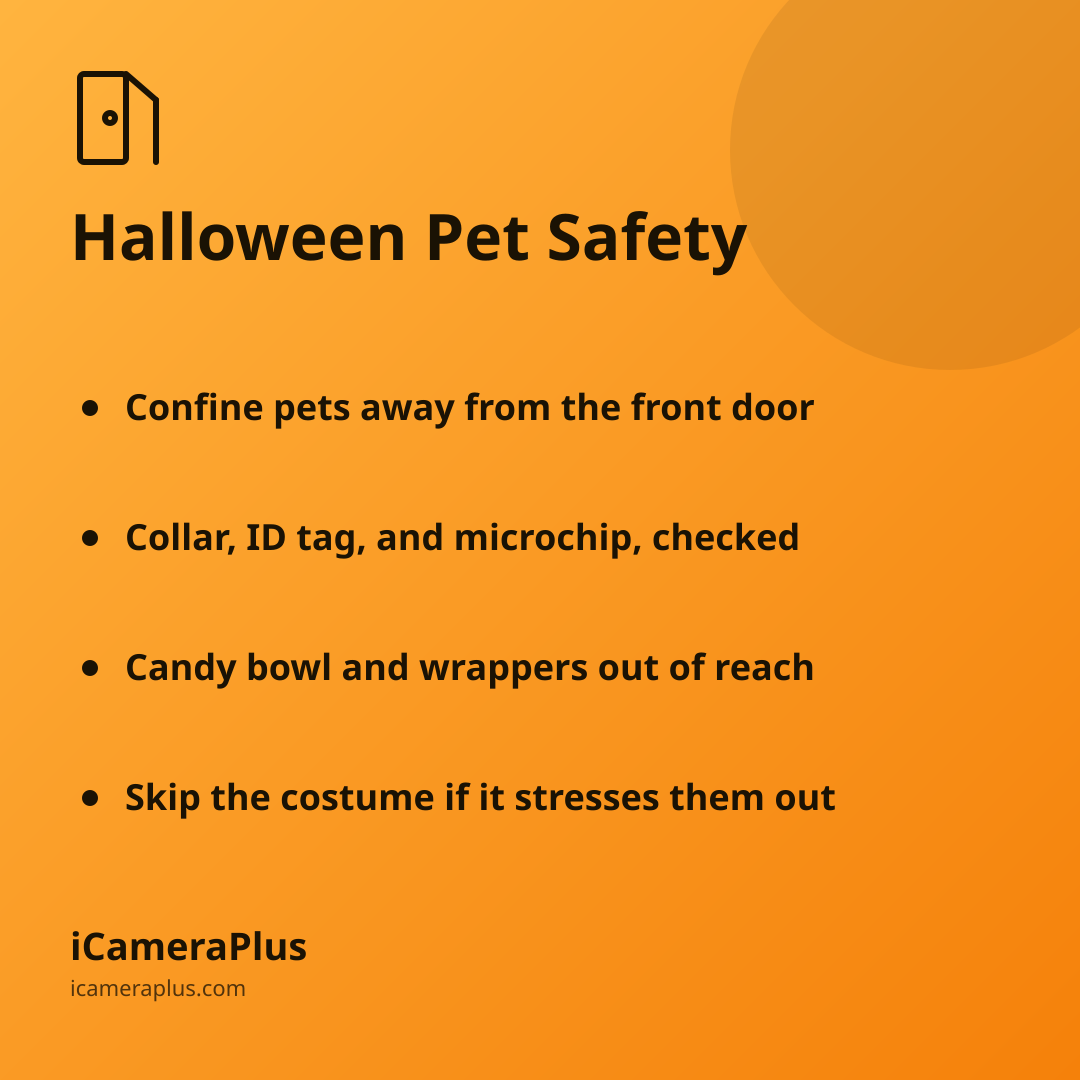
- Confine pets away from the front door
- Collar, ID tag, and microchip, double-checked
- Candy bowl and wrappers out of reach
- Skip the costume if it stresses them out
Beyond that checklist, the AVMA's guidance is specific: if you do dress up a pet, the costume should never restrict their breathing, sight, hearing, or movement, and a costumed pet should never be left unsupervised. Jack-o'-lanterns with lit candles, glow sticks, and dangling decorations are also worth moving out of paw's reach — the AVMA notes chewed glow sticks release a liquid that tastes bad enough to make most pets spit it out, but it's still an unpleasant surprise.
Can you keep an eye on your pet during the chaos without buying new gear?
You're already busy answering the door, so a live check-in matters more on Halloween than most nights. If you have an old phone sitting in a drawer, apps like iCameraPlus can turn it into a dedicated pet camera: it records continuously with audio and video, and you can pull up a live view from a web panel between doorbell rings to see whether your dog is pacing by the door or your cat found the candy bowl. Everything is archived to a private cloud you browse yourself, and you can start or stop recording remotely without walking back to the device.
If you're recording audio as well as video near your front door this time of year, it's worth knowing your state's rules — our audio recording law guide covers what's generally allowed. And if a pet sitter, co-host, or roommate will also be home for trick-or-treating, our guide on disclosing cameras to a pet sitter walks through what's expected. For more on pointing an old phone at your pet generally, see our pet camera page.
Quick answers
My dog ate a little Halloween candy — is that an emergency? Don't wait to see if symptoms appear. Contact your veterinarian or the ASPCA Animal Poison Control Center right away and let a professional assess the amount and type of candy involved.
Should I just lock my pet in another room during trick-or-treating? The AVMA specifically recommends a quiet room away from the front door for pets that are anxious around strangers or noise — it's one of their core Halloween guidelines, not an overreaction.
Do I need a special pet camera, or will my old phone work? A phone you already own can work just as well as a dedicated pet camera for an evening of checking in — you just need continuous recording and a way to view it live, which is exactly what a setup like iCameraPlus provides.