Is It Legal to Record Audio on Your Home Security Camera? 2026 State Guide
This article was produced with AI assistance. Sources are listed at the end.
Federal law lets you record audio with one person's consent — usually your own, since you're a party to anything your camera picks up on your own property. But 11 states require consent from everyone whose voice gets captured in any conversation, and two more apply that same rule to phone calls specifically. If you live in one of those states, or your camera's microphone reaches past your property line, the audio track on your "security" footage can create legal exposure that the video alone never would.
What does the law actually require?
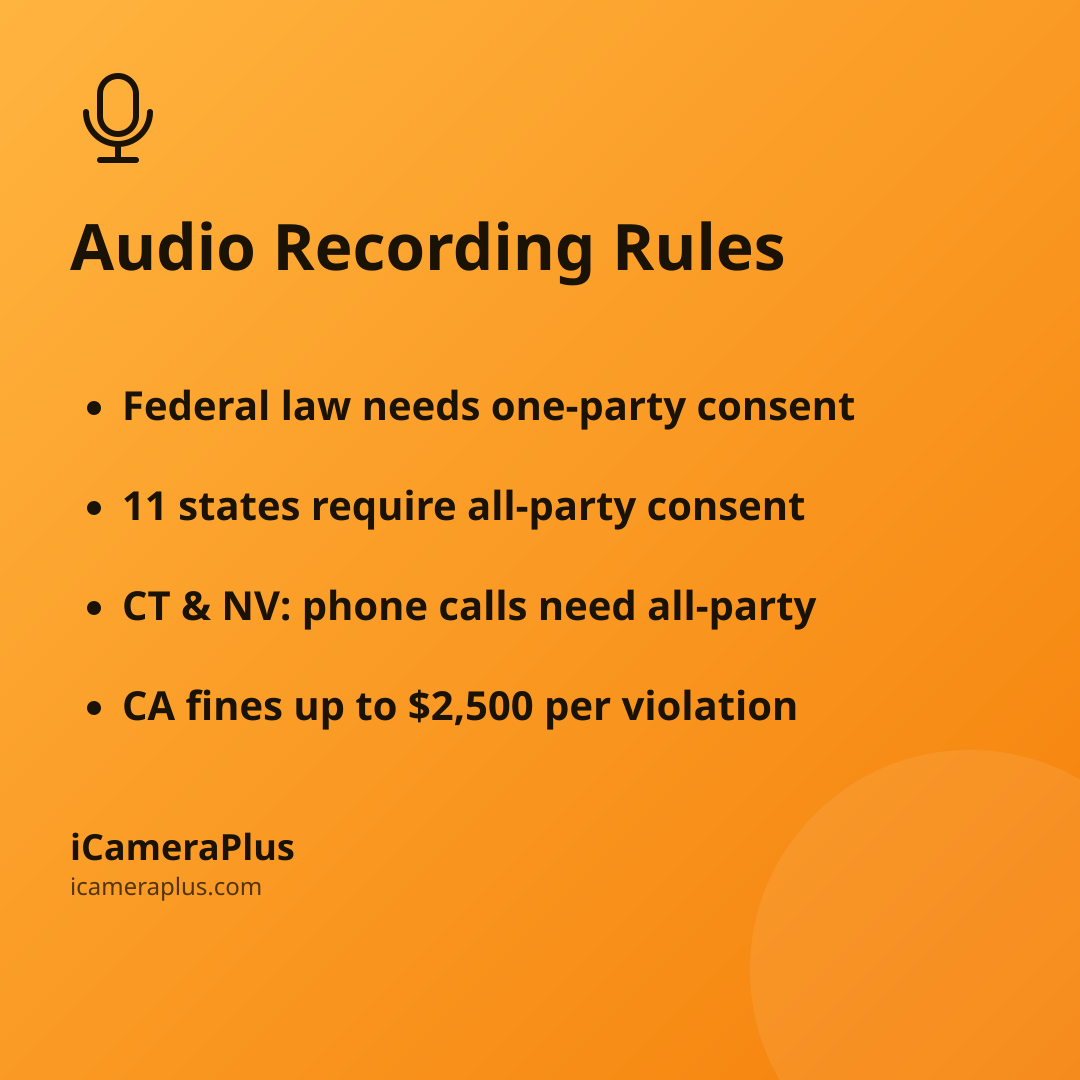
The federal Wiretap Act, 18 U.S.C. § 2511, sets a one-party consent floor: if you're a participant in a conversation, or you have the consent of at least one participant, you can record it without telling anyone else. That's the default in most of the country. But state law can — and often does — set a stricter bar.
According to the Reporters Committee for Freedom of the Press's introduction to its state-by-state recording law guide, 11 states require all-party consent for recording both phone calls and in-person conversations: California, Delaware, Florida, Illinois, Maryland, Massachusetts, Michigan, Montana, New Hampshire, Pennsylvania, and Washington. Two more states, Connecticut and Nevada, apply that same all-party rule specifically to phone calls, while still allowing one-party consent for in-person conversations. In the 11 comprehensive all-party states, a microphone that picks up a confidential conversation — even one happening near a shared sidewalk or porch — can require consent from every voice on the recording, not just yours.
Why does a doorbell camera's microphone complicate this?
Most video doorbells and outdoor cameras record audio by default, and homeowners often don't realize the microphone's range extends well past their own doorstep. A March 2026 analysis in the University of Richmond Journal of Law & Technology traces how a 2019 New Hampshire case over Ring-doorbell audio of an altercation forced a court to weigh the state's all-party consent rule against video evidence that was otherwise legal to capture. The court ultimately allowed the audio as evidence, reasoning that a loud exchange audible to neighbors wasn't a protected "oral communication" in the first place.
The practical problem is that a camera doesn't know whether a conversation it overhears counts as "confidential" under state law. Under California's statute, as interpreted by the state supreme court in Flanagan v. Flanagan (2002), a conversation is "confidential" only if a party has an objectively reasonable expectation it won't be overheard or recorded — a quiet exchange on a porch can qualify, but a loud argument neighbors can plainly hear typically will not. California Penal Code § 632 makes it a crime, punishable by a fine of up to $2,500 per violation, to record a genuinely confidential conversation without everyone's consent, and California Penal Code § 637.2 lets anyone whose conversation was recorded without consent sue for $5,000 per violation or triple actual damages, whichever is greater.
Does this apply to a camera made from an old phone, not just a name-brand doorbell?
Yes — the law cares about what was recorded and where, not which brand made the device. A phone repurposed as a security camera with iCameraPlus records audio and video the same way a dedicated camera does, and the same state consent rules apply whether the hardware was bought new or was already sitting in a drawer. The advantage of an owner-controlled setup like this is that you decide where the camera points and what it covers, which is the single biggest factor in staying on the right side of these laws.
What should you actually do about it?
- Check your state's consent rule
- Aim mics at your own property
- Treat loud outdoor talk as still private
- When in doubt, skip audio
Pointing a camera's field of view — and its microphone's range — inward toward your own entry, porch, or yard rather than outward toward a shared walkway, neighboring unit, or public sidewalk is the simplest way to reduce exposure. This matters most for shared entryways, duplexes, and apartment hallways, where a camera aimed at "security" can end up recording a neighbor's private conversation by accident. Being transparent about where your camera points and keeping it focused on space you control is both the legally safer choice and the one that keeps monitoring squarely about your own property.
Eleven states require everyone's consent before you can legally record their voice — even on your own porch.
How does this interact with nanny cams and baby monitors specifically?
Using a phone as a nanny cam or baby monitor raises the same audio question, just indoors. Video-only recording of common areas in your own home is legal in all 50 states, but once audio is involved, the same one-party versus all-party split applies to whoever else is in the room — a caregiver, a visiting relative, or an older child. Some states also layer separate disclosure rules on top of consent law specifically for household employees, so if you employ a caregiver, it's worth checking your state's domestic-worker protections in addition to its general recording-consent rule.
Quick answers
Can I turn off audio and just record video? Yes. Video-only recording of your own property is legal in all 50 states without consent from anyone who walks into frame, which is why many owners simply mute audio in all-party consent states.
Does it matter if the person didn't know the camera was there? Generally no — most of these laws focus on whether the conversation was confidential and whether consent was given, not on whether the recording device was visible. A camera in plain view can still violate an all-party consent law if it captures a private conversation without everyone's agreement.
What about a camera that only records when something happens nearby? The same consent rules apply regardless of whether a camera records continuously or is triggered by activity — it's the content of what's captured that matters under these statutes, not the recording pattern.
Sources
- 18 U.S.C. § 2511 — Interception and disclosure of wire, oral, or electronic communications prohibited (Cornell Legal Information Institute)
- Reporters Committee for Freedom of the Press — Introduction to the Reporter's Recording Guide
- California Penal Code § 632 — Eavesdropping (California Legislative Information)
- California Penal Code § 637.2 — Civil damages for unlawful recording (California Legislative Information)
- Flanagan v. Flanagan, 27 Cal. 4th 766 (2002) — Supreme Court of California, via Stanford SCOCAL
- University of Richmond Journal of Law & Technology, "Smart Doorbells and the Legality of the Audio Recording Feature," March 2026