New iPhone Season Is Coming: What a Record $6.4 Billion Trade-In Report Means for Your Old Phone
Every September, the same ritual plays out in millions of households: a new iPhone arrives, and last year's model gets shoved in a drawer "just in case." Apple is expected to hold its next iPhone launch event in September 2026, which means the annual wave of device upgrades — and the pile of retired phones that comes with it — is about to start again.
This year, the decision about what to do with that old phone comes with real numbers attached. A new industry report shows the trade-in market just had its biggest year ever, while separate research shows the average time people keep a phone before replacing it is on track to hit a new high in 2026. Both facts change the math on whether to trade a phone in for cash or put it back to work at home.
The Trade-In Market Just Hit a Record
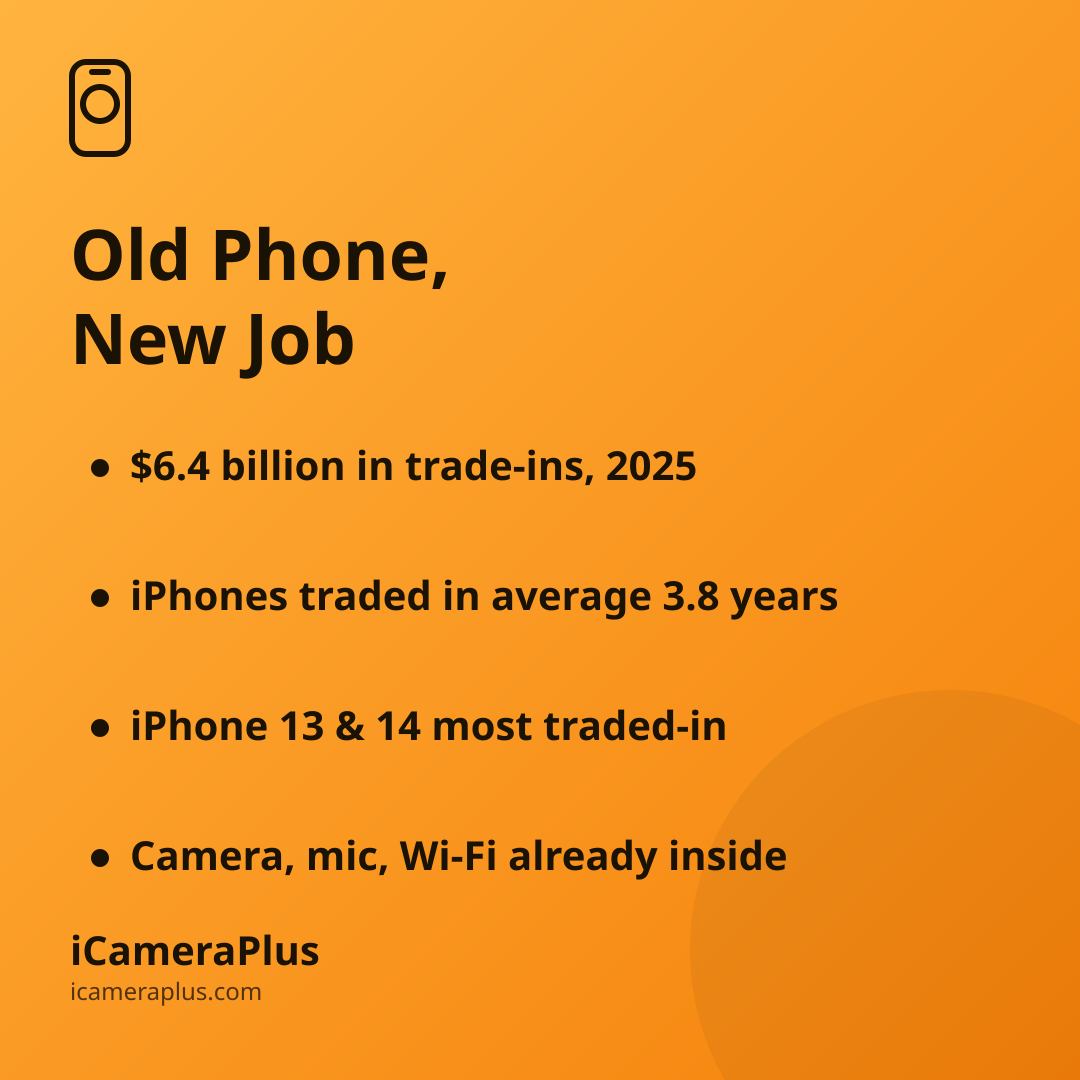
According to Assurant's 2025 Mobile Trade-In and Upgrade Trends report, released in March 2026, U.S. consumers received a record $6.4 billion in value through mobile trade-in and upgrade programs in 2025 — a 42% jump over 2024 and the highest annual total since Assurant began tracking the data in 2015. The fourth quarter of 2025 alone accounted for $2.2 billion, the strongest quarter on record, driven by the usual rush of trade-ins around new phone launches.
The most commonly traded-in devices were the iPhone 13 and iPhone 14, according to the report, with the Samsung Galaxy S22 Ultra 5G the most frequently turned-in Android model. Assurant also reports that since 2009 its trade-in and recycling programs have diverted more than 39,600 metric tons of e-waste and avoided an estimated 10.3 million metric tons of CO₂ emissions — a reminder that whatever you do with an old phone, tossing it in the trash is the one option that has a real environmental cost.
Phones Are Also Getting Older Before They're Replaced
Here's the twist: the same Assurant report found that traded-in iPhones averaged 3.8 years old in 2025, up from 3.67 years in 2024, while traded-in Android devices averaged just under 4 years old. People aren't upgrading more often — they're upgrading less often, and getting more value when they finally do.
That lines up with independent research from Counterpoint Research, cited by TechCrunch in August 2026, which found the average global smartphone replacement cycle was about 3.5 years in 2025 and is projected to stretch to roughly 4 years in 2026 — which would make it the longest average replacement cycle Counterpoint has tracked — as rising component costs and incremental year-over-year improvements give people fewer reasons to rush an upgrade.
The practical takeaway for anyone eyeing a new phone this fall: the device you're about to retire has likely been your daily driver for three-plus years, and it's almost certainly still fast enough, and has a good enough camera, to do real work around the house — starting with keeping an eye on your own property.
Trade-In Cash vs. Keeping the Phone Running
Trading in is the easiest option, and for a recent flagship phone in good condition, it can genuinely be worth doing — that's exactly what the Assurant data reflects. But it's worth being honest about a few things before you box it up:
- Trade-in values drop fast with age and condition. A phone that's 3-4 years old, has a cracked screen, or is a mid-range model often qualifies for only a small credit, sometimes just a token amount toward a new device.
- A retired phone still has every sensor a purpose-built security camera has. A camera, a microphone, night-capable optics, and a Wi-Fi radio — the same hardware a standalone security camera is built around — is already sitting in your drawer.
- Once it's traded in, it's gone. There's no undoing that decision if you later realize you could have used a second camera at the back door, in the garage, or watching a pet or a nursery.
The Practical Middle Ground: Put the Old Phone to Work
If the trade-in credit on your specific phone is small, or you simply want a second set of eyes on your home, the old phone doesn't have to go anywhere. An app like iCameraPlus turns a phone you already own into a dedicated home security camera — continuous recording, footage archived off the device (so it survives if the phone is ever damaged, lost, or stolen), remote live view from your current phone, and motion alerts. There's nothing to buy and nothing new to unbox; you're just giving hardware you already paid for a second job.
The same setup works just as well pointed at a driveway or front porch as it does watching a pet home alone or keeping a nursery or playroom in view — the point is that a phone with a good camera and a Wi-Fi connection is genuinely useful hardware, not e-waste, as long as something is doing the job of turning it into a monitoring device instead of a paperweight.
How to Decide
- Check the actual trade-in quote first. Get a real number from your carrier or Apple/Samsung's trade-in tool before deciding — don't assume it's worth more (or less) than it is.
- If the credit is meaningful and the phone is in good shape, trade it in. That's real money, and Assurant's own numbers show it's a bigger payout than it's ever been.
- If the credit is small, or you've been wanting a camera at the door, in the garage, or on a pet, keep it. Wipe it, then set it up as a dedicated camera rather than letting it sit in a drawer for another three years.
- Don't just let it sit. A phone doing nothing is the one outcome that wastes the hardware, the trade-in value, and the opportunity to put it to work.
Whichever way you go, the worst option is the default one: sliding last year's phone into a drawer "to deal with later." With trade-in values at a record high and old phones now capable enough to run a full-time camera, this is a genuinely good year to make a decision either way.
Sources
- Assurant, "2025 Mobile Trade-In and Upgrade Industry Trends Report" (March 2026)
- Resource Recycling, "Record $6.4B in trade-ins as older phones drive market" (March 2026)
- TechCrunch, "Should you still buy your next smartphone — or subscribe to it instead?" citing Counterpoint Research (August 2026)
- MacRumors, "Everything Apple Is Expected to Announce in September" (August 2026)