Moving Into a Rental This Season? The No-Drill Way to Secure Your New Place
If you're signing a lease this month, you have company. A national moving company, U-Haul, notes that 70% of all moves occur between Memorial Day and Labor Day, which makes late summer one of the busiest stretches of the year for moving trucks and cardboard boxes on curbs across the country (U-Haul). At the same time, renting itself keeps growing: the U.S. Census Bureau's Housing Vacancy Survey found that 35.0% of occupied U.S. housing units were renter-occupied in the second quarter of 2025, the highest share since late 2019 (U.S. Census Bureau, Housing Vacancy Survey, Q2 2025).
Put those two facts together and you get a predictable, unglamorous problem: a huge number of households are, right now, unpacking boxes in a home with no security system at all — because the one they had, if any, stayed behind with the old lease. This guide is about closing that gap without drilling a single hole or risking your deposit.
Why Move-In Season Is a Vulnerable Window
A new place comes with a stretch of time when almost nothing is locked down yet: you don't know your neighbors, you may not have met the landlord in person, boxes and expensive electronics sit visible through windows, and — unless you rekey it yourself — you often don't actually know how many old keys or fobs are still floating around from previous tenants.
Nationally, the Bureau of Justice Statistics' Criminal Victimization, 2024 report, based on the National Crime Victimization Survey, put the household burglary/trespassing rate at 12.0 victimizations per 1,000 households in 2024, a rate the report describes as not significantly different from 2023's 13.1 (Bureau of Justice Statistics, Criminal Victimization 2024). That figure isn't specific to renters or new movers — but it's a useful reminder that burglary is a real, ongoing background risk for any household, which is exactly why the "figure out security later" instinct is worth resisting during the first few weeks in a new place, when a home is least monitored and least familiar.
Read Your Lease Before You Touch a Drill
Before buying or mounting anything, check your lease's "alterations," "fixtures," or "modifications" clause. Most standard leases restrict drilling holes, running wiring, or making exterior changes to the unit — and violating that clause can mean charges out of your security deposit, or worse, a dispute at move-out. Landlords generally have far more say over anything permanent or exterior-facing than over what you do inside your own unit with a battery-powered or plug-in device.
The practical takeaway: favor security tools that use adhesive mounts, tension mounts, or simply sit on a shelf or windowsill, and skip anything that requires drilling into drywall, brick, or siding you don't own.
Skip the Wiring: Turn a Phone You Already Own Into a Camera
One of the most overlooked no-damage options is sitting in a drawer already: an old smartphone. Nearly any phone with a working camera and a power outlet nearby can act as a security camera — no drilling, no hub, and often no new hardware purchase at all.
This is the exact gap iCameraPlus is built to fill: it turns a phone you already own into a camera that records continuously, stores footage off-device so it can't simply be grabbed along with the phone, and lets you check in remotely and get motion alerts from anywhere. You can prop it on a bookshelf facing the entryway, tuck it on a windowsill overlooking the parking lot, or set it up in a hallway — then move it to a new spot in ten seconds when you rearrange furniture, which is more than can be said for a permanently mounted camera.
For guidance on picking good angles once you're set up, see our home security camera guide — it applies just as well to a repurposed phone as to a dedicated camera.
Building a No-Damage Security Layer
A repurposed phone covers the "see and record" layer, but a few other lease-friendly additions round things out without touching a drill:
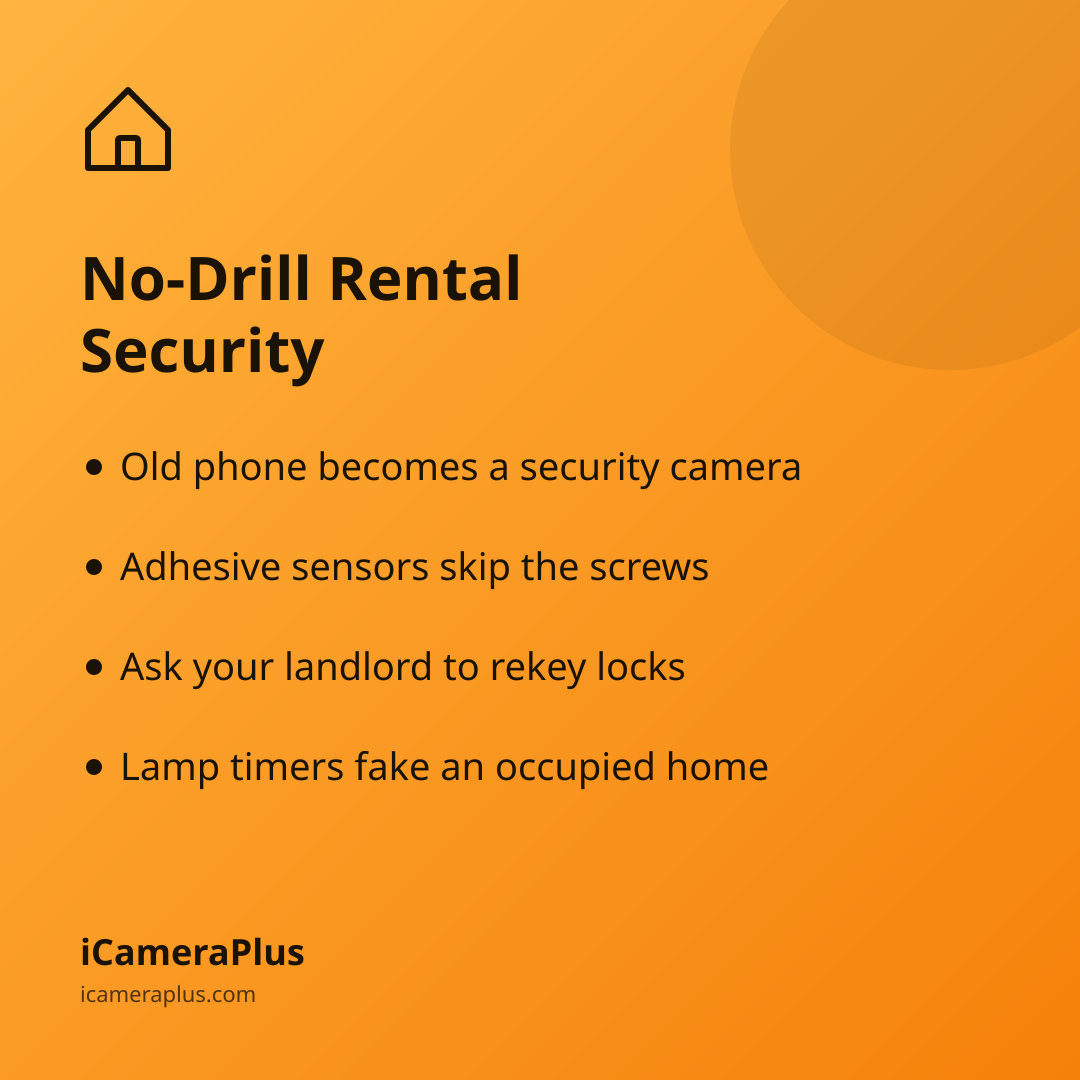
- Portable door alarms. Small battery-powered alarms that hook over a doorknob or sit against a door frame with pressure sensors — no installation required.
- Adhesive window and door sensors. Many contact sensors now mount with strong adhesive pads rated for indoor use, avoiding screws entirely.
- A rekey conversation with your landlord. You may not be able to swap the lock yourself, but you can usually ask the landlord or property manager to rekey between tenants — a reasonable, common request.
- Timers on lamps. A cheap, low-tech way to make an empty apartment look occupied during the first few weeks while you're still settling in and may be away more than usual.
None of these require permission from a landlord, and all of them come out of the unit as easily as they went in.
A Simple Move-In Security Checklist
- Walk the perimeter. Check that every window latch and door lock actually functions before you finish unpacking.
- Ask about rekeying. Confirm with the landlord whether the locks were changed since the last tenant, and request it if not.
- Set up a camera on day one, not week three. An old phone charging on a shelf, running as a camera, covers the exact window when your home is least settled.
- Note exits and hallways if you're in a multi-unit building — shared entrances and propped-open doors are common ways buildings lose their security, independent of what your own unit does.
- Introduce yourself to a neighbor. A neighbor who recognizes your face — and knows to notice a stranger at your door — is still one of the most effective, zero-cost security layers there is.
When the Lease Ends
The advantage of a phone-based setup is that moving out is as simple as unplugging it. If you eventually replace the phone you used as a camera, wipe it with a factory reset before recycling, trading in, or handing it down — footage and account access should never travel with a device to its next owner.
The best move-in security setup is the one you'll actually finish during a week when you're also unpacking dishes and hanging curtains. Favor tools you can set up in minutes and take with you when the lease is up.