New 2026 Data: Renter Security Camera Ownership Just Jumped 12 Points — Here's What's Really Driving It
If you rent your home, you're far more likely to own a security camera today than you were two years ago — and new industry data shows the shift happened faster than almost anyone expected.
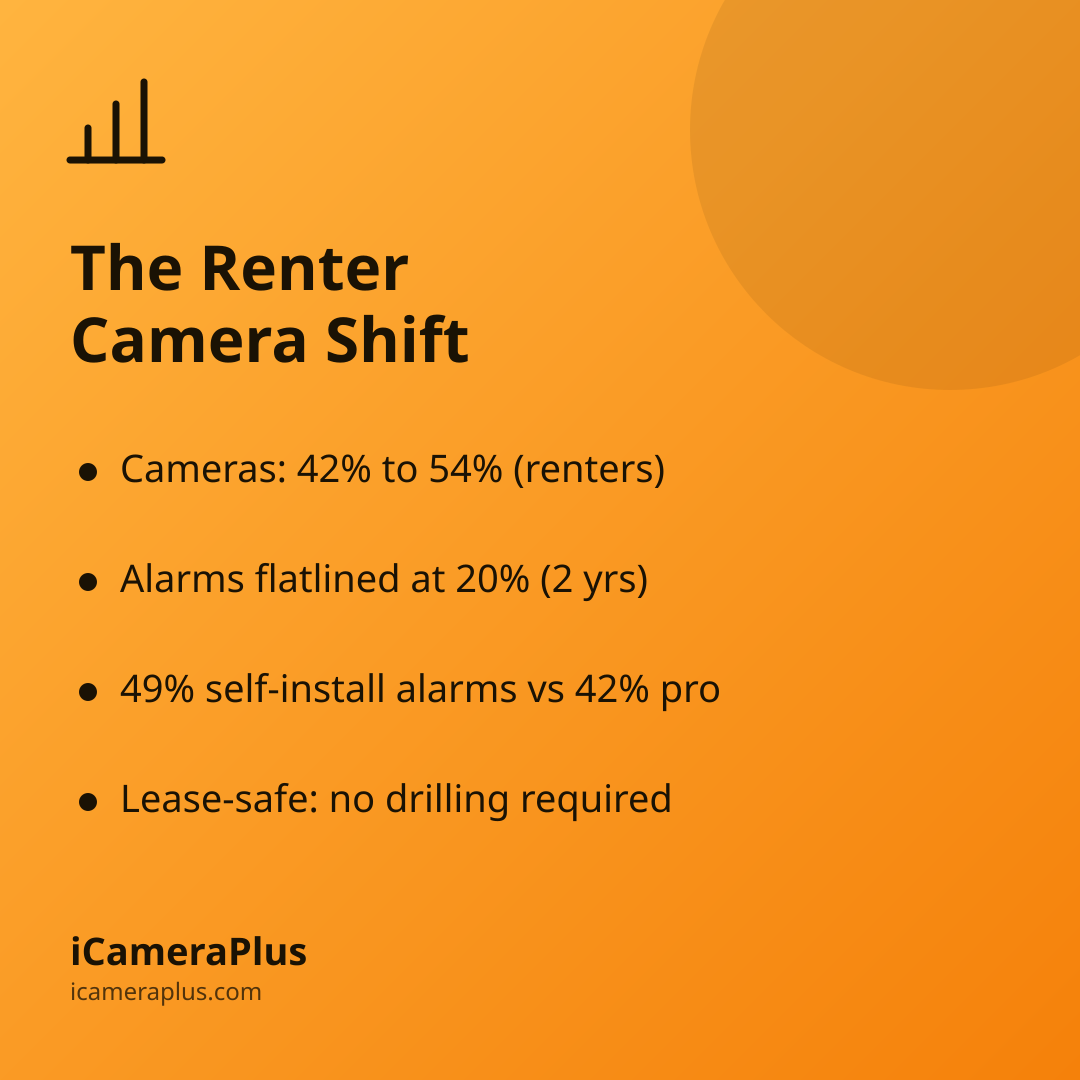
According to the 2026 Home Security Market Report from SafeHome.org, published April 2026, security camera adoption among renters jumped from 42% in 2024 to 54% in 2026 — a 12-percentage-point gain the report calls "the sharpest single-year gain in the dataset." Meanwhile, alarm system adoption among renters has "flatlined at 20 percent for two consecutive years." Renters are clearly choosing cameras. The question is why — and what that means if you're one of the millions of Americans renting your home right now.
A 12-Point Jump Nobody Predicted
Year-over-year jumps like this are rare in home security data, which tends to move a few points at a time. SafeHome.org's researchers attribute the spike to the mainstream availability of wireless, battery-powered cameras that renters can set up temporarily — without asking a landlord for permission or touching a drill.
That distinction matters more than it might seem. Traditional alarm systems and wired cameras were built with homeowners in mind: permanent sensors, wall-mounted panels, contracts tied to an address. Renters move more often, have less control over their unit, and are naturally drawn to security options that travel with them rather than staying behind with the walls.
Why Cameras Are Winning and Alarms Aren't
The same SafeHome.org research points to a broader shift in how Americans set up home security generally. For the first time, more people installing alarm systems are doing it themselves rather than hiring a professional: 49% self-installed their current alarm system, compared with 42% who used a professional installer. That DIY preference skews younger — 54% of people ages 18–29 self-installed, versus 38% of those 60 and older.
Cameras fit this DIY, renter-friendly moment better than alarms do for a simple reason: a camera can be a single self-contained device you plug in and connect to an app, while a full alarm system typically still involves door and window sensors, a base station, and sometimes a monitoring contract. For someone who might move again in a year, that's a lot of infrastructure to install — and to leave behind.
The Real Obstacle Isn't Cost — It's Your Lease
If cameras are so much easier to adopt, why isn't renter adoption at 100%? The remaining barrier isn't usually the price of the device. It's what your lease actually allows you to do to the unit itself.
Most residential leases treat any physical modification — drilling a hole for a mount, running a cable through a wall, screwing a bracket into siding — as an "alteration" that requires the landlord's written consent, according to legal guidance from LegalClarity's overview of tenant camera rights. Landlords generally can't stop you from having a camera inside your own apartment, but if your setup damages the walls or trim, that cost can come straight out of your security deposit. Freestanding cameras placed on a shelf, windowsill, or tripod avoid that risk entirely because they don't alter the unit at all.
That's exactly the calculation renters are making when they choose a battery-powered or plug-in camera over a wired system: it's not about which is "better" in a vacuum, it's about which one doesn't put a deposit at risk.
The Renter Population Behind the Numbers
This trend affects a genuinely large share of American households. Renter-occupied housing has been climbing for over a decade: the U.S. Census Bureau's 2019–2023 American Community Survey estimates put the number of renter-occupied homes at 44.6 million, up from 43.3 million in the 2014–2018 estimates, according to the Census Bureau's 2024 release comparing the two periods. Whatever the ownership-versus-renting balance looks like nationally, tens of millions of households are making security decisions inside a home they don't own outright — and that changes what "good" security advice looks like for them.
The Zero-Deposit-Risk Option: A Phone You Already Own
There's one renter-friendly option that doesn't show up in most industry surveys because it isn't a purchase at all: turning a phone already sitting in a drawer into a security camera. It requires no drilling, no bracket, no adhesive strong enough to pull paint off when you move out, and no new hardware to buy or eventually dispose of.
This is the exact use case iCameraPlus is built around — it turns a phone you already own into a continuously recording camera with an off-device archive, remote live viewing, and motion alerts, all managed from your own account. Because the "camera" is just a phone propped on a shelf or windowsill, it's as lease-safe as it gets: nothing to patch when you move, nothing left behind for the next tenant, and nothing that needs a landlord's sign-off in the first place.
For renters specifically, that combination — free to start since you already own the phone, fully portable, and zero risk to a security deposit — addresses the exact friction the SafeHome.org data points to. It's not a replacement for a professionally monitored alarm system in every situation, but for watching an entry door, a living room, or a package drop-off spot in a rented home, it removes the two biggest reasons renters have historically held back.
A Quick Checklist Before You Set One Up
- Check your lease's "alterations" clause. If it bans drilling or adhesive mounts, a freestanding setup sidesteps the issue entirely.
- Only cover your own space. Point cameras at your own unit's entry points and interior — not into a shared hallway, neighboring unit, or another tenant's window.
- Keep footage off the device. If a phone or camera is lost, stolen, or left behind after a move, footage stored off-device rather than only on the hardware itself is easier to secure and access later.
- Tell the people you live with. Being upfront with roommates or family about where a camera is pointed keeps monitoring squarely about your own home's security.
- Take it with you. Unlike a wired system, a phone-based camera packs up in seconds when your lease ends.
The broader lesson in the 2026 data isn't just that renters are buying more cameras — it's that the security options winning renters over are the ones that respect the basic reality of renting: you don't own the walls, and you might not be there next year. Whatever camera setup you choose, that's the standard worth measuring it against.