Will a Security Camera Actually Lower Your Home Insurance Bill? What Insurers Require in 2026
Homeowners insurance premiums have been climbing for years, and 2026 is no exception. That's pushed a common question up the search rankings: if you install a security camera, will your insurance company actually give you a discount? The honest answer is more complicated than the ads suggest — and knowing the details can save you from buying the wrong thing for the wrong reason.
Why This Is on So Many Homeowners' Minds Right Now
In March 2026, state insurance regulators through the National Association of Insurance Commissioners (NAIC) launched a nationwide data call asking insurers to report homeowners premiums, deductibles, cancellations, and non-renewals by ZIP code for policy years 2018 through 2025. The stated goal is to help regulators understand why coverage is getting more expensive and harder to find in many parts of the country — a sign of just how much pressure is on household insurance budgets this year.
That pressure is real: according to a 2026 analysis by insurance marketplace Insurify, the average U.S. homeowners insurance premium for a policy with $300,000 in dwelling coverage has climbed to $2,868 a year, with some states running far higher. When premiums rise, "install a camera and save on insurance" starts sounding very appealing — which is exactly why it's worth checking what's actually true before you spend money expecting a discount that may not apply.
What Insurers Actually Discount
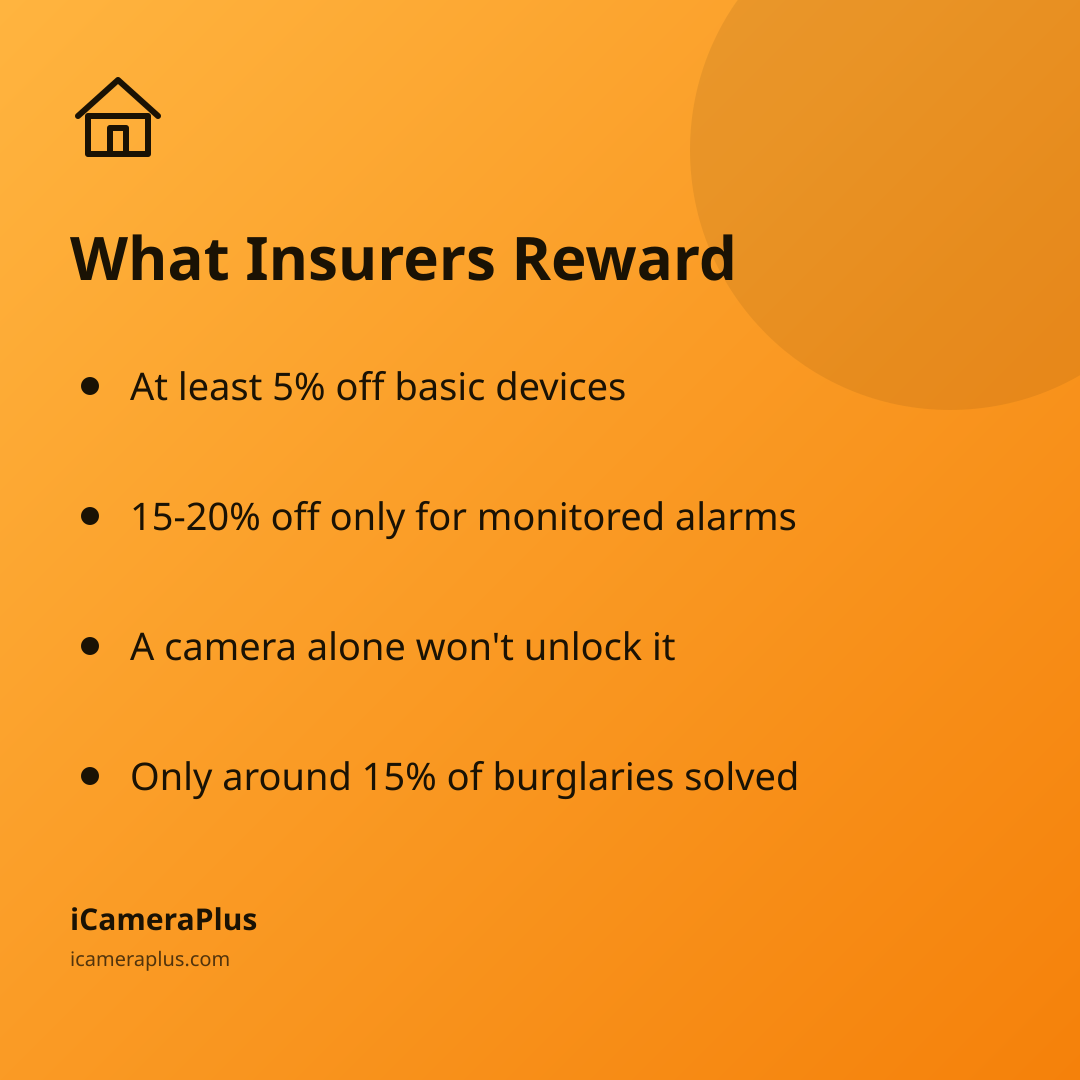
The Insurance Information Institute (Triple-I), the industry's leading consumer-facing research organization, lays out the general shape of these discounts: many insurers offer at least 5 percent off for basic protective devices like a smoke detector, burglar alarm, or dead-bolt locks. The bigger discounts — 15 to 20 percent — are reserved for more sophisticated setups, specifically alarm systems that "ring at the police, fire, or other monitoring station."
Notice the qualifier. The size of the discount isn't really about having a camera or an alarm — it's about whether that system automatically notifies a third party who can respond. That distinction matters a lot for anyone shopping based on price alone.
The Catch: Monitoring, Not Just Recording
This is where a lot of people get tripped up. A standalone security camera, a video doorbell, or a smart-home app that only alerts your own phone is not the same thing, in an insurer's eyes, as a monitored system that dispatches police or fire services on your behalf. Triple-I's own language — a system that "rings" a monitoring station — describes an active, third-party response mechanism, not a device that simply records or sends you a push notification.
In practice, that means:
- A camera you monitor yourself (including a repurposed phone set up as a home camera) generally will not unlock the largest insurance discount tiers on its own.
- Pairing a camera with a professionally monitored alarm service may qualify you for the bigger discount, but the credit is typically tied to the monitoring contract, not the camera itself.
- Discount rules vary by carrier and by state, so the only way to know what your policy actually rewards is to ask your insurer directly and get the answer in writing before you buy anything.
None of this means a self-monitored camera is a waste of money — it just means you shouldn't buy one purely to chase a rate cut. The value shows up elsewhere.
So Why Bother With a Camera If It Won't Move Your Premium Much?
Because insurance discounts aren't the only — or even the main — reason a camera pays for itself. Two facts make that clear.
First, most burglaries are never solved. According to FBI Uniform Crime Reporting data for 2024, only around 15 percent of reported burglaries nationwide were cleared by arrest — one of the lowest clearance rates of any major crime category. That means the footage from your own camera is often the most complete record of what actually happened, for you, for police, and for your insurer.
Second, when you do have to file a claim, documentation is what determines how smoothly it goes. The Insurance Information Institute's guidance on filing a homeowners claim is explicit: photograph or videotape the damage, keep a list of what was lost or damaged, and provide that documentation to your adjuster. Video that already exists — timestamped, continuous, and stored somewhere other than the device that might have just been stolen or damaged — is exactly the kind of evidence that makes a claim faster and less contentious.
This is the practical case for turning a spare phone into a dedicated home security camera: it costs you nothing but a phone you already own, and apps like iCameraPlus keep it recording continuously with the footage archived off the device itself, so a break-in or a fire doesn't also wipe out your evidence. It won't necessarily change your premium, but it can change how quickly and completely an insurance claim gets resolved.
How to Actually Check What Your Policy Rewards
Before you assume anything about a discount, a short phone call can save you from a wasted purchase:
- Ask your agent directly which specific device types and monitoring arrangements qualify for a discount on your policy, and how large each discount is.
- Ask whether self-monitored or DIY cameras count for any credit at all — some insurers offer a smaller discount for any documented protective device, even without professional monitoring; many don't.
- Get the answer in writing (an email from your agent is enough) before you buy or commit to a monitoring contract on the assumption it will lower your premium.
- Re-shop periodically. Given how much premiums are moving in 2026, the discount landscape between carriers is moving too.
If it turns out your insurer only offers a marginal credit — or none — for a self-monitored setup, that's not a reason to skip cameras altogether. It just means you should choose a setup based on what you actually need for coverage and evidence, rather than a discount that may not materialize.
Bottom Line
A security camera is far more likely to help you after something happens — with a clearer picture for police, a faster insurance claim, and evidence that doesn't disappear with the device — than it is to meaningfully shrink your premium today. If you're looking for an inexpensive way to add real coverage while you sort out what your insurer will and won't reward, putting an old phone to work as a continuously recording camera is a reasonable place to start.
Sources
- National Association of Insurance Commissioners (NAIC) — Nationwide Homeowners Market Data Call, March 2026
- Insurify — Average Cost of Homeowners Insurance, 2026
- Insurance Information Institute — 12 Ways to Lower Your Homeowners Insurance Costs
- Insurance Information Institute — How to File a Homeowners Claim
- FBI Uniform Crime Reporting Program — Summary of Reported Crimes in the Nation, 2024