Security Cameras and the Law: What You Can (and Can't) Legally Record at Home
Most people set up a home camera thinking about one question: will it catch someone? But the law cares about a different pair of questions — where is it pointing, and can it hear? Get those two right and a home camera is not only legal in most places, it's genuinely useful as evidence. Get them wrong and the same footage can expose you to a privacy complaint, a civil claim, or in some places a criminal charge.
This is a plain-English tour of the rules that actually matter for a camera on your own property. It is general information, not legal advice — laws differ sharply from one country, state and even city to the next — but it will tell you which questions to ask before you mount anything.
Video and audio are governed by two different rulebooks
The single most useful thing to understand is that a security camera does two legally separate things at once. It records images, and it often records sound. In most legal systems those are judged under completely different standards — and the sound half is almost always the stricter one. People who get into trouble usually did so because of audio they forgot was even switched on.
Video: the "reasonable expectation of privacy" line
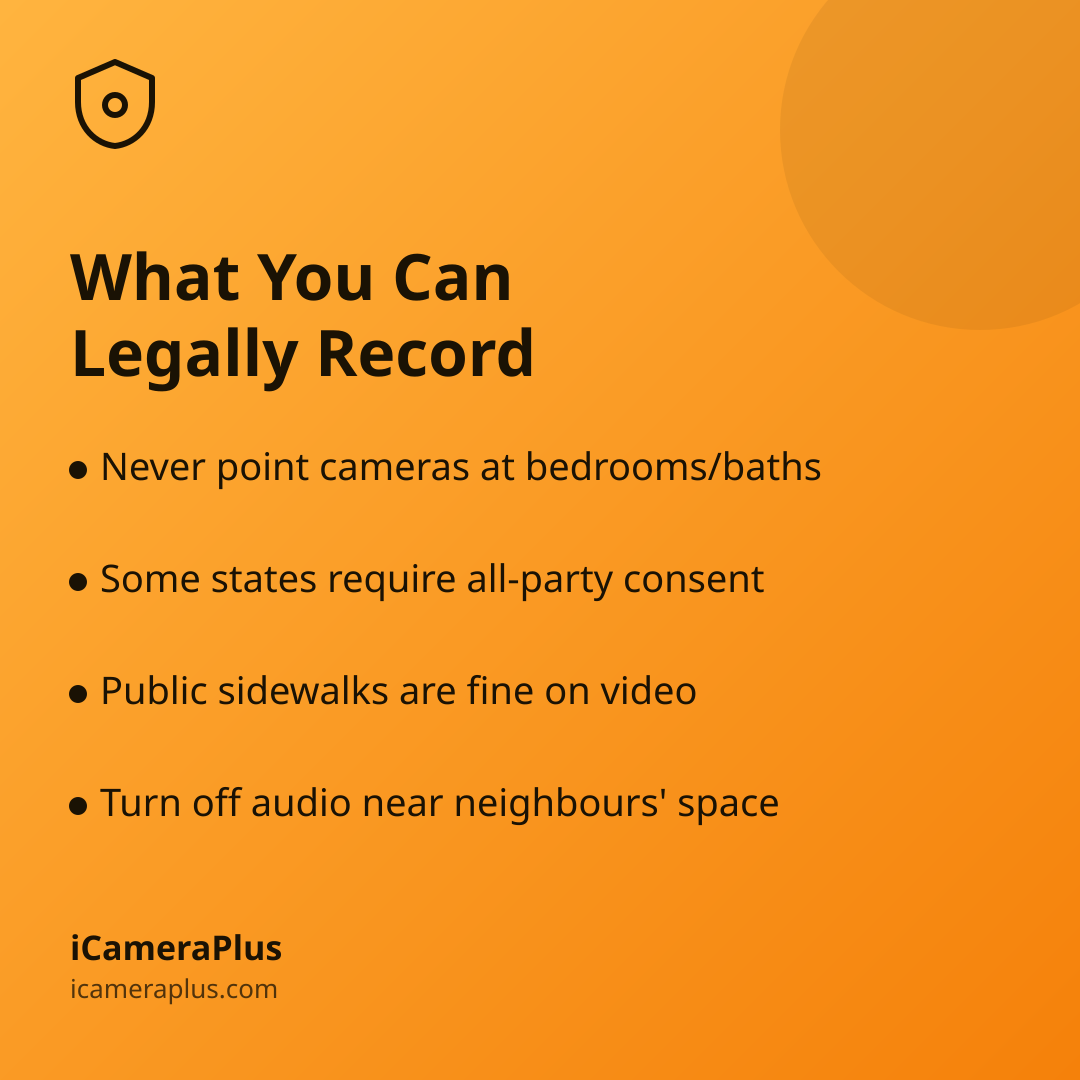
For images, the guiding idea across the U.S., the UK, the EU and much of the world is the reasonable expectation of privacy. In areas where a person would not reasonably expect to be watched, cameras are broadly acceptable — your own front porch, driveway, living room, hallway, garage or garden. In areas where anyone would expect privacy, cameras are off-limits, and pointing one there can be illegal regardless of who owns the property.
The bright-line "never" list is remarkably consistent everywhere:
- Bathrooms and toilets
- Bedrooms, including a guest's or a tenant's bedroom
- Changing areas, dressing rooms and anywhere people undress
A simple test covers almost every case: if it's a place where a reasonable person would close the door and expect to be unseen, don't put a camera there. This holds even inside your own home — a camera aimed at a live-in nanny's or a house-guest's bedroom crosses the line even though you own the walls.
Audio is the stricter half — and the one people miss
Recording sound is treated far more seriously than recording pictures, because listening in on conversations falls under long-standing wiretapping and eavesdropping laws that were written long before doorbell cameras existed.
In the United States, federal law and most states follow one-party consent: as long as one person in the conversation agrees to the recording, it's permitted. But roughly a dozen states require all-party consent — every person being recorded has to agree. The exact list varies by source and by whether the conversation happens in person or over a phone line, which is precisely why you can't rely on a rule of thumb here. States consistently classified as all-party consent include California, Delaware, Florida, Illinois, Maryland, Massachusetts, Montana, New Hampshire, Pennsylvania and Washington, with Connecticut and Oregon counted depending on the context. In those states, a camera that captures a conversation nobody consented to can break the law even if the video itself is perfectly fine.
The practical takeaway: if your camera covers an area where private conversations happen — a shared hallway, a porch close to a neighbour's door, a back garden over the fence line — the safest move is to turn the microphone off unless you have a clear reason to keep it on. Most cameras, including a phone running iCameraPlus, let you disable audio independently of video.
What about the street, the sidewalk, and your neighbour's yard?
Here the two rulebooks pull in different directions. For video, recording a public space — the street, a public sidewalk, the view from your window — is generally lawful in the U.S., because there is no reasonable expectation of privacy in public. Incidentally catching a slice of the pavement or a passing car usually isn't a problem.
Two things change that calculus, though. First, if the camera is angled so its main purpose is watching a neighbour's private space — their garden, their windows, their front door — that can support a harassment or nuisance complaint even where the raw recording would otherwise be legal. Second, audio follows you into public: capturing the conversations of people walking past can still run into those all-party consent laws. The considerate and lower-risk setup is to frame your camera on your property and entry points, and to keep public areas to the incidental minimum. (Our guide on where to place a home security camera walks through angles that protect your home without overreaching into a neighbour's.)
Outside the U.S.: GDPR, the UK, and the doorbell that went to court
For readers in Europe and the UK, the framework is the General Data Protection Regulation (GDPR). GDPR includes a "household exemption": purely personal or domestic use of a camera is exempt from most of its obligations. Film only your own garden and driveway and you are almost certainly covered.
The exemption has a hard edge, though, established by the EU's top court. In Ryneš (Court of Justice of the EU, Case C-212/13, 11 December 2014), the court ruled that when a fixed home camera points outward and captures a public space, the recording is no longer "purely personal or household" — and the homeowner becomes a data controller with real GDPR duties. In short: the moment your camera meaningfully records the footpath, the road, a shared alley or a neighbour's property, the easy exemption falls away.
How real is this? Very. In Fairhurst v Woodard (Oxford County Court, 12 October 2021), a UK judge found that a neighbour's cluster of cameras — including a Ring video doorbell — breached the UK Data Protection Act and GDPR and amounted to harassment. Tellingly, the court accepted that video could in principle be justified for security, but singled out the audio: the doorbell could pick up conversations from over 60 feet away, far beyond any security need, which the judge called even more problematic than the video. It's the clearest illustration you'll find of the two lessons above — mind where the lens points, and take the microphone seriously.
The pattern across every jurisdiction: filming your own property = broadly fine. Reaching past your boundary — especially with audio — is where the law starts to bite.
Renters, guests, and the courtesy of a heads-up
A few situations trip people up regardless of country:
- Landlords and tenants: a landlord generally cannot place cameras inside a rented unit, and never in private areas. A tenant's home is their private space for the length of the lease.
- Live-in help and long-term guests: common areas are usually fair game; their private bedroom and any bathroom are not.
- Notice: in many places, and as a plain matter of good faith, telling people that an area is monitored — a small sign, a mention to houseguests — reduces both legal risk and friction. Transparent monitoring is the whole point; hidden recording of people who'd expect privacy is exactly what the law is built to catch.
A quick self-check before you mount anything
- Is the camera pointed away from any bathroom, bedroom or changing area — including other people's?
- Does it mainly frame your property, with public areas kept incidental?
- If it reaches a neighbour's space or a public path, do you actually need that angle — or can you narrow it?
- Is the microphone off unless you have a specific reason and the right to record sound where you live?
- Have you checked your own state, country or data-protection authority's rules, rather than assuming?
The bottom line
For the overwhelming majority of homeowners, a security camera is entirely legal and a smart thing to have. The law isn't trying to stop you protecting your home — it's drawing a line between watching your own property and surveilling other people. Stay on the right side of that line and you get all the security benefit with none of the exposure.
That's the philosophy iCameraPlus is built around: transparent monitoring of your own space, under your control. An old phone running as a home security camera lets you frame exactly the entry points you care about, and switch audio on or off, so your setup stays firmly on the lawful side of every rule above.
This article is general information, not legal advice. Camera, privacy and recording laws vary significantly by country, state and locality and change over time. Before relying on anything here, check the rules that apply where you live — in the EU/UK, your national data-protection authority; in the U.S., your state's recording and privacy statutes.
Sources
- Recording Law — Two-Party (All-Party) Consent States
- Security.org — Are Security Cameras Legal? Laws by State
- SafeWise — Home Security Camera Laws
- Court of Justice of the EU — Ryneš, Case C-212/13 (11 December 2014)
- Ireland's Data Protection Commission — CCTV in the Home
- Inforrm / Charles Russell Speechlys — Fairhurst v Woodard (2021)