The Days Are Getting Shorter — Here's What the Research Says About Your Home's Riskiest Hours
If it feels like the sun is setting earlier every day right now, it is. Days have been shrinking since the summer solstice in June, and the pace is about to pick up: around the September equinox (September 22, 2026), the U.S. loses daylight at its fastest rate of the year — roughly two to three minutes a day — and that continues until clocks "fall back" on November 1, 2026. That slow slide toward earlier darkness isn't just an inconvenience for evening dog walks — it's a documented shift in when and where certain crimes happen, and it's worth understanding before the darkest months arrive.
This isn't a scare piece. It's a look at what researchers who study light, darkness, and crime have actually found, and what that means for the practical, low-cost steps you can take around your own home.
The research: darkness, not the clock, is the real variable
The most cited study on this question comes from economists Jennifer Doleac (University of Virginia) and Nicholas Sanders (Cornell University), published in The Review of Economics and Statistics in 2015. They analyzed FBI National Incident-Based Reporting System data from 558 U.S. jurisdictions between 2005 and 2008 and compared robbery rates in the days right before and after daylight saving time shifts each spring and fall.
Their finding: robbery rates dropped about 7% overall right after the spring shift to daylight saving time, and in the specific hour after sunset, robberies fell by roughly 27% compared to the same clock hour when it had still been dark. In other words, the deciding factor wasn't the calendar or the clock — it was whether the sky was light or dark at that hour. The researchers estimated the spring shift's crime-reduction effect was worth about $59 million a year in avoided social costs. William & Mary and Cornell both published summaries of the study when it came out.
The practical takeaway for homeowners: as sunset creeps earlier through fall, the hours between roughly 5 p.m. and 9 p.m. — when people are still out and about, but it's now dark instead of light — become a meaningfully higher-risk window. That's also, not coincidentally, when many people are still commuting home, picking up kids, or running errands, leaving houses empty right at dusk.
It's not just crime — it's visibility in general
The same light-versus-dark dynamic shows up in traffic safety data, which is a useful proxy for how much visibility itself matters after sunset. According to the National Highway Traffic Safety Administration's 2023 pedestrian data, 77% of pedestrian fatalities occurred in dark conditions, compared with 19% in daylight — even though far more hours in a day are technically daylight than dark. (NHTSA, "Pedestrians: 2023 Data")
The pattern across both crime and traffic research is the same: reduced visibility changes behavior and outcomes, for pedestrians, drivers, and anyone casing a property. A porch, driveway, or side gate that's easy to see clearly in July can become a much harder read by eye in late October at the same hour.
Burglary is a different story — and worth knowing
It's worth being precise here, because home burglary and robbery aren't the same crime and don't follow the same clock. Robbery — a confrontational crime against a person — is the one Doleac and Sanders studied, and it clusters around dusk and evening. Residential burglary, which targets an empty house, more often happens during the day, when burglars can reasonably expect no one home. So the "darkness raises risk" finding is strongest for what happens on the street and at your door around dusk, not necessarily for a daytime break-in while you're at work. Both matter, but they call for different habits: during the day, an empty-looking house is the risk; at dusk and after, poor visibility around entry points is the risk.
What actually helps during the dusk window
None of this requires an expensive system overhaul. A few things the research and basic security guidance both point to:
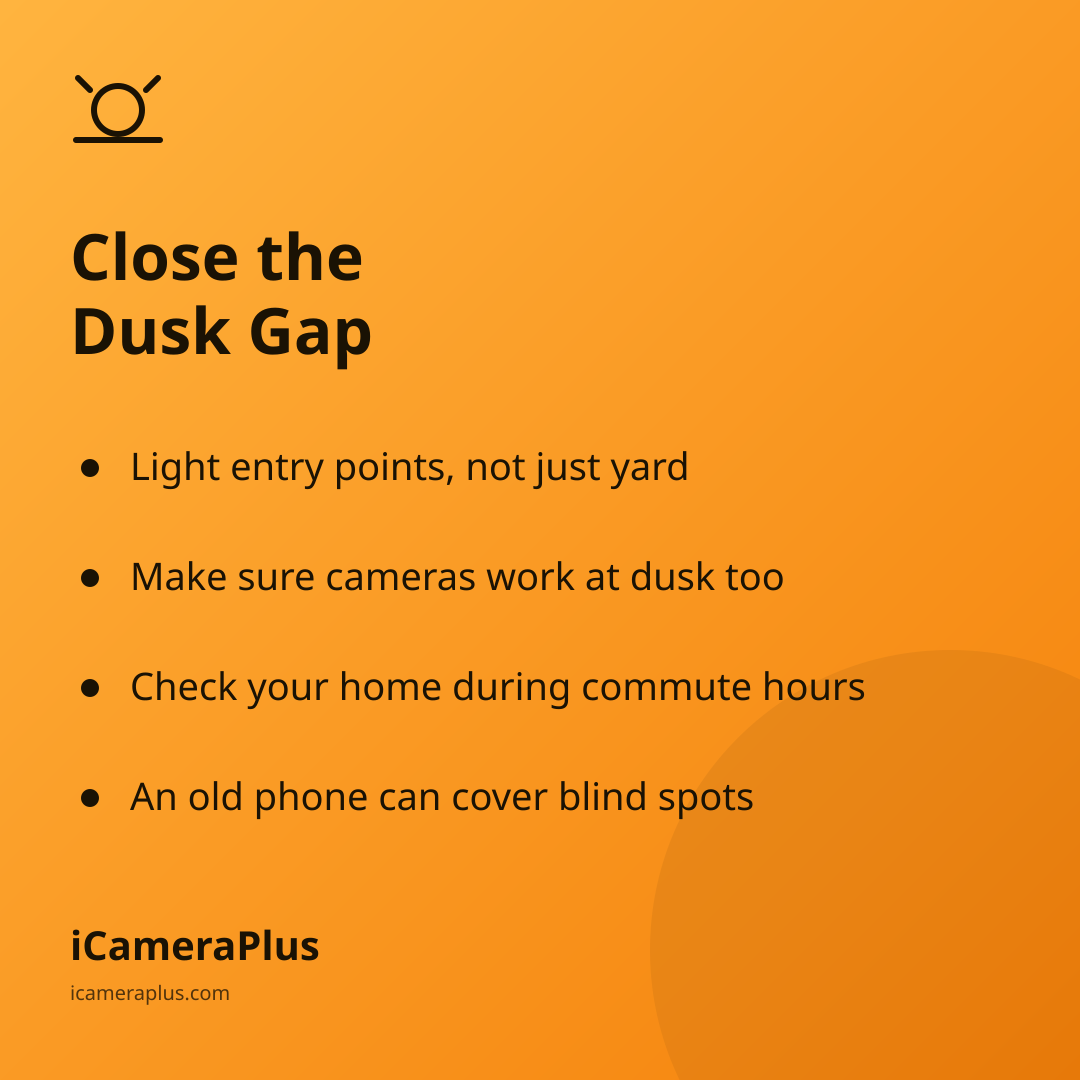
- Light your entry points, not just your yard. Motion-activated lights at doors, driveways, and side gates restore the visibility that disappears at dusk — for you, for neighbors, and for any camera you have pointed there.
- Don't let "dusk" become a blind spot for your camera setup. Cheaper cameras can struggle with the low-light, high-contrast conditions right at sunset (bright sky, dark foreground). Check that whatever is watching your entry points actually produces a usable picture in that specific in-between light, not just full daylight or full night.
- Cover the hours you're not home. If dusk is when you're commuting or running errands, that's exactly when a live view of your own property is most reassuring — being able to check that the porch, driveway, or backyard looks normal from your phone.
- Extend coverage cheaply if you're short a camera. An old phone propped in a window or mounted near a side door can cover a dusk-vulnerable spot — a side gate, a detached garage, a driveway — without buying new hardware. This is a good use for a device that's otherwise sitting in a drawer: an app like iCameraPlus can turn that old phone into a continuous, owner-controlled camera with off-device recording and motion alerts, so you get eyes on the exact area you're worried about without adding another purchase.
The bigger picture: this window is temporary but predictable
Every fall, this same pattern repeats, and every fall it catches people off guard because the shift is gradual rather than sudden. The clock change on November 1, 2026 will make it obvious overnight, but the actual exposure has been building for months already, and it accelerates through the September equinox. Reviewing your outdoor lighting and camera coverage now — before the days get noticeably shorter — means you're not scrambling to fix a blind spot in late October when it's already dark at 6 p.m.
If you're setting up or reviewing camera coverage for the season, our guide on where to place a home security camera covers the entry points worth prioritizing first.
Sources
- William & Mary News: "Daylight Saving Time spurs drop in crime rate"
- Cornell Chronicle: "Fall back and watch out: Robbers thrive on standard time" (2015)
- Doleac & Sanders, "Under the Cover of Darkness: How Ambient Light Influences Criminal Activity," The Review of Economics and Statistics (MIT Press, 2015)
- NHTSA, "Traffic Safety Facts: Pedestrians, 2023 Data"