Should You Buy a Refurbished Phone for a Security Camera in 2026? Check Your Drawer First
This article was produced with AI assistance. Sources are listed at the end.
No — in most cases you don't need to buy a refurbished phone just to get a home security camera. Refurbished phone sales are climbing in 2026 because new phones have gotten dramatically more expensive, but survey data shows most households already own an idle phone that can do the same job for free.
That's the real story behind this year's used-phone boom: it isn't really about security cameras at all. It's about a global memory chip shortage that's rewriting smartphone prices — and, as a side effect, making the old phone in your drawer worth a second look before you spend money on another one.
Why Are Refurbished Phones Suddenly So Popular in 2026?
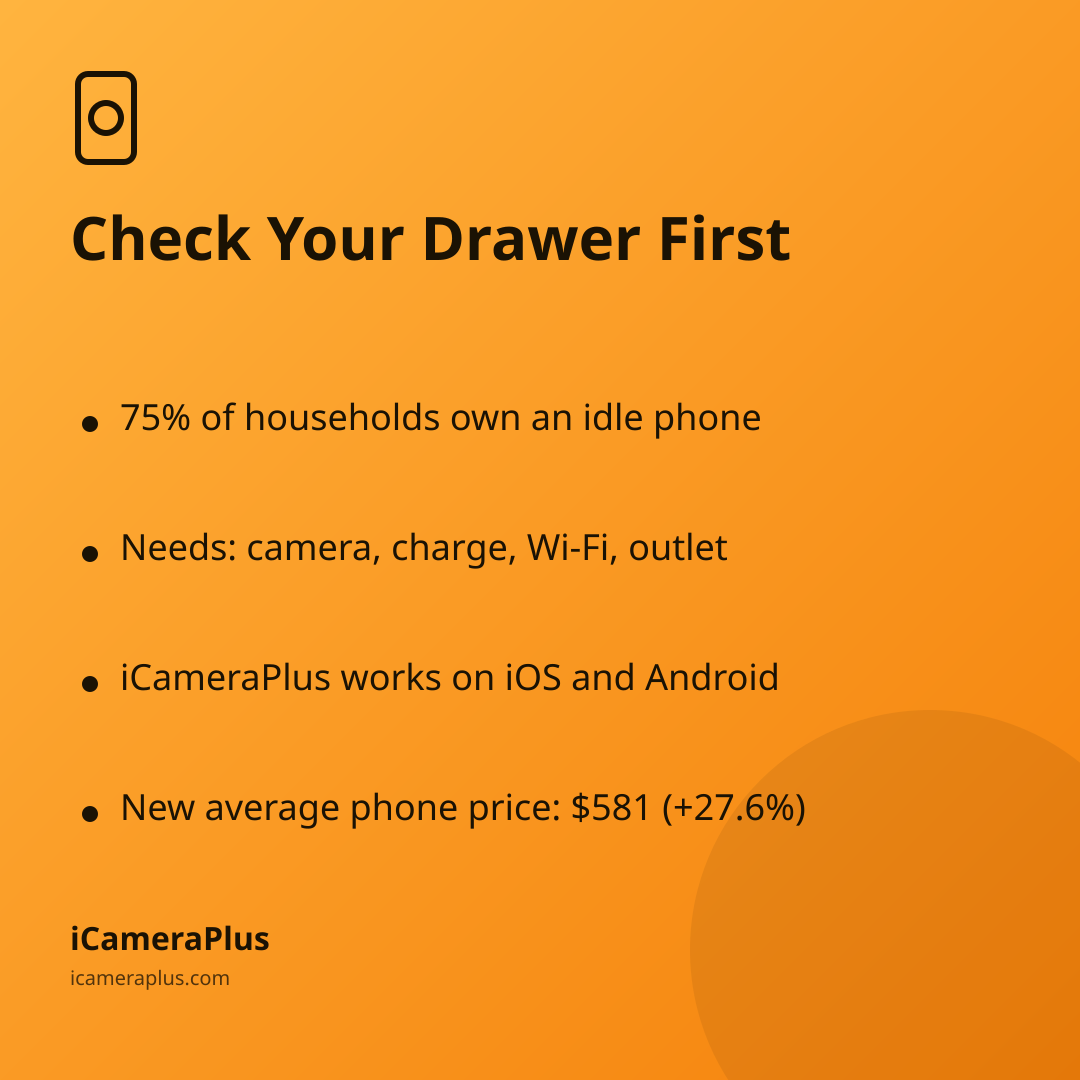
Worldwide smartphone shipments are on pace to fall 16.7% in 2026, to just over 1 billion units — a record contraction, according to IDC's August 2026 forecast. The average new phone now costs $581, up 27.6% in a single year, as DRAM and NAND memory chips — squeezed by AI data center demand — eat into manufacturers' budgets.
FDM CCS Insight forecasts the primary smartphone market will shrink 14.8% in 2026, while the global secondary (refurbished and used) market grows 15.4% over the same period, according to the firm's June 2026 press release. "Some entry-level smartphones have already seen prices rise by more than 50% compared with this time last year," said Ben Hatton, a research analyst at CCS Insight, in the same release.
Our earlier look at why new phones are so expensive in 2026 breaks down the memory chip crisis in more detail — it's the same shortage pushing buyers toward refurbished devices now.
Do You Already Own a Phone That Could Do the Job?
Before adding a refurbished device to the mix, it's worth checking what's already in the house. In a 2024 survey of 10,000 consumers across 26 countries, the GSMA — the trade body representing mobile network operators worldwide — found that 75% of respondents had at least one old phone at home not in regular use. For most people, that unused phone is sitting idle — not working as anything.
A security camera has modest requirements, so an old phone usually clears the bar easily:
- Rear camera still focuses
- Screen turns on and holds a charge
- Connects to home Wi-Fi
- A spot near an outlet to leave it plugged in
If an old phone checks those boxes, it's already a capable camera — no purchase required.
What Does It Actually Take to Turn That Phone Into a Camera?
Once a phone is set aside for the job, the gap between "old phone" and "security camera" is mostly software. iCameraPlus is built for exactly this: it turns a phone you already own into a 24/7 camera, recording continuously with audio and video, storing footage in a private cloud archive you can browse from a web panel, with live view, remote start and stop, and a screen-dimming option so the display doesn't stay lit while it's working. It works on both iOS and Android, so it doesn't matter which old phone is in the drawer.
That's the practical answer to the "refurbished vs. reuse" question: the camera function doesn't need a newer processor or a sharper screen — it needs a working camera, a power source, and an internet connection, which most retired phones still have.
Is Buying Refurbished Ever the Better Move?
Refurbished phones still make sense — just usually not as a dedicated camera purchase. If someone needs an actual phone upgrade and can't justify this year's new-device prices, a refurbished model is a reasonable middle ground, and CCS Insight's research suggests supply may tighten as demand rises, so prices for used devices could climb too. But buying a device specifically to repurpose as a stationary camera adds cost, shipping, and e-waste for a job a device already on hand can usually do. We covered a similar trade-off when weighing whether a discounted dedicated security camera beats an old phone — the math tends to favor what's already paid for.
What's the E-Waste Angle Here?
The world generated 62 million tonnes of electronic waste in 2022, and only 22.3% of it was documented as properly collected and recycled, according to the 2024 Global E-waste Monitor from the United Nations Institute for Training and Research (UNITAR) and the International Telecommunication Union (ITU). Every month a retired phone keeps working — as a camera, a monitor, or anything else — is a month it isn't adding to that pile.
Refurbished sales are rising for the same reason new-phone prices are: memory chips got expensive, not cameras.
Quick answers
- Is a refurbished phone good enough to use as a security camera? Yes — a refurbished phone works fine as a camera, but so does almost any working phone already owned, which makes a new purchase unnecessary for this specific use.
- Will refurbished phone prices keep rising in 2026? Possibly — CCS Insight has noted that stronger demand for secondary devices could push refurbished prices up if supply doesn't keep pace, though that mainly affects buyers looking for a full phone upgrade.
- What should I do with a phone that's too old to use as a camera? If a phone's camera, battery, or Wi-Fi no longer works reliably, recycle it through a manufacturer take-back program or certified e-waste recycler rather than letting it sit in a drawer.