New 2026 Data: 61% of U.S. Homes Now Have a Security Camera — Here's What's Still Holding Back the Rest
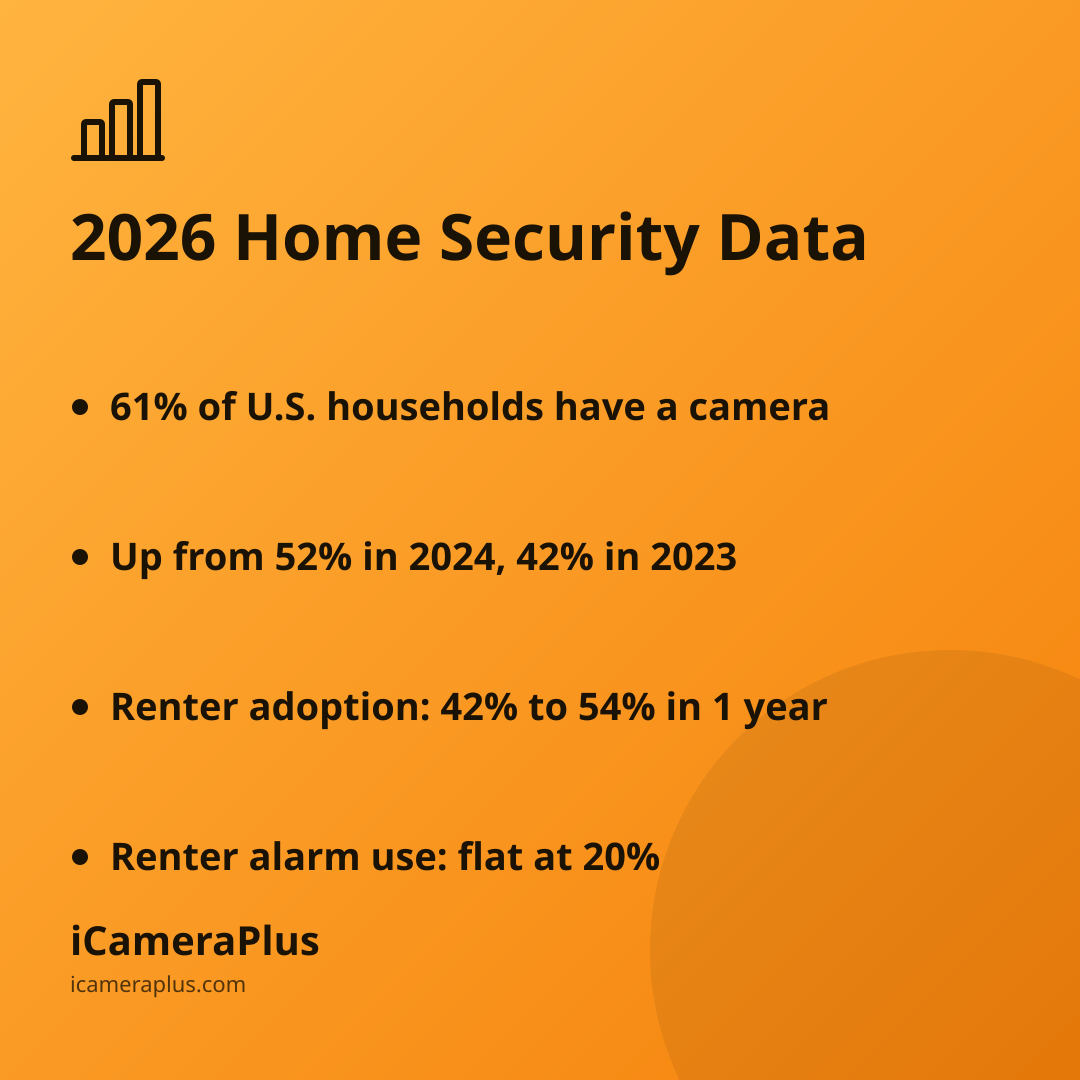
For the first time, most American homes are watching themselves. A survey of 2,435 U.S. adults published in April 2026 by SafeHome.org's 2026 Home Security Market Report found that 61% of U.S. households now have at least one security camera — up from 52% in 2024 and 42% in 2023. That's a 19-point jump in two years, one of the fastest shifts in home security behavior on record.
But a majority isn't everyone. Nearly four in ten households still don't have a camera watching their own property. The same report offers a rare, detailed look at exactly who's catching up, who's stuck, and why — and the answers say less about desire than about cost and logistics.
Renters Just Had Their Biggest Year Yet
The headline number in the 2026 report isn't the overall average — it's what happened among renters. Security camera adoption among renters jumped from 42% to 54% in a single year, which SafeHome.org describes as the sharpest single-year gain in its dataset. That's a meaningful shift for a group that has historically lagged homeowners on nearly every security metric.
Traditional alarm systems tell a different story. Alarm adoption among renters has stayed flat at 20% for two consecutive years, a number the report ties directly to lease restrictions, upfront hardware costs, and the complexity of traditional alarm installation — three barriers that don't apply to a wireless camera you can set up in an afternoon and take with you when you move.
Renters aren't a small slice of the market, either. Roughly 44.6 million U.S. households rent rather than own, according to the U.S. Census Bureau's 2019–2023 American Community Survey 5-Year Estimates, released in December 2024. When a group that size shifts its buying behavior, it moves the whole market — and it's a big part of why camera-based security is growing faster than alarm systems industry-wide.
The Interest Is There. The Friction Is the Problem.
It isn't that the remaining households don't want a camera. Among people who currently have no home security devices at all, 28% told SafeHome.org's 2026 survey they're interested in buying a security camera within the next 12 months. That's a lot of latent demand sitting behind the same barriers renters already named: cost, installation, and — for anyone not sure they'll be in the same place next year — commitment.
The report also flags a smaller but notable figure worth watching: 6% of respondents said they'd stopped using home security devices altogether in the past year. The survey doesn't ask why, but it's a reminder that adoption isn't just about getting a first camera — it's about a solution that people actually keep using once the novelty wears off, rather than one that ends up in a drawer alongside a monthly bill nobody remembers signing up for.
Nearly 4 in 10 U.S. households still have no camera on their property at all — and cost, not desire, is the biggest reason why.
What the Barriers Have in Common
Line up the report's findings and a pattern emerges. The households still without a camera aren't skeptical of the idea — they're blocked by three specific, practical things:
- Upfront hardware cost. Buying a dedicated camera, even an inexpensive one, is still money out of pocket before you've confirmed it's the right fit.
- Installation complexity. Drilling, wiring, or app pairing that isn't as simple as it sounds on the box.
- Lease restrictions and mobility. Renters in particular don't want to mount something they can't take with them, or that a landlord won't allow.
None of those barriers are really about wanting security less. They're about the on-ramp being harder than it needs to be for a large share of households — which is exactly the gap that reusing a device you already own is built to close.
The Camera Already in Your Pocket (or Drawer)
Most households have at least one retired smartphone sitting unused, complete with a working camera, microphone, and internet connection. That's the entire hardware list for a home security camera — no purchase, no drilling, and nothing that violates a lease because there's nothing permanently installed.
This is the practical middle ground between "no camera" and "buy new hardware": an app like iCameraPlus turns a phone you already own into a continuously recording camera, with footage archived off the device, remote live view, and motion alerts sent to your current phone — the same functionality the report describes renters gravitating toward, without the upfront cost or the installation step that keeps showing up as a barrier in the data.
If You're One of the 39% Still Without a Camera
- Check for an old phone with a working camera and a way to keep it charged and connected to Wi-Fi.
- Pick a spot that covers an entry point — a front door, back door, or driveway is usually the highest-value first placement.
- Set up remote viewing and motion alerts so you're not relying on someone to check the phone screen itself.
- Make sure footage is stored somewhere other than the camera itself, so a stolen or damaged phone doesn't mean losing the recording too.
For a longer walkthrough of where a first (or second) camera does the most good, see our guide on choosing and placing a home security camera.
The Bottom Line
The 2026 data tells a clear story: home security camera adoption is climbing fast, renters are driving a big part of that growth, and the households still on the sidelines are mostly stuck on cost and logistics rather than lack of interest. Closing that last gap doesn't require waiting for a bigger budget or a landlord's permission — it just requires putting a device you already own to work.
Sources
- SafeHome.org, "2026 Home Security Market Report" (published April 1, 2026; survey of 2,435 U.S. adults, Jan. 29–Feb. 11, 2026, ±2 percentage points margin of error)
- U.S. Census Bureau, "Nearly All U.S. Counties Had More Homeowners Than Renters Between 2019 and 2023" (2019–2023 American Community Survey 5-Year Estimates, released December 12, 2024)