Weekly Tech & AI Roundup: AT&T's Gemini Cameras, Flock Backlash & DOJ's AI Task Force (November 2–8, 2026)
This article was produced with AI assistance. Sources are listed at the end.
It was a split-screen week for home tech: Google's Gemini AI moved into professionally monitored security cameras for the first time, while a different kind of camera network kept losing customers over trust. A new survey crystallized the tension — only 24% of smart-home owners say they fully trust their devices with their privacy, even as 7 in 10 now own up to ten of them. Here's everything that mattered for home security, privacy, and AI between November 2 and 8, 2026.
The week in 60 seconds
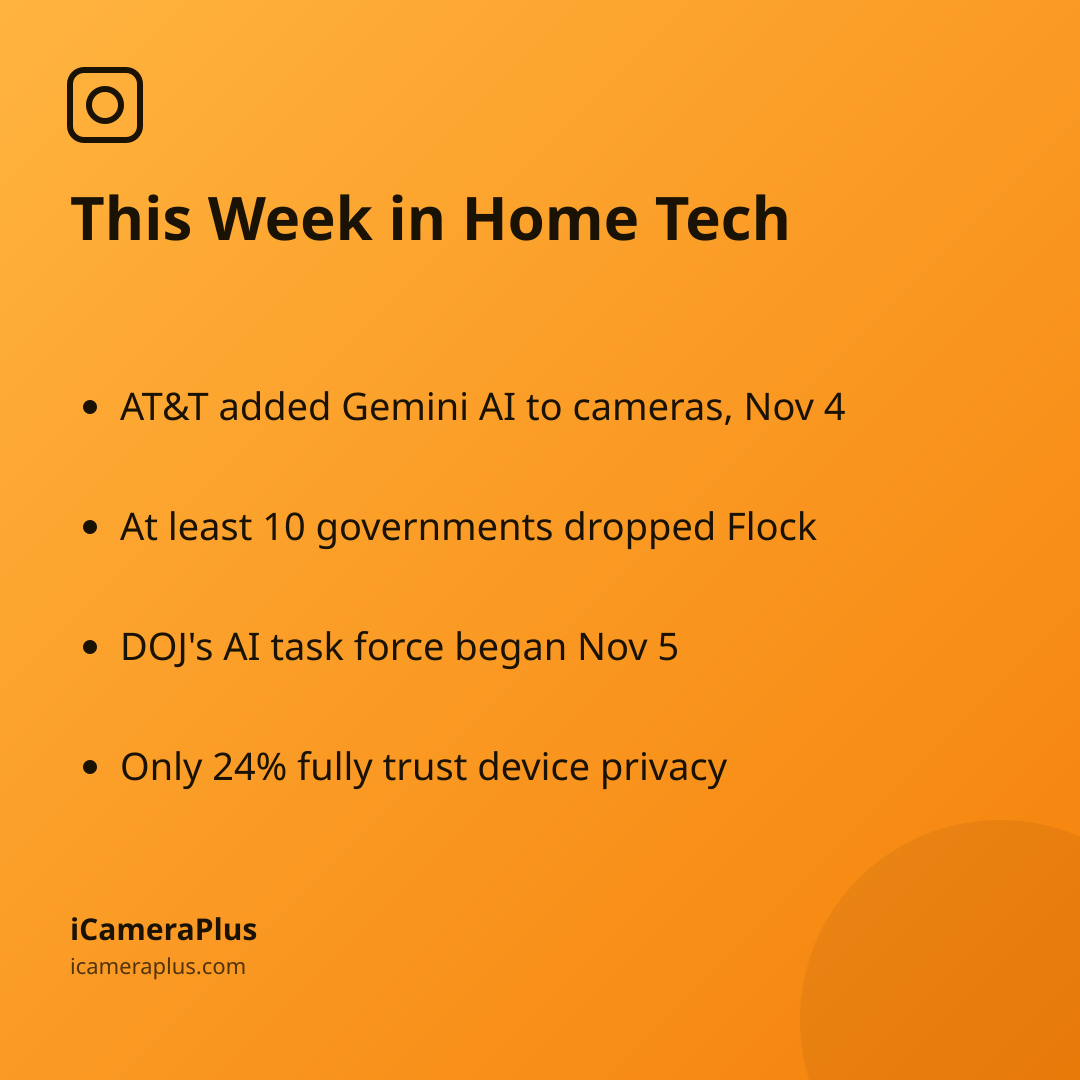
- AT&T added Google Gemini to its Connected Life security cameras on November 4, 2026, with plain-language alerts and natural-language video search.
- At least 10 local governments have dropped or restricted Flock Safety's license-plate cameras since summer, TechCrunch reported November 5, 2026.
- A class action filed November 3, 2026 accuses Axon of pulling data from privately owned doorbell cameras without a warrant.
- The Justice Department's new Super Intelligence Task Force began operating November 5, 2026, to police criminal and foreign misuse of advanced AI.
- CrowdStrike launched an "AI Kill Switch" on November 3, 2026, letting companies instantly shut down rogue AI agents.
- A Vivint-commissioned survey found 7 in 10 Americans now own up to 10 smart home devices, but just 24% fully trust them with their data.
Smart Home & Security Cameras
AT&T began rolling Google's Gemini AI into its Connected Life home security service on November 4, 2026, according to AT&T's own announcement. Connected Life is now the first home security product built on the Google Home Platform with Gemini, adding plain-language explanations of what a camera spotted, natural-language video search ("what dug up the yard last night?"), and location-based automatic arming, as Forbes reported on November 5, 2026. For your home: the feature set — 24/7 recording, searchable footage, smarter alerts — is arriving first as part of a paid, professionally monitored plan, so if you just want continuous recording and a browsable archive without a new monitoring contract, iCameraPlus turns a phone you already own into a 24/7 camera with a private cloud archive you can check from the web.
Separately, a survey of 5,000 U.S. homeowners commissioned by Vivint and fielded through OnePoll found that 7 in 10 Americans now own up to 10 smart home devices, including security cameras, thermostats, and pet feeders, and that only 24% of respondents fully trust their devices' privacy practices, with brand reputation cited as the main reason among those who do, according to a Stacker analysis of the survey published November 5, 2026. Only 24% of homeowners fully trust their smart devices with their privacy. For your home: the more devices you add, the more useful it is to know exactly where your footage lives — our rundown of which smart home device is most likely to get hacked digs into which gadgets actually carry the most risk.
Privacy & Surveillance
At least 10 local governments and police departments have moved since summer to curb, restrict, or end their use of Flock Safety's license-plate camera network, TechCrunch reported on November 5, 2026. Monroe, Ohio; Richmond, Virginia; and South Windsor, Connecticut are among the municipalities that have voted to end or limit their Flock contracts, out of more than 100,000 Flock cameras currently in use nationwide. The backlash follows an October 2, 2026 bill from Sen. Bernie Sanders, Rep. Alexandria Ocasio-Cortez, and Sen. Jeff Merkley — the Ban Flock Act — that would block federal funding to agencies using automatic license plate readers. For your home: this is about government-run plate-reading networks, not doorbell or indoor cameras you control yourself, but it's a reminder that footage shared with a third party can outlive your control over it.
That exact concern surfaced in a new lawsuit: law firm Gibbs Mura filed a class action against Axon on November 3, 2026, alleging its license-plate camera platform can pull data from privately owned doorbell cameras and that police can search the combined footage without a warrant, per Morningstar's coverage. The suit claims this violates California's ALPR privacy statute and state constitutional privacy protections. For your home: check your camera or doorbell app's data-sharing settings — most platforms let you opt out of sharing footage with police request networks, and it's worth knowing whether yours is opted in by default. See our privacy guide for what to check before you buy or set up a camera.
Artificial Intelligence
The Justice Department's Super Intelligence Task Force officially began operating on November 5, 2026, under a mandate from an October 13, 2026 memo from Attorney General Todd Blanche, according to Crowdfund Insider's report. Co-chaired by Associate Attorney General Stanley Woodward and Associate Deputy Attorney General Stephen Weiss, the task force will coordinate criminal and civil enforcement against foreign actors, criminal organizations, and companies that misuse advanced AI systems, as The Register confirmed on November 6, 2026.
Independent AI research group METR published an assessment on November 5, 2026 estimating that Anthropic's model capabilities, measured on its internal AECI benchmark, have been improving at roughly 1.9 times the rate seen before October 2025. METR ran the eleven-week review from August 12 through October 29, 2026, and attributed as much as 80% of the acceleration to Anthropic using AI to speed its own research, per Unite.AI's writeup.
"Since Oct 2025, AECI scores for Anthropic's models have grown at 1.9x [95%: 1.5–2.8] the earlier rate." — METR, November 5, 2026
Anthropic also began applying its invisible text watermark to four older Claude models — Mythos 5, Opus 4.7, Opus 4.6, and Sonnet 4.6 — starting November 3, 2026, after customers were notified by email October 28–30, according to Notebookcheck's report. The watermark, framed as EU AI Act compliance support, applies globally with no regional opt-out.
Notable Releases
Cybersecurity firm CrowdStrike unveiled an "AI Kill Switch" inside its Falcon Guardian product on November 3, 2026 at Fal.Con Europe, giving enterprise security teams a one-click way to stop a misbehaving AI agent, block it from relaunching, and cut its network access, per CNBC's coverage. The tool works by cutting the agent off from the AI models it depends on rather than deleting its code.
Generative-media inference startup Fal raised $1.3 billion on November 3, 2026 in a round led by Bessemer that doubled its valuation to $16 billion, up from $8 billion just seven months earlier, according to SiliconANGLE. Nvidia, T. Rowe Price, and Sound Ventures also joined the round; Fal's annualized revenue reportedly passed $800 million earlier this year.

Sources
- AT&T — Puts Google Gemini AI to Work for Smarter Home Security
- Forbes — AT&T Uses Google Gemini to Tackle Security Camera Alert Overload
- Stacker (via KEYT) — Thermostats, Security Cameras and Pet Feeders: Survey Finds 7 in 10 Americans Now Own Up to 10 Smart Devices
- TechCrunch — At Least 10 Local Governments Have Moved to Drop Flock's Surveillance Cameras
- Sen. Bernie Sanders — Sanders, Ocasio-Cortez, Merkley Unveil Ban Flock Act
- Business Wire via Morningstar — Gibbs Mura Files Class Action Against Axon Over License Plate Surveillance
- Crowdfund Insider — U.S. DOJ Establishes Task Force to Counter Foreign and Criminal Misuse of Advanced AI
- The Register — DoJ's "Super Intelligence Task Force" Up and Running
- Unite.AI — METR Estimates Anthropic's Model Capability Growth Has Nearly Doubled
- METR — AECI benchmark growth assessment, November 5, 2026
- Notebookcheck — Claude Now Watermarks Text From Older Models, With No Opt-Out
- CNBC — CrowdStrike Launches AI Kill Switch That It Says Can Stop Internal Agents That Go Rogue
- SiliconANGLE — Generative Media Inference Startup Fal Raises $1.3B at a $16B Valuation