Where Do Most Bike Thefts Really Happen in 2026? Not the Street — Your Garage
This article was produced with AI assistance. Sources are listed at the end.
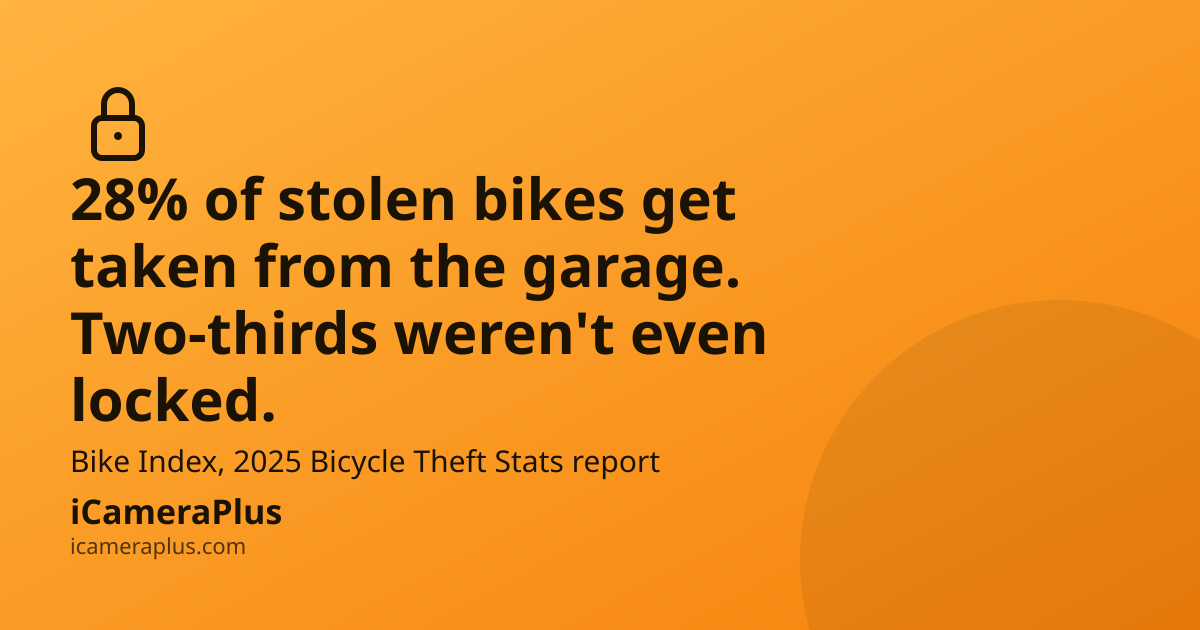
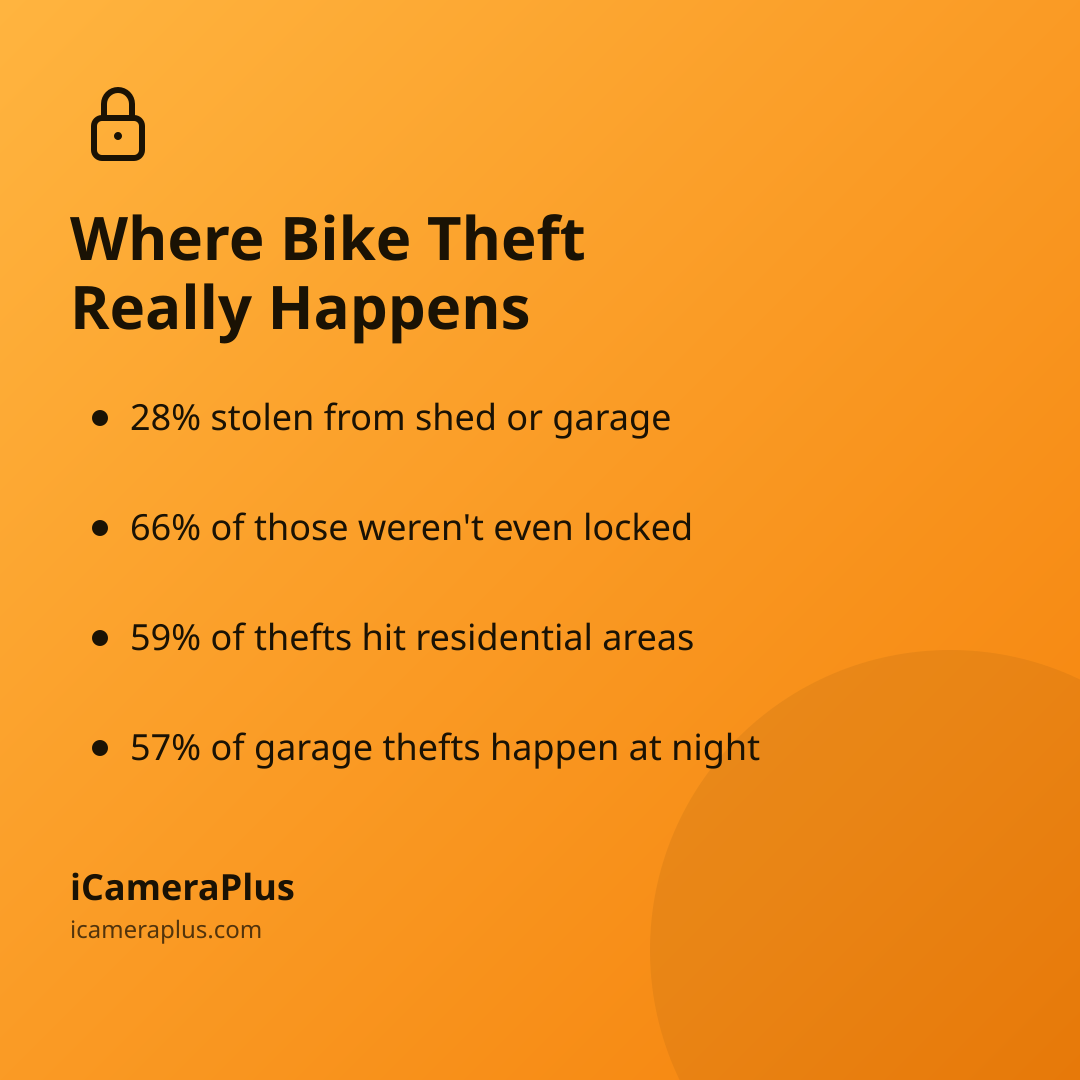
Most stolen bikes never make it off the owner's property. According to Bike Index's 2025 Bicycle Theft Stats report, 28% of stolen bikes were taken from a shed or garage — more than from any other single location type — and 66% of those bikes weren't even locked when they disappeared. If your home security plan stops at the front door and driveway, the garage is probably the biggest blind spot you have.
That gap matters more right now. Fall is when bikes, lawn equipment, grills, and tools all get wheeled into the garage or shed for the season — exactly when owners tend to assume the "theft season" is over and stop paying attention.
Where do most bike thefts actually happen?
Bike Index, a nonprofit bike registry that works with the UC Santa Barbara SPAR Lab and draws on FBI crime data, estimates that roughly 2.4 million bicycles are stolen in the United States every year, worth a combined $1.4 billion (Bike Index, 2025). The organization's data also shows that 59% of bike thefts occur in residential areas rather than downtown streets or bike racks — and within that residential share, sheds and garages are the single most common point of loss.
Timing matters too: Bike Index (2025) found that 57% of shed and garage thefts happen at night, while thefts from outdoor bike racks skew toward the afternoon. A locked door isn't the deterrent people assume it is — a garage is often treated as a vault when it's really just a room with a door that happens to be closed.
"Most stolen bikes were taken from sheds or garages (28%)." Bike Index also found that 66% of those bikes were left unlocked. — Bike Index, 2025 Bicycle Theft Stats report
Why does this matter heading into fall and winter?
Bike Index's data shows theft activity peaks from May through September, with August the single highest month. That can create a false sense that risk drops once the season turns — but it's exactly when bikes, e-bikes, snowblowers, and other gear get parked in the garage for months at a stretch, sometimes untouched and unchecked by the owner for weeks. A thief casing a neighborhood in October or November is looking at the same unlocked garage door as a thief in July; the owner is just paying less attention to it.
This isn't a niche problem. According to the U.S. Department of Energy's 2018 analysis of Census Bureau American Housing Survey data (DOE, 2018), two-thirds of all U.S. housing units have a garage or carport. For most homeowners, that's a storage space sitting just outside the usual security perimeter.
Why doesn't the garage get a camera like the front door does?
Most people put a camera on the doorbell or the driveway because that's where packages and visitors show up. The garage interior gets skipped for practical reasons: running a new wired camera out to a detached shed is a project, a dedicated indoor camera is another device and another subscription to manage, and a space that's "just storage" doesn't feel worth the effort — until something goes missing from it.
The irony is that garages are usually easier to cover than the exterior of a house. They already have an outlet, four walls, and no weather to worry about. For related reading on where cameras tend to go first (and where coverage usually stops), see How Many Security Cameras Does a Home Actually Need in 2026?
How can you watch a garage without buying new hardware?
You likely already own the easiest fix: an old phone. iCameraPlus turns a spare iOS or Android phone into a dedicated camera for exactly this kind of space — continuous recording with a private cloud archive you can browse from a web panel, plus live view and remote start/stop so you can switch it on before a trip or a long weekend without walking out to the garage. Its screen-dimming feature keeps the phone from glowing in an otherwise dark space, which matters in a garage or shed where a lit-up screen is the opposite of what you want.
A mounted phone costs nothing extra to acquire and solves the two problems that keep garages uncovered: it doesn't require running new wiring, and it doesn't require deciding whether a rarely-used room justifies a whole new piece of hardware.
- Lock bikes even inside a locked garage
- Store bikes and tools out of window sightlines
- Add a camera to the one room you skipped
- Turn on recording before you leave for days at a time
Quick answers
Does homeowners or renters insurance cover a bike stolen from the garage?
Coverage varies by policy and insurer, and many standard policies cap personal property or bicycle-specific claims at a lower sublimit than the bike's replacement cost. Check your specific policy or ask your insurer directly before assuming a stolen bike is fully covered.
Should I still lock a bike that's inside a closed garage?
Yes. Bike Index's 2025 data found that 66% of bikes stolen from sheds and garages were left unlocked, which suggests the closed door is doing most of the work people think a lock is doing. Locking the bike to something fixed, even indoors, removes the easiest version of the theft.
Can an old phone really hold up as a garage camera in cold weather?
Phones are generally designed to operate in typical indoor and garage temperature ranges, and keeping the phone plugged in (as continuous recording requires anyway) avoids the battery drain that cold can otherwise cause. Avoid mounting it anywhere it would be exposed to freezing temperatures or direct precipitation.