Why Does My Security Camera Keep Sending False Alerts This Fall?
Short answer: if your security camera's alerts suddenly spike this time of year, it's almost certainly fall weather and fall pests, not a broken camera. Wind-blown leaves and swaying branches trip motion sensors, and spiders and insects looking for a warm place to shelter build webs directly on outdoor camera housings right as your camera's night vision kicks in more often. In one documented case, a single home camera sent 99 false alerts in a single night — every one triggered by an insect, not an intruder. The National Pest Management Association's 2026 Fall & Winter Bug Barometer, released August 26, 2026, confirms this isn't just anecdotal: a warmer-than-average autumn is giving pests "more time to forage and reproduce" before the cold sets in, which means more insect and spider activity around the outside of your home than usual.
Why Do Security Camera Alerts Spike Every Fall?
Most home cameras detect motion by comparing pixels or contrast between frames, not by recognizing "person" versus "leaf." Anything that changes the image — a gust of wind, a falling leaf, a shadow moving across the lens — can register as motion. Fall adds several triggers at once: leaves start dropping, wind picks up in many regions, and pests that were active outdoors all summer start looking for shelter as temperatures drop. The NPMA's 2026 forecast breaks this down by region, noting that in the Intermountain West and Southwest, for example, heavier rainfall is pushing spiders and scorpions indoors in search of drier conditions, while other regions see extended activity from ants, mosquitoes, and ticks thanks to the warm stretch.
Are Spiders Really Setting Off My Camera?
Often, yes. Purdue University's Plant & Pest Diagnostic Laboratory notes that "during late summer and fall, spiders often appear in and around homes and other buildings" — and outdoor web-building spiders typically stick around until the first hard freeze. A camera housing is an attractive spot: it's elevated, sheltered from rain, and sits still enough for a web to survive more than a night. Once a web is spun across or near the lens, every breeze that moves it can trigger a fresh motion alert.
Do Wind and Falling Leaves Really Trigger Motion Alerts?
Yes — this is one of the most common, and most fixable, causes of fall false alerts. A camera aimed at a tree, shrub, or pile of leaves is aimed at something that's going to move all season. Combined with pests building webs on the housing itself, it's easy to end up with a camera that alerts constantly about nothing. In a 2-week diary study on smart home notifications, researchers at the Nielsen Norman Group (February 2026) documented this exact pattern: one participant described getting 99 notifications in a single night from a camera that was reacting to insects, and another disabled a sensor entirely after getting alerts every 30 seconds.
One camera sent 99 alerts in a single night — and every one of them was a bug.
Why Are False Alerts More Than Just Annoying?
The real risk of a noisy camera isn't the notifications themselves — it's what they train you to do. Once you start swiping away alerts without looking, or muting notifications altogether, you're also less likely to catch the one that actually matters. This isn't a new problem for home security: a landmark analysis by Arizona State University's Center for Problem-Oriented Policing found that 94 to 98 percent of burglar alarm calls to police turn out to be false, with alarm reliability measured at just 2 to 6 percent — a pattern significant enough that many police departments now deprioritize or charge fees for repeated false alarms. Fall's extra triggers just make the same underlying problem worse for camera owners specifically.
How Do You Actually Stop Fall False Alerts?
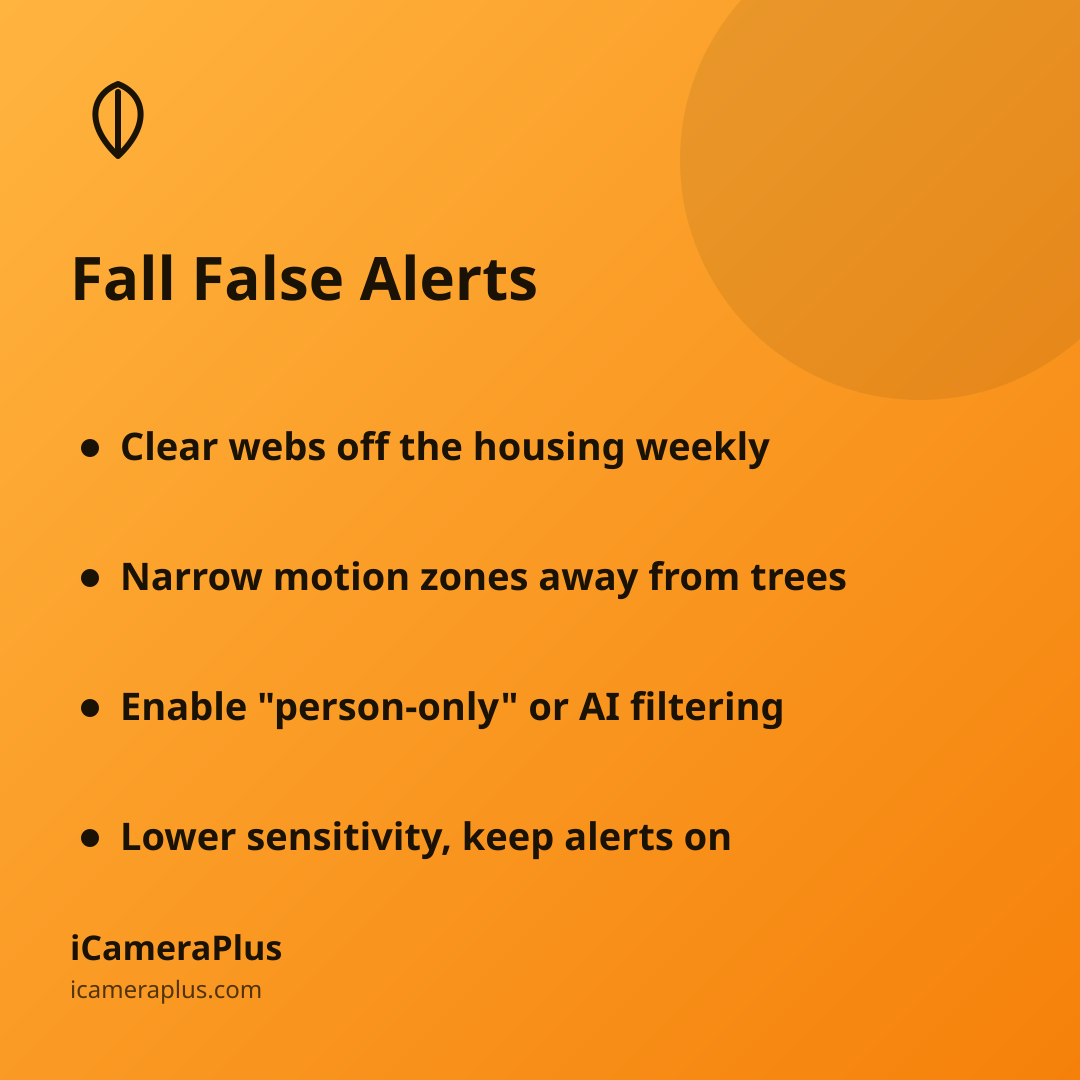
A few adjustments handle most of the seasonal spike:
- Clear webs off the housing weekly
- Narrow motion zones away from trees
- Enable "person-only" or AI filtering
- Lower sensitivity, don't disable alerts
That last point matters most. Fully turning off alerts to escape the noise means you also lose the whole point of monitoring your own property in real time. This is one place where a phone repurposed as a camera has an advantage: an app like iCameraPlus keeps continuous recording running and archived off the device even while you're tuning motion-alert sensitivity, so a poorly aimed or overly sensitive detection zone during peak pest season doesn't cost you footage — you can still scrub back through the recording later if something real happened, instead of relying only on the clips a jumpy sensor decided were worth saving.
Quick Answers
Will alerts calm down once it gets cold?
Largely, yes. Purdue's Plant & Pest Diagnostic Laboratory notes that outdoor web-building spiders disappear after the first hard freeze, and falling-leaf activity naturally tapers off once trees are bare. Until then, adjusting detection zones and sensitivity is more reliable than waiting out the season.
Should I just turn off motion alerts until spring?
It's better to narrow or filter them than switch them off completely. Disabling alerts removes the real-time warning that makes a camera useful for monitoring your own home, and it's easy to forget to turn them back on.
Does "AI" or "smart" detection actually help with bugs and leaves?
Object-based filtering (person, vehicle, package) is generally more effective than raw motion detection because it's looking for shapes rather than any pixel change, which cuts down on alerts from insects, webs, and windblown debris. It won't eliminate every false alert, especially from webs built directly on the lens, so regular cleaning still matters.
Sources
- National Pest Management Association, "Summer's Not Clocking Out Yet: Warmer Fall Forecast Could Extend Pest Activity Across the U.S." (2026 Fall & Winter Bug Barometer, August 26, 2026)
- Purdue University Plant & Pest Diagnostic Laboratory, "Spooked by Spiders"
- Nielsen Norman Group, "Designing Useful Smart Home Notifications" (February 2026)
- Arizona State University Center for Problem-Oriented Policing, "False Burglar Alarms," 2nd Edition