Why Do 1 in 5 Homeowners Never Finish Installing a New Smart Home Device? (2026 Data)
This article was produced with AI assistance. Sources are listed at the end.
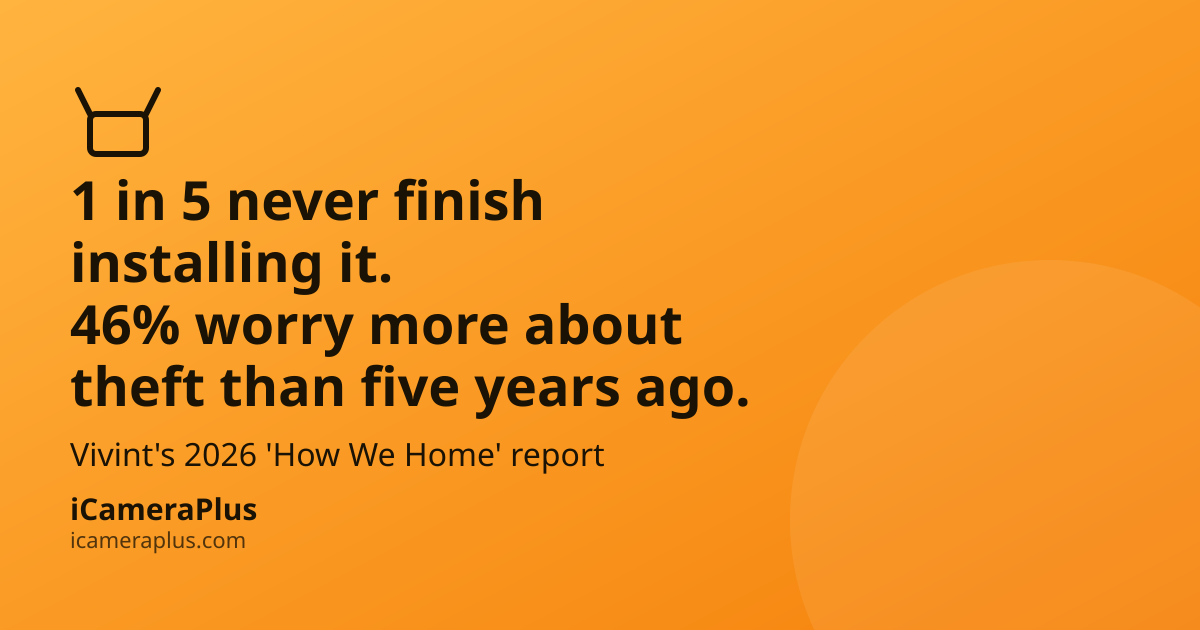
Roughly 1 in 5 U.S. homeowners who buy a smart home device never finish installing it, and 47% say they rarely or never use at least one smart device they already own, according to Vivint's 2026 "How We Home" report. For security specifically, that gap matters: the same report found 46% of homeowners are more concerned about theft than they were five years ago, even as device ownership climbs. In other words, the gap between buying security and actually being protected is getting wider, not narrower.
That disconnect is the real story. Homeowners are buying more smart devices, worrying more about theft, and still ending up with hardware sitting half set up in a drawer or a box in the garage.
What Did the 2026 "How We Home" Report Actually Find?
Vivint's second annual "How We Home" report is based on an online survey of 5,000 U.S. homeowners, fielded in September 2026 by OnePoll and commissioned by Vivint, according to Gearbrain's November 2026 coverage of Vivint's release, which states the report came out on November 5, 2026. The headline numbers are worth sitting with:
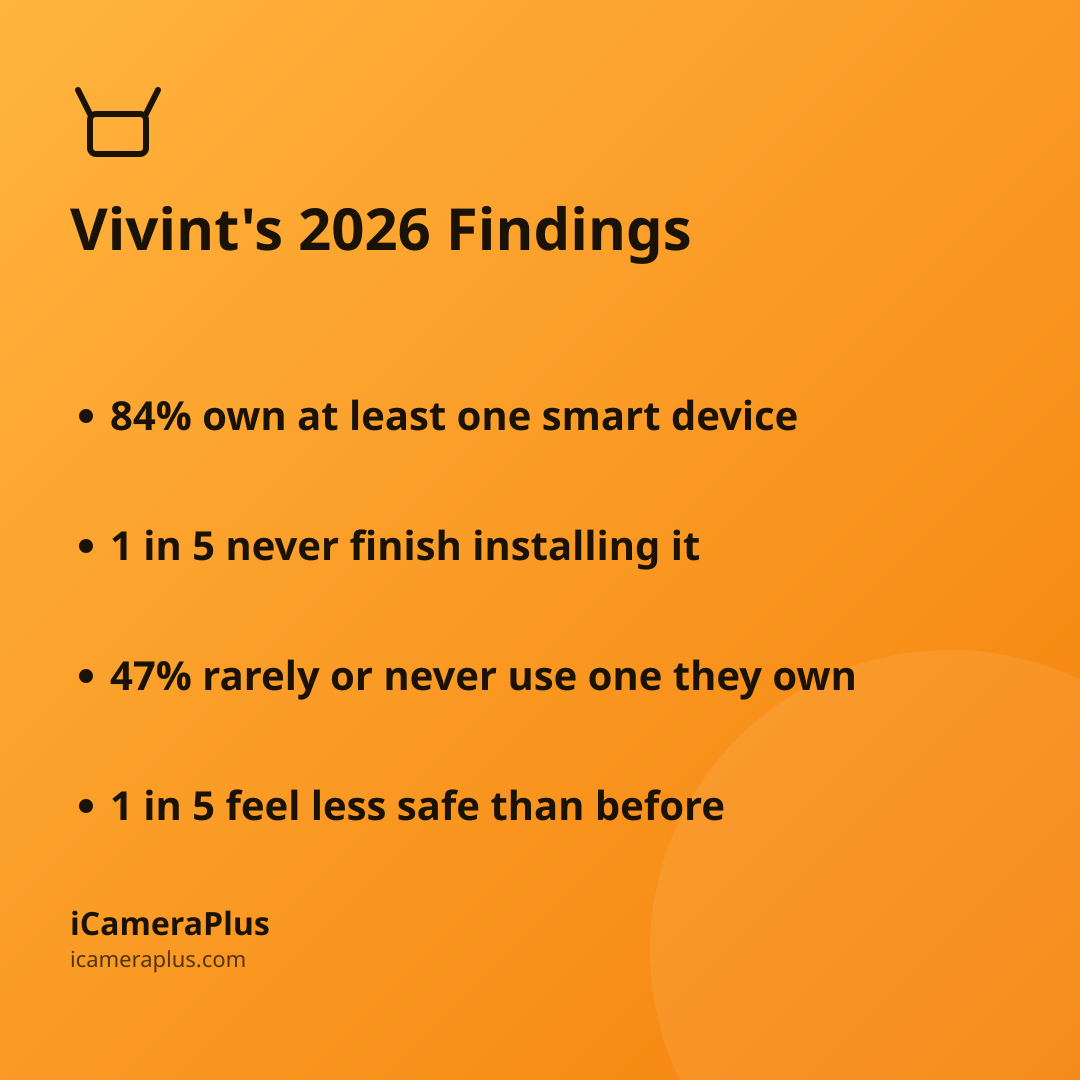
- 46% of homeowners are more concerned about theft affecting their home than they were five years ago, per Vivint's 2026 report.
- 1 in 5 homeowners say they feel less safe in their homes than they used to, citing crime, economic conditions, and severe weather, per Vivint (2026).
- Roughly 1 in 5 homeowners who bought a smart home device never finished installing it, per Vivint (2026).
- 47% of homeowners rarely or never use at least one smart home device they already own, per Vivint (2026).
- 84% of homeowners now own at least one smart home device, according to CE Pro's 2026 coverage of the report.
Why Do So Many Smart Home Devices End Up Unused?
It isn't that homeowners don't care about security — the rising theft worry makes that clear. It's that finishing the job is harder than buying the box. SDM Magazine's coverage of the report found that 34% of homeowners who prefer professional installation say it's because they want the device set up correctly — a tell that a meaningful share of people don't trust themselves to mount a camera, pair it to Wi-Fi, and get the app talking to a hub without help.
That friction — drilling, wiring, hub pairing, app pairing, subscription sign-up — is exactly the point where a security purchase stalls out between "ordered" and "actually watching your home."
Does Buying More Hardware Make Homeowners Feel Safer?
Not according to this data. CE Pro's coverage of the report found that 84% of homeowners now own at least one smart home device, a near-saturation level of adoption. Yet homeowner concern about theft kept rising anyway: 46% say they're more worried about theft than they were five years ago, and 1 in 5 feel less safe in their homes than before, per Vivint's 2026 report. More boxes on the porch and more apps on the phone haven't closed the gap between "I bought protection" and "I feel protected."
One in five homeowners never finish installing the smart home device they just bought.
Could the Phone Already in Your Drawer Solve the Install Problem?
If the barrier is installation — not motivation — the fix is removing steps, not adding hardware. That's especially relevant for home security cameras, which carry the same drilling, hub-pairing, and app-pairing friction as any other smart home device. A phone most households already own skips the drilling, the hub pairing, and the second device to charge and troubleshoot. That's the idea behind turning a phone you already own into a security camera with an app like iCameraPlus: it records continuously, keeps a private cloud archive you can browse from a web panel, lets you view live and start or stop recording remotely, and captures audio and video — all without buying, mounting, or configuring a new device. For the phone that's just sitting in a drawer anyway, that's a more direct path from "I'm worried about theft" to "I can actually check on my house," and it fits naturally alongside the broader case for reusing an old phone instead of letting it collect dust.
What Actually Gets a Security Setup Finished
- Skip the drilling and mounting hardware
- Use a phone that's already charged and online
- Avoid adding a device that needs its own setup
- Check footage from the web, from anywhere
Quick Answers
Is a security camera worth it if I never finish setting it up?
No — an uninstalled or rarely used device provides zero protection, and that's close to what Vivint's 2026 report found happening to roughly 1 in 5 smart home device purchases overall. For a security camera specifically, the fix is choosing a setup with fewer steps between unboxing and actually recording, not buying a second device.
What's the easiest way to add home security without new hardware?
Repurposing a phone you already own with a dedicated app avoids the mounting, wiring, and hub-pairing steps that stall out traditional camera installs. It also means there's no new device to forget to finish setting up.
Does owning more smart home devices make people feel safer?
Not necessarily. Vivint's 2026 data shows theft concern climbing even though smart home device ownership is near-universal — 84% of homeowners now own at least one, per CE Pro's coverage of the report — which suggests the problem is often how security devices are set up and used, not how many a household owns.
Sources
- Vivint, "How We Home" Report (2026)
- Gearbrain, "Vivint's 2026 Report Reveals What U.S. Homeowners Want From Smart Home Tech" (November 2026)
- SDM Magazine, "Vivint's How We Home Report Reveals What Homeowners Want From Their Smart Homes" (November 2026)
- CE Pro, "'How We Home' Explores Current State of Smart Home Adoption Among Homeowners" (2026)