Clocks Fall Back November 1, 2026: Should You Also Change Your Smoke Alarm Batteries?
This article was produced with AI assistance. Sources are listed at the end.
Yes. When clocks fall back for Daylight Saving Time on Sunday, November 1, 2026, fire officials want you to do more than reset your microwave — they want you to test and, if needed, replace the batteries in every smoke alarm and carbon monoxide detector in your home. The habit has a name, a 30-year campaign behind it, and real data showing why it matters.
Why Do Fire Officials Tie Battery Checks to the Clock Change?
For three decades, the Energizer brand and the International Association of Fire Chiefs (IAFC) have run Change Your Clock, Change Your Battery, a campaign that uses the twice-a-year time change as a built-in reminder to test smoke and CO alarms and swap their batteries. The timing isn't arbitrary — a reminder tied to a date everyone already has to deal with is far more likely to stick than a reminder with no anchor at all, according to the Energizer and IAFC campaign page.
How Often Do Smoke Alarms Actually Fail in a Real Fire?
More often than most homeowners assume. In home fires reported between 2018 and 2022, smoke alarms were present in 74% of cases, but nearly three in five home fire deaths (59%) happened in properties with no smoke alarm at all (43%) or an alarm that failed to operate (16%), according to a June 2024 National Fire Protection Association (NFPA) report. The same report found that hardwired alarms operated successfully 94% of the time, compared with 85% for battery-only units — and when an alarm did fail, batteries were almost always the reason.
71% of smoke alarms that failed to operate in a fire had missing, disconnected, or dead batteries. (NFPA, 2024)
That single statistic is the entire case for the clock-change habit: the alarm itself is rarely the problem. The battery is.
Are Americans Actually Testing Their Alarms?
Not consistently. A 2024 national survey conducted for the NFPA's Fire Protection Research Foundation, in coordination with the U.S. Consumer Product Safety Commission and the National Institute of Standards and Technology (NIST), found that 99% of U.S. households now have at least one smoke alarm, up from 88% in 1994 — genuine progress. But the same survey found that 61% of households test their alarms less often than the recommended monthly schedule, 33% say they never test them, and 16% believed every alarm in the home was working only to find at least one problem — including a dead battery — once they actually checked. NFPA's June 2024 report on home fires found that working smoke alarms cut the risk of dying in a home fire by more than 60%, which makes that testing gap one of the more fixable safety failures in American homes.
What Should You Check This Weekend?
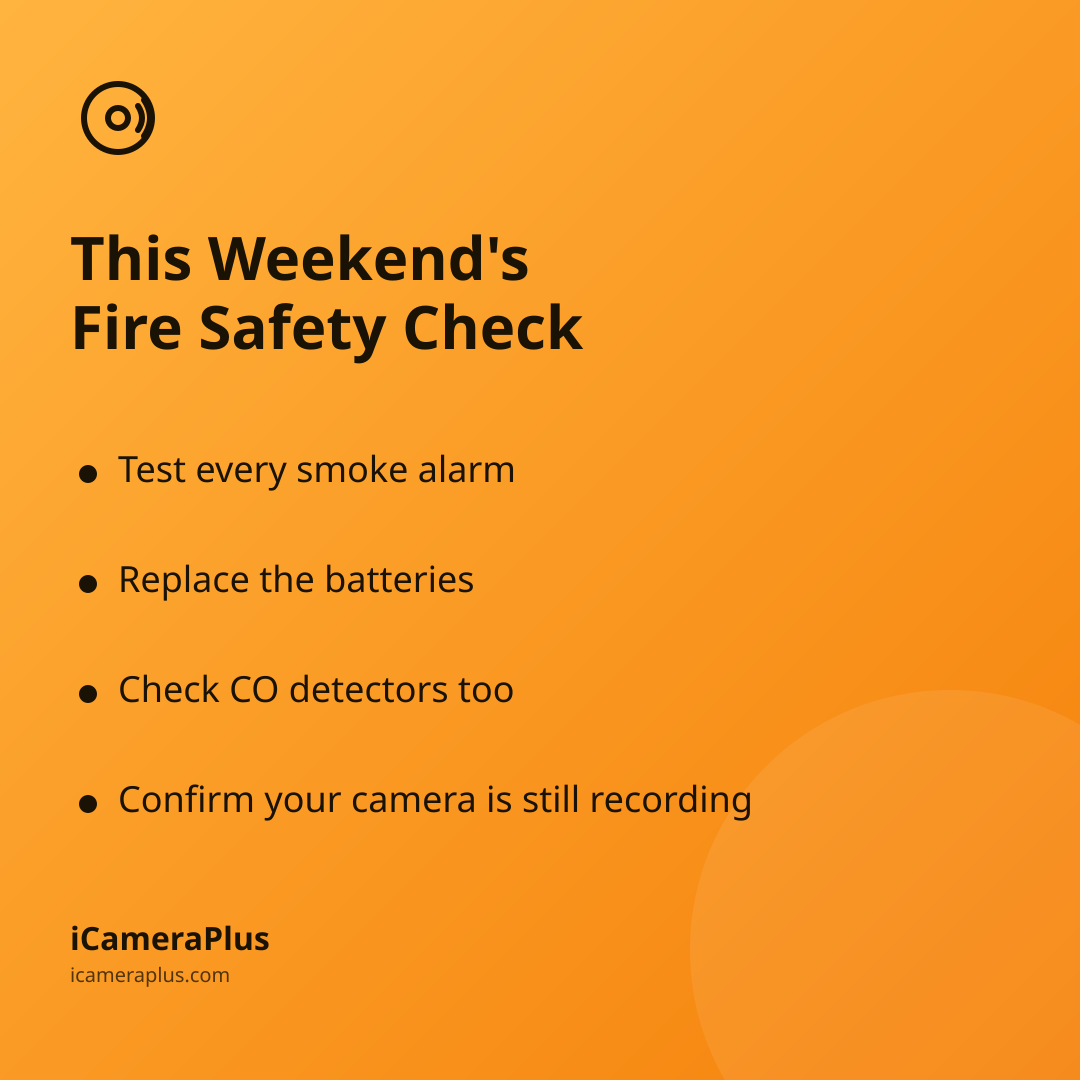
- Test every smoke alarm
- Replace the batteries
- Check CO detectors too
- Confirm your security camera is still recording
It's also a sensible moment to check the alarm's age — most manufacturers print a manufacture date on the back, and the devices themselves are generally meant to be replaced every 10 years, regardless of battery changes.
Where Does an Old Phone Security Camera Fit In?
If you're already doing a home safety pass this weekend, it's worth glancing at whatever is watching your home while you're out, too — especially heading into a season when space heaters and holiday travel both raise fire risk (see our guide on why space heaters are the most dangerous way to heat a home). A phone repurposed as a security camera with continuous recording and audio, like one running iCameraPlus, keeps a private, owner-controlled archive you can browse later — so if a smoke or CO alarm ever does go off while you're away, the audio and video from that window exists for you to review, rather than being lost the moment it happens. That's a meaningful backstop, not a replacement for a working alarm. It's also worth knowing that recording doesn't necessarily stop the moment the power does; we covered what actually happens to camera footage during an outage in this breakdown.
Quick answers
Do I need to change batteries in a hardwired smoke alarm too?
Most hardwired alarms still have a backup battery that needs periodic replacement, even though the unit itself runs on household power. The NFPA's own data show hardwired alarms fail less often than battery-only ones, but "less often" isn't "never" — the clock-change check applies to both types.
How do I know if my smoke alarm is too old to trust?
Check the manufacture date printed on the back of the unit. Manufacturers generally recommend replacing the entire alarm, not just the battery, after about 10 years of service.
Does a security camera replace the need for a smoke alarm?
No. A camera can record evidence of an event and, with audio enabled, may pick up an alarm sounding — but it is not a certified life-safety device and shouldn't be treated as a substitute for a working, regularly tested smoke alarm.