Crime Hit a Record Low in 2025 — So Why Do Only 28% of Americans Feel Safe at Home?
This article was produced with AI assistance. Sources are listed at the end.
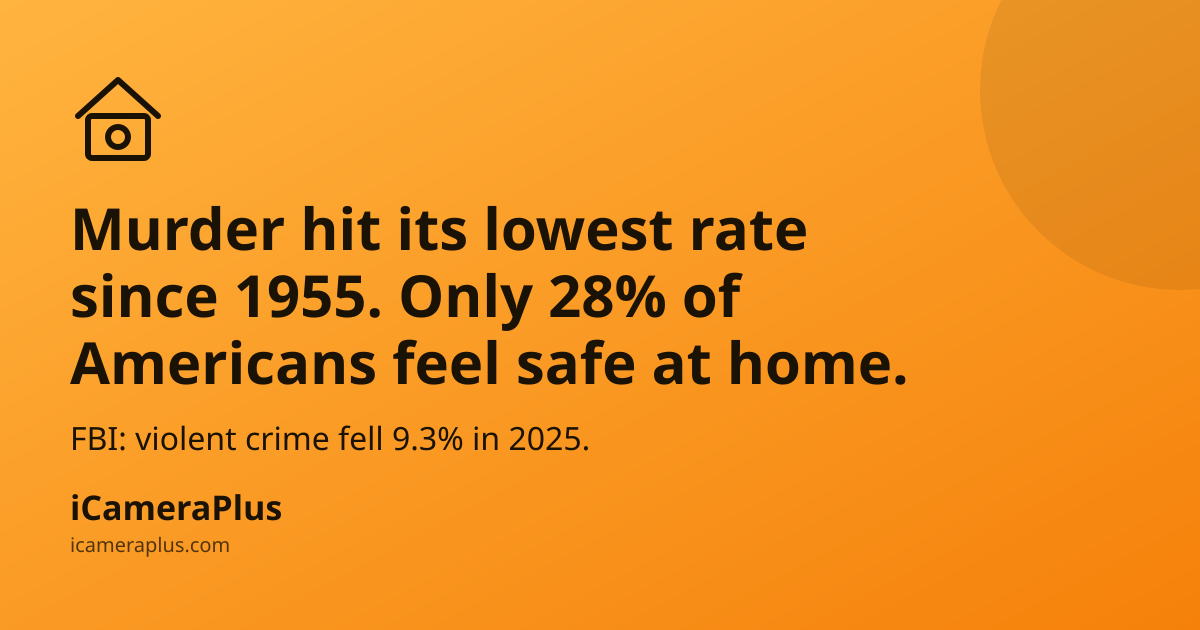
Yes, crime actually fell in 2025 — by the largest margin in decades. FBI data released in 2026 shows violent crime dropped 9.3% and burglary fell 15.8% compared with 2024, the sharpest one-year decline since the agency began estimating national crime trends in 1936. Yet a 2026 survey found only 28% of Americans say they feel genuinely safe inside their own home — a gap worth understanding before you decide what, if anything, to do about it.
How much did crime actually fall in 2025?
By the numbers, 2025 was a historic year for declining crime. The FBI's preliminary data, reported in August 2026, shows violent crime fell an estimated 9.3% year-over-year, with the national rate dropping from 362.9 to 327.6 offenses per 100,000 people — the FBI's largest recorded one-year decline since it began tracking national estimates in 1936. The murder rate fell 18.1% to 4.1 killings per 100,000 people, matching levels last seen in 1955 and 1956. Property crime dropped 12.4% overall, with burglary down 15.8% and motor vehicle theft down 22.7%. The data draws on submissions from more than 17,000 law enforcement agencies covering roughly 96% of the U.S. population. Early 2026 figures suggest the trend is holding, not reversing.
So why don't Americans feel safer at home?
Because feelings about crime and the data on crime have been moving in opposite directions for a while. Gallup's October 2025 crime survey found that fear of walking alone at night in one's own neighborhood fell to 31%, down from 40% in 2023, and that just 30% of adults believed local crime had risen — a 19-point drop from the year before. Worry about home burglary specifically fell to 34%, the lowest level Gallup has recorded since it began tracking that question in 2000. On paper, Americans' own answers show the fear easing. But a separate August 2026 survey of 1,000 U.S. adults by home security company Tri-State Gate found that only 28% feel genuinely safe at home during a typical evening, even though 69% of the same respondents said neighborhood crime risk hadn't changed in two years. People aren't necessarily reporting more danger — they're reporting less certainty about their own safety, which isn't the same thing.
Murder fell to its lowest rate since the 1950s — but most Americans still say they don't feel safe at home.
Is the fear really still about burglars?
Less than it used to be. Gallup's 2025 data shows the crimes Americans worry about most today are identity theft (69%) and being targeted by financial scammers (53%) — both well ahead of burglary. That shift matters because a feeling of "unsafe at home" increasingly isn't about someone breaking a window; it's a diffuse sense that risk is everywhere and hard to verify, whether that's a package thief, a scam call, or a stranger at the door. A camera watching your own front porch doesn't touch identity theft. But it does answer the one question that's actually answerable with evidence: what is physically happening at my house, right now and over time.
What actually closes the gap between the data and how you feel?
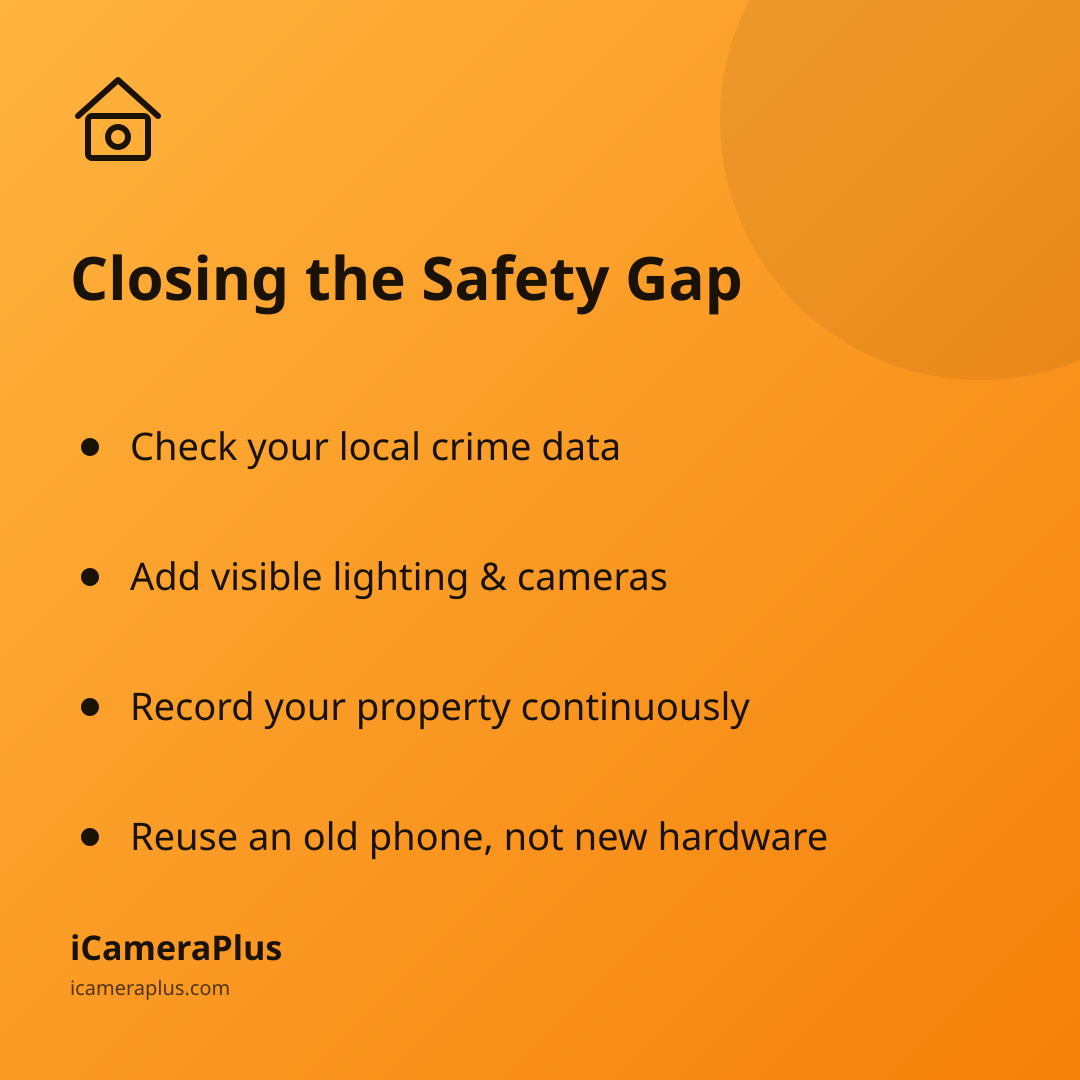
Not more headlines about national crime rates — reassurance has to be local and concrete to register. Several things reliably help: visible deterrents like exterior lighting and signage, knowing your own neighborhood's actual numbers instead of national averages, and having a continuous, owner-controlled record of your own property so "I think everything's fine" becomes "I can check." A security system doesn't have to be expensive or complicated to do that last part — a phone you already own can become a 24/7 camera covering a door, driveway, or porch. iCameraPlus, for instance, turns an old iOS or Android phone into a continuous-recording camera with a private cloud archive you can browse from the web, live view, and remote start and stop — a low-cost way to replace vague unease with an actual look at what's going on, without adding a new device to the landfill. SafeHome.org's 2026 home security market report found that 87% of camera owners say the device increases their peace of mind — which tracks with the idea that the fix for the "feel safe" gap is visibility, not just statistics.
- Check your local crime data, not national headlines
- Add basic deterrents: lighting, visible camera
- Record your own property continuously
- Reuse an old phone instead of buying new hardware
Quick answers
Is crime still falling in 2026? Early 2026 FBI figures suggest yes — violent crime was down 10.6% and murder was down 23.0% in the first half of 2026 compared with the same period in 2025, continuing the record 2025 decline.
Why do people feel unsafe even when local crime hasn't changed? Surveys suggest it's less about new danger and more about uncertainty — Tri-State Gate's 2026 survey found most respondents who felt unsafe also said neighborhood risk was unchanged, and Gallup's 2025 data shows worry has shifted toward harder-to-verify threats like identity theft and scams rather than break-ins.
Does having a security camera actually make people feel safer? Yes, according to industry survey data — SafeHome.org's 2026 market report found 87% of camera owners say the device increases their peace of mind, regardless of whether local crime rates are rising or falling.
Sources
- FBI — Violent Crime Falls at Historic Rate, New FBI Data Show (2026)
- Gallup — Crime in U.S. Seen as Less Serious for Second Straight Year (October 2025 survey)
- Tri-State Gate — Home Security Anxiety: What Americans Fear Most and What They're Doing About It (August 2026)
- SafeHome.org — 2026 Home Security Market Report
How Many Security Cameras Does a Home Actually Need in 2026? and Clocks Fall Back November 1, 2026 — Does That Really Mean More Break-Ins? dig deeper into separating real risk from perceived risk at home.