Back to Work, Back to School: What FBI Data Says About the Empty House You Just Created
Labor Day has a strange side effect nobody puts on a greeting card: it's the day your house quietly becomes emptier, more often, on a more predictable schedule than it's been all summer. Kids are back in school. Vacation days are used up. Commutes resume. For the next nine months, most homes on most blocks will sit vacant on the same weekday hours, week after week.
That predictability matters more than most homeowners realize. According to the FBI's 2024 Crime in the United States report, burglary fell an estimated 8.6% from 2023 to 2024, and overall property crime hit its lowest recorded rate since 1961. That's genuinely good news. But the data buried inside that report — about exactly *when* the burglaries that still happen tend to occur — is the more useful part for anyone deciding how to protect a house that now sits empty on a routine schedule.
The Data: Daytime, Not Night, Is When It Happens
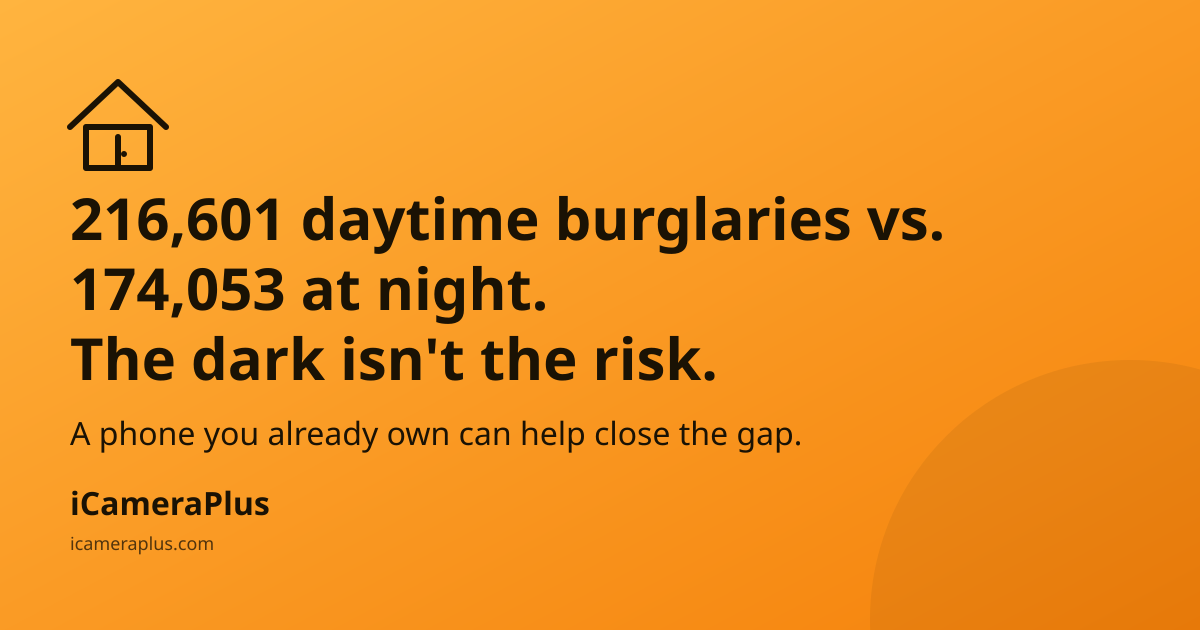
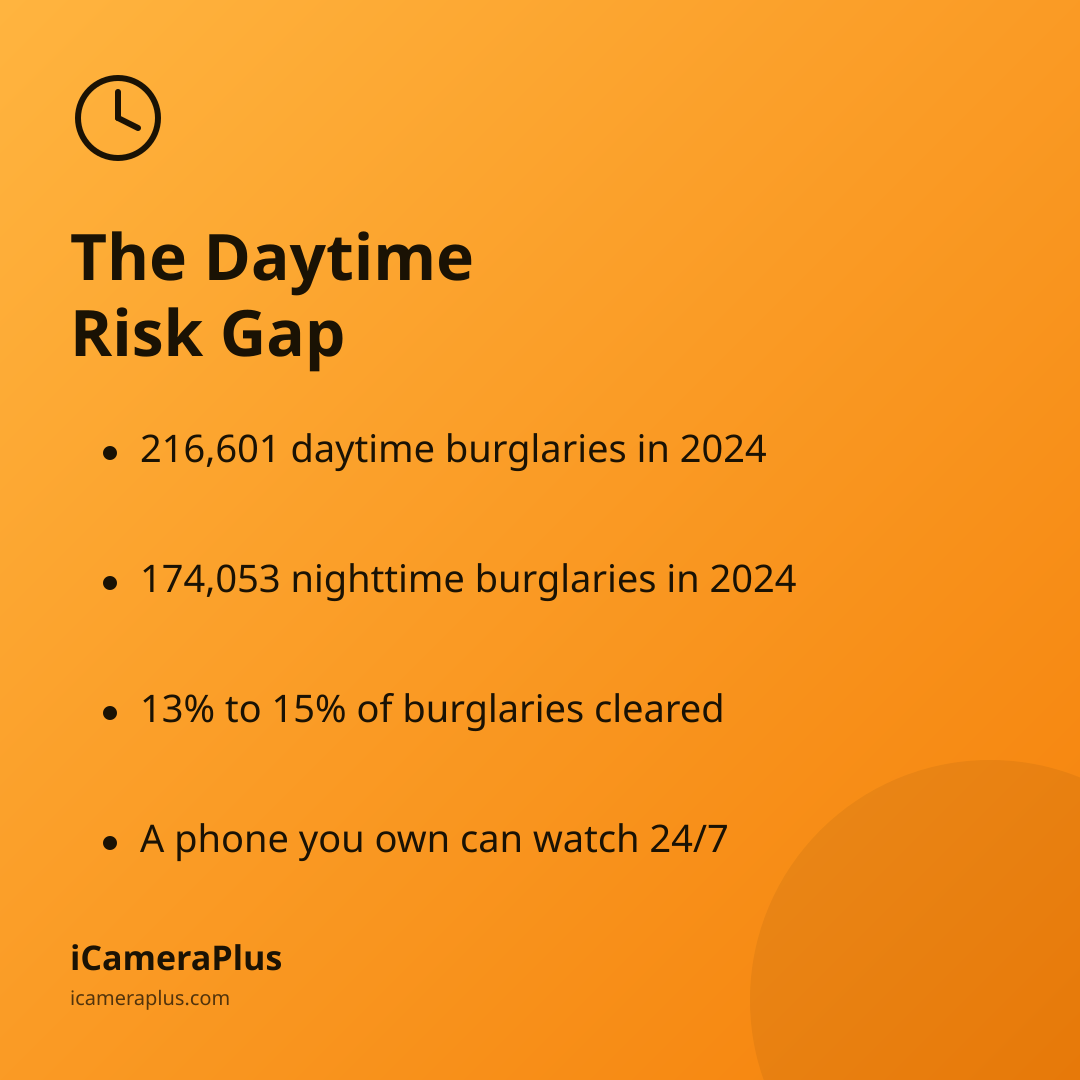
The popular image of a burglar is someone working under cover of darkness. The FBI's own numbers don't back that up. An analysis of FBI Crime in the United States data by MoneyGeek's 2026 home burglary report found 216,601 daytime residential burglaries against 174,053 nighttime ones — meaning burglars are hitting homes during the day noticeably more often than after dark. The same analysis found that only 13% to 15% of reported burglaries were cleared by police in 2024, one of the lowest clearance rates of any major property crime.
The reasoning tracks with common sense once you sit with it: a burglar's biggest risk isn't the dark, it's a homeowner answering the door. Daytime, on a weekday, during work and school hours, is exactly when a house is most likely to be unoccupied and least likely to have anyone glance out a window. Night has more foot traffic in most neighborhoods than a Tuesday at 11 a.m. on a residential street where every driveway is empty.
Why Labor Day Changes the Math
This is where the calendar matters. Through the summer, occupancy is genuinely unpredictable — someone's on vacation, a teenager's home, a parent works from the kitchen table between errands. After Labor Day, that unpredictability collapses into a routine: kids leave by 8, parents leave by 9, nobody's back until mid-afternoon at the earliest. It's the most regular, most guessable empty-house window a home will have all year, repeating five days a week.
September also happens to be FEMA's National Preparedness Month; the 2026 theme, "Americans Stand Ready," centers on the idea that resilience — including everyday home security — is something households build through their own routine choices, not just something that happens to them. A predictable empty house during the day is a small but real gap in that resilience, and unlike a hurricane or a wildfire, it's one you can close for the cost of an app.
What "Watching" Actually Solves — and What It Doesn't
It's worth being honest about limits here. A camera does not stop a burglary from being attempted, and research on visible deterrents is mixed at best: MIT Media Lab researchers Dan Calacci, Jeffrey Shen, and Alex Pentland analyzed roughly 850,000 Ring Neighbors posts, using Los Angeles as a case study, and found no strong correlation between video doorbell posting activity and lower property crime rates in a given area. A camera on your porch doesn't necessarily scare anyone off.
What a camera does reliably do is remove the single biggest cost of a daytime break-in for the homeowner: not knowing. If something happens at 12:40 p.m. on a Wednesday while you're at your desk two towns over, the difference between a case police can act on and one that goes nowhere is often whether there's footage — and whether that footage survived. That second part matters more than people expect: burglars who take the time to look around a house sometimes take the camera or the recorder with them, which is exactly why footage that's copied off-site, not just stored on the device that was watching, is worth having.
Using a Phone You Already Own to Cover the Gap
You don't need to buy new hardware to close a predictable weekday gap. A phone already sitting in a drawer — last year's model, a cracked-screen hand-me-down, anything with a working camera and a charging cable — can be set up as a continuously running camera pointed at a door, driveway, or living room in a few minutes. That's the core idea behind turning an old phone into a security camera: it's hardware you already own, doing a job you'd otherwise pay for.
Apps like iCameraPlus take that old phone and turn it into an actual 24/7 camera — recording continuously through the exact daytime hours the FBI's data flags as riskiest, backing footage up off the device so it's still there even if the phone itself is disturbed, and pushing a live view and motion alerts to your current phone so you can check the house on a lunch break instead of wondering about it until 5 p.m. It's not a replacement for locking doors or knowing your neighbors — it's a way to make sure that if the empty-house window is ever tested, you're not relying on memory to know what happened.
There's a Sustainability Angle Too
Repurposing an old phone instead of letting it sit unused also chips away at a genuinely large problem. The world generated 62 million tonnes of e-waste in 2022, according to the United Nations' Global E-waste Monitor 2024 (produced by UNITAR and the ITU) — and less than a quarter of that was documented as properly collected and recycled, leaving an estimated $62 billion in recoverable materials unaccounted for. A phone that's still watching your door every day is one less phone in that pile, at least for a while longer.
A Short Checklist for the Post-Labor-Day Schedule
- Know your own routine's blind spot. If everyone leaves within the same hour and returns within the same window, that's now a predictable pattern to anyone watching the house — not just to you.
- Point a camera at the entry points that matter most — front door, back door, or the driveway — rather than trying to cover everything at once.
- Make sure footage lives somewhere other than the device recording it. On-device-only storage means a disturbed camera can mean lost footage.
- Check in during the day, not just after. A live view during a lunch break catches problems while they're still small.
- Don't stop at the camera. Locked doors, a light on a timer, and a neighbor who knows your schedule still do real work alongside any camera.
The Takeaway
Labor Day doesn't just end summer — it locks in the weekday schedule that will define how empty your house is, and when, for the next several months. FBI data suggests that gap is worth taking seriously: daytime burglaries now outnumber nighttime ones, and police clear only a small fraction of the cases that do happen. You don't need a new security system to respond to that. A phone you already own, pointed at the right door and backed up off-device, covers most of the actual gap — and it's already sitting in a drawer somewhere in the house.
Sources
- FBI — FBI Releases 2024 Reported Crimes in the Nation Statistics
- MoneyGeek — US Home Burglary Statistics: State Rates and Trends (2026 Report), citing FBI Crime in the United States, 2024 data
- FEMA — FEMA Kicks Off National Preparedness Month 2026 (September 1, 2026)
- Scientific American — Do Video Doorbells Really Prevent Crime?, citing MIT Media Lab research by Dan Calacci, Jeffrey Shen, and Alex Pentland
- UNITAR / ITU — Global E-waste Monitor 2024