Does a Security Camera Work Through a Window? What to Know Before You Buy One in 2026
This article was produced with AI assistance. Sources are listed at the end.
A security camera can work through a window during the day, but most indoor cameras struggle at night — not because of the glass itself, but because their own infrared light bounces back off it. That reflection washes out the image right when you need visibility most. Daytime footage through clean glass is usually fine; nighttime footage from a standard IR camera placed behind a window often is not.
Does a Security Camera Work Through a Window?
During daylight hours, yes — an indoor camera placed close to clean glass can capture a reasonably clear view of a porch, driveway, or yard. The problem shows up after dark. Most indoor and budget outdoor cameras rely on infrared (IR) LEDs to "see" in low light, and when that camera sits behind glass, the IR light reflects off the window instead of reaching outside. According to camera maker Reolink, this reflection causes "window glare" that overexposes the image, washing out details just when motion is most likely to matter.
Why Does Night Vision Fail Through Glass?
The mechanism is simple physics, not a design flaw you can easily blame on one brand. Infrared LEDs sit right next to the lens, so when a sheet of glass is in front of both, some of that light bounces straight back into the sensor instead of traveling outward. The closer the lens is pressed to the glass and the darker the room behind it, the less bounce-back there is — which is why manufacturers recommend turning off indicator lights, dimming the room, and mounting the lens flush against the pane.
It's a small, specific fact with an outsized effect on footage quality: an IR camera's own night-vision light is often what ruins its footage through glass.
What Just Changed: A Camera Built Specifically for This
This question is getting more attention because a major manufacturer just built a product around solving it. In November 2026, Anker's eufy brand launched the Window Camera E10, a $79.99 indoor camera designed to stick to interior window glass with a reusable adhesive mount — no drilling. It records in 2.5K resolution, supports continuous 24/7 recording to a microSD card, and eufy states it works with no monthly fee required, addressing the glare problem with a downward-tilting lens and anti-glare design meant to sit flush against the pane.
The launch is a useful signal for anyone weighing a window-mounted camera: a well-known security brand decided the "point a camera through your own window" use case was common enough to engineer a dedicated product for it, rather than leaving people to prop an ordinary indoor camera on a sill and hope for the best.
Why This Matters More If You Rent
Window mounting matters most for people who can't drill into exterior walls or siding. More than a third of U.S. households now rent rather than own: 34.7% of occupied housing units were renter-occupied in 2024, up from 29.9% in 2010, according to the U.S. Census Bureau's American Community Survey 1-Year Estimates. For that growing share of households, a camera that watches the yard or driveway from inside the glass — with no permanent installation — is often the only outdoor-facing option a lease allows.
That's also where the legal boundary sits: the generally accepted rule, per consumer guides on apartment camera law, is that you can point a camera out from your own window toward your own porch or yard, but not into a neighbor's window or a shared space where someone has a reasonable expectation of privacy. Check your specific state and lease terms — rules vary by jurisdiction.
Do You Need to Buy a Dedicated Window Camera?
Not necessarily. A phone you already own can do the same job from a windowsill or a small stand, with one practical advantage: you control the exact placement, angle, and lighting rather than relying on a fixed clip-on mount. An old phone's camera sensor also tends to handle ambient light and glass reflection differently than a cheap IR module, especially if you keep a little room light on rather than going fully dark — the no-IR approach manufacturers recommend to begin with.
This is exactly the gap iCameraPlus is built to fill: it turns a phone already sitting in a drawer into a continuous, 24/7 recording camera, with footage saved to a private cloud archive you can browse from a web panel, live viewing, remote start and stop, and a screen-dimming mode that keeps the device unobtrusive on a sill overnight. It works on both iOS and Android, so there's no new hardware to buy or return if the angle doesn't work out. If you're curious whether your specific phone makes sense for this versus starting fresh, our guide on repurposing an old phone as a security camera covers the hardware limits to check first.
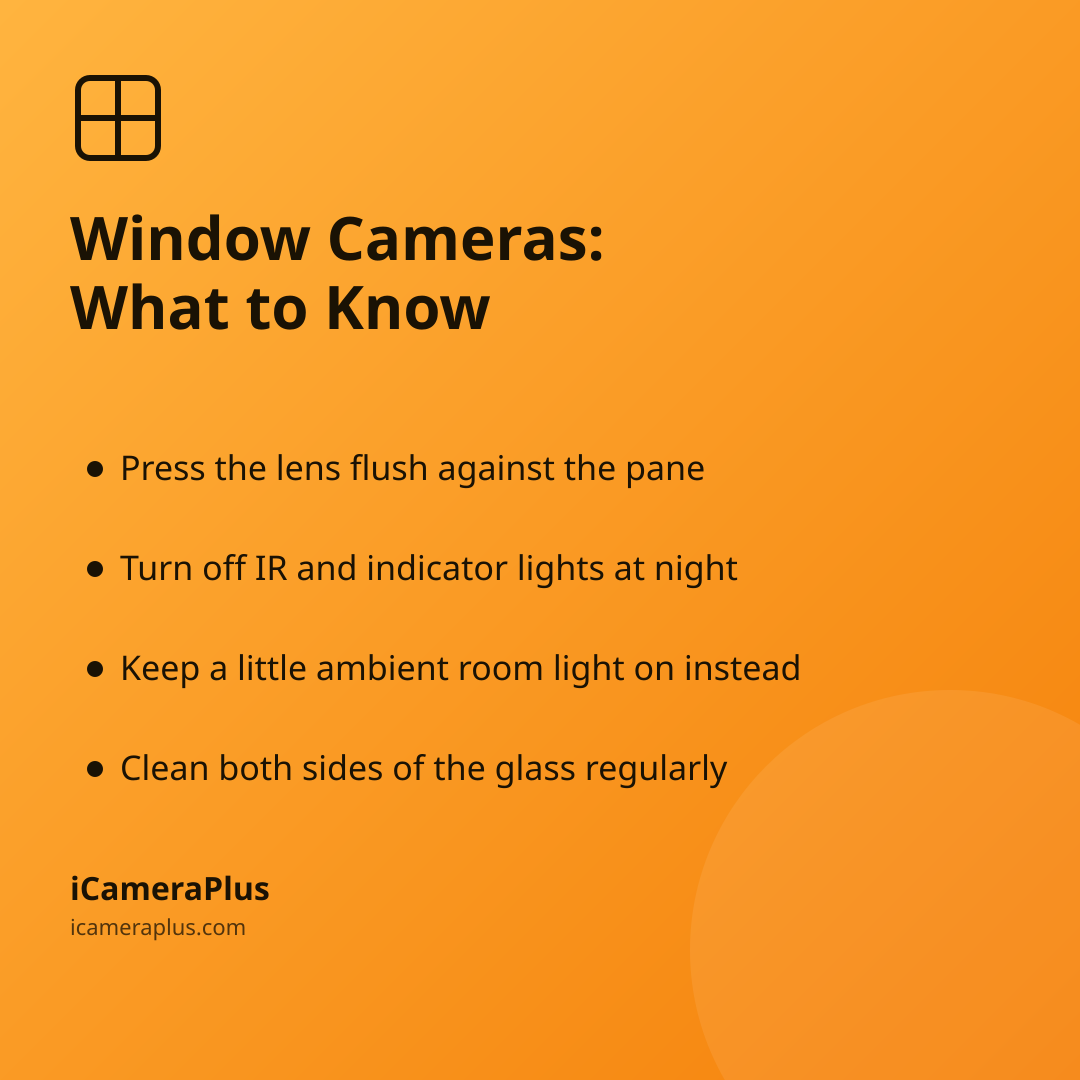
Quick checklist before you mount anything on glass:
- Press the lens flush against the pane
- Turn off IR and indicator lights at night
- Keep a little ambient room light on instead
- Clean both sides of the glass regularly
Quick answers
Can a security camera see through tinted or frosted glass? Tinted, frosted, or heavily coated glass reduces clarity far more than clear glass, both in daylight and at night, because it scatters light in addition to any IR reflection. Clear, clean glass gives noticeably better results.
Does double-pane glass make the glare worse? It can, since each additional glass surface is another chance for infrared light to reflect back toward the lens. Pressing the camera directly against the inner pane minimizes the air gap that makes this worse.
Is it legal to record my own yard through my window? Generally yes — recording video of your own property from inside your own home is typically allowed. Audio recording and footage that captures a neighbor's private space are treated differently under many state laws, so check your specific state's rules; see our privacy overview for general guidance.