Does Selling Your Old Phone Actually Help the Environment? A 2026 Study Found Out
This article was produced with AI assistance. Sources are listed at the end.
Yes, but only about half as much as it could. A 2026 study in Communications Earth & Environment found that reselling a smartphone does lower its lifetime carbon footprint compared with buying new — but "rebound effects," mainly the tendency to replace a phone sooner once you've sold or traded in the old one, cancel out nearly half of that potential climate benefit. The researchers' own data points to a better option for anyone who actually wants the full environmental credit: keep using the phone you already own.
What did the 2026 study actually measure?
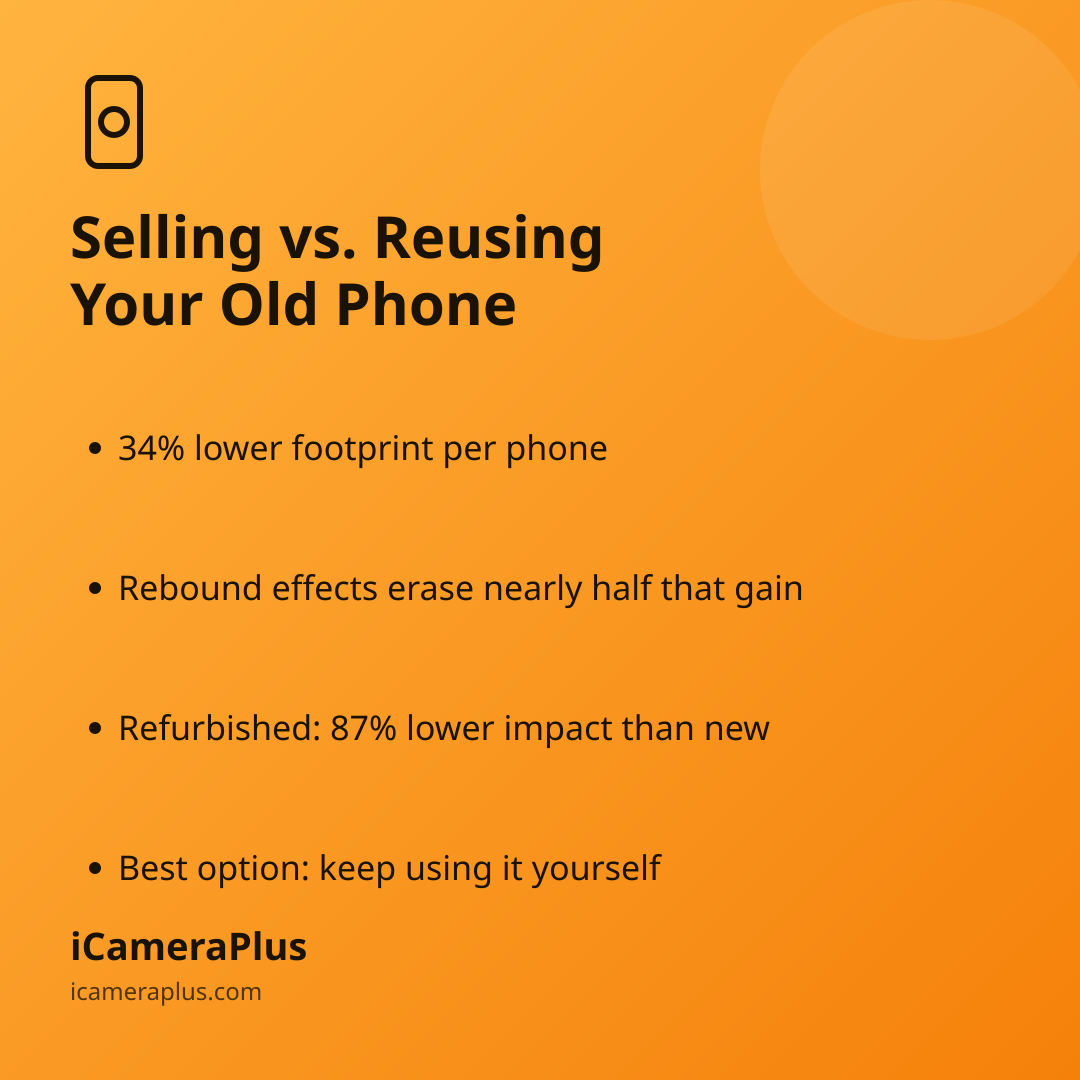
Researchers from Leiden University's Institute of Environmental Sciences (CML), Delft University of Technology, and the University of Tokyo built a stock-and-flow model of the U.S. smartphone market to see what secondhand sales really do to emissions, not just what they're assumed to do. The study, published in Communications Earth & Environment in 2026, found that each secondhand transaction currently extends a phone's use time by 40%, displaces an average of 0.4 new device purchases, and works out to a 34% lower annual carbon footprint per phone kept in circulation instead of scrapped.
At today's adoption level — about 25% of U.S. buyers choosing a used phone, per the same study — that circulation lowers total new-phone production demand by roughly 15% and total handset-related carbon emissions by roughly 14%.
Why doesn't reselling capture the full climate benefit?
The study's authors point to two "rebound effects" that eat into the savings. First, people tend to use a resold phone for a shorter stretch than they would a phone they kept themselves — trading in a device you're no longer using can also nudge you toward upgrading again sooner. Second, "imperfect substitution" means a secondhand phone doesn't always replace a would-be new purchase one-for-one; sometimes it just expands the total number of phones in circulation, for example when it goes to someone who wouldn't otherwise have bought a device at all.
Rebound effects erase nearly half the climate benefit of reselling your old phone.
None of this means the resale market is pointless — a phone that gets a second owner is still far better for the climate than one that's replaced and forgotten. It just means reselling isn't automatically the highest-impact move available to you.
Is a refurbished phone actually better than a new one?
Separately from the academic study, the mobile industry has been making a similar case from the manufacturing side. "A refurbished phone can have an 87% lower climate impact compared to a new phone," Steven Moore, GSMA's head of climate action, told Tech Xplore/AFP in March 2026. The refurbished-phone market itself is growing quickly: it was valued at roughly $69.7 billion in 2026 and is projected to reach nearly $97 billion by 2031, according to Mordor Intelligence's 2026 industry analysis. Buying refurbished instead of new is a genuinely good default. But the 2026 study's finding still applies once that refurbished phone reaches you: how long you personally keep using it matters as much as where it came from.
So what should you actually do with your old phone?
Based on the study's own framing, the options rank roughly like this, from best climate outcome to worst: keep using the phone yourself in some capacity, sell or hand it down to someone who will use it for a full second lifespan, and only recycle it once it's truly unusable. The quickest way to see the logic: every month you keep a working phone out of the upgrade cycle is a month of manufacturing emissions you didn't create.
- Keep it, don't trade in
- Wipe data before handoff
- Give it a real job
- Recycle only when dead
That "real job" is where most old phones fall short — they end up in a drawer instead of doing anything at all, which captures none of the environmental upside either way.
How does turning an old phone into a security camera fit in?
One of the more practical second jobs for an old phone is exactly the kind of continuous, always-on use the study's model rewards: a dedicated home security camera. Apps like iCameraPlus are built around this idea — install it on the phone you already own, point it at your own entryway or living room, and it continuously records to a private cloud archive you can browse from a web panel, with live view, remote start/stop, audio and video, and screen dimming, on both iOS and Android. No new device gets manufactured, and no resale-and-replace cycle gets triggered, because the phone just keeps doing a job you'd otherwise buy separate hardware for. If you want a fuller walkthrough of setup and camera placement, our home security camera guide covers it in more detail.
Does this connect to the bigger e-waste picture?
It does. The rebound-effect problem the study identifies — devices getting replaced faster than expected — is the same dynamic driving global e-waste growth more broadly. We covered the wider scale of that problem, including how "fast tech" upgrade habits compare to fast fashion, in our International E-Waste Day 2026 piece. The throughline is the same in both articles: the greenest phone is usually the one you already have.
Quick answers
Does selling my old phone actually reduce carbon emissions?
Yes, on average — a 2026 study found secondhand transactions cut a phone's annual carbon footprint by about 34% compared with a new purchase. But the same study found rebound effects (shorter use times, faster replacement) cancel out nearly half of that benefit, so selling isn't the single best option available.
Is it better to keep an old phone or sell it?
Keeping and actively using an old phone yourself avoids the rebound effects the 2026 study documented entirely, since no resale-driven replacement cycle gets triggered. Selling or handing it down is still better than letting it sit unused, since the study found each transaction displaces an average of 0.4 new device purchases.
Is a refurbished phone worth buying instead of new?
Industry data reported by GSMA's head of climate action in March 2026 put a refurbished phone's climate impact at roughly 87% lower than a new one. That makes refurbished a strong default when you do need a device — the same logic that favors reusing your own old phone rather than replacing it.
Sources
- Amatuni, Clemm, Sprecher, Tukker & Mogollón, "Second-hand smartphones reduce carbon emissions, yet shorter use times limit actual gains," Communications Earth & Environment, 2026
- "Second-hand phones surf rising green consumer wave," Tech Xplore / AFP, March 2026
- Mordor Intelligence, "Used and Refurbished Smartphone Market Analysis," 2026