Does Your College's Crime Report Cover Your Off-Campus Apartment? 2026 Clery Act Rules
This article was produced with AI assistance. Sources are listed at the end.
No — in almost every case, a privately rented off-campus apartment is not covered by your college's Clery Act crime report. The Clery Act only requires colleges to report crime statistics for campus buildings, student-organization property the school controls, and public property right next to campus — not for apartments or houses that students rent on the open market. Every college in the U.S. had to publish its 2026 Annual Security Report by October 1, 2026, and for millions of students who live off campus, that report simply doesn't describe the building they sleep in.
What is the Clery Act, and what does it actually require?
The Clery Act is a federal law (20 U.S.C. § 1092(f)) that requires every college and university that receives federal financial aid to publish an Annual Security Report (ASR) by October 1 each year, disclosing three years of crime statistics and campus safety policies. Institutions must distribute it to all enrolled students and employees, and provide it to any prospective student or employee on request, according to the Clery Center, the nonprofit most closely tied to the law's authorship and federal compliance guidance.
The 2026 reports carry one new requirement: they are the first to include hazing statistics, after the Stop Campus Hazing Act was signed into law on December 23, 2024. Schools have had to collect hazing data reported to campus security authorities or local police since January 1, 2025, and must now disclose it in the ASR and a new Campus Hazing Transparency Report, per a Congressional Research Service summary.
Why doesn't my apartment count as "Clery geography"?
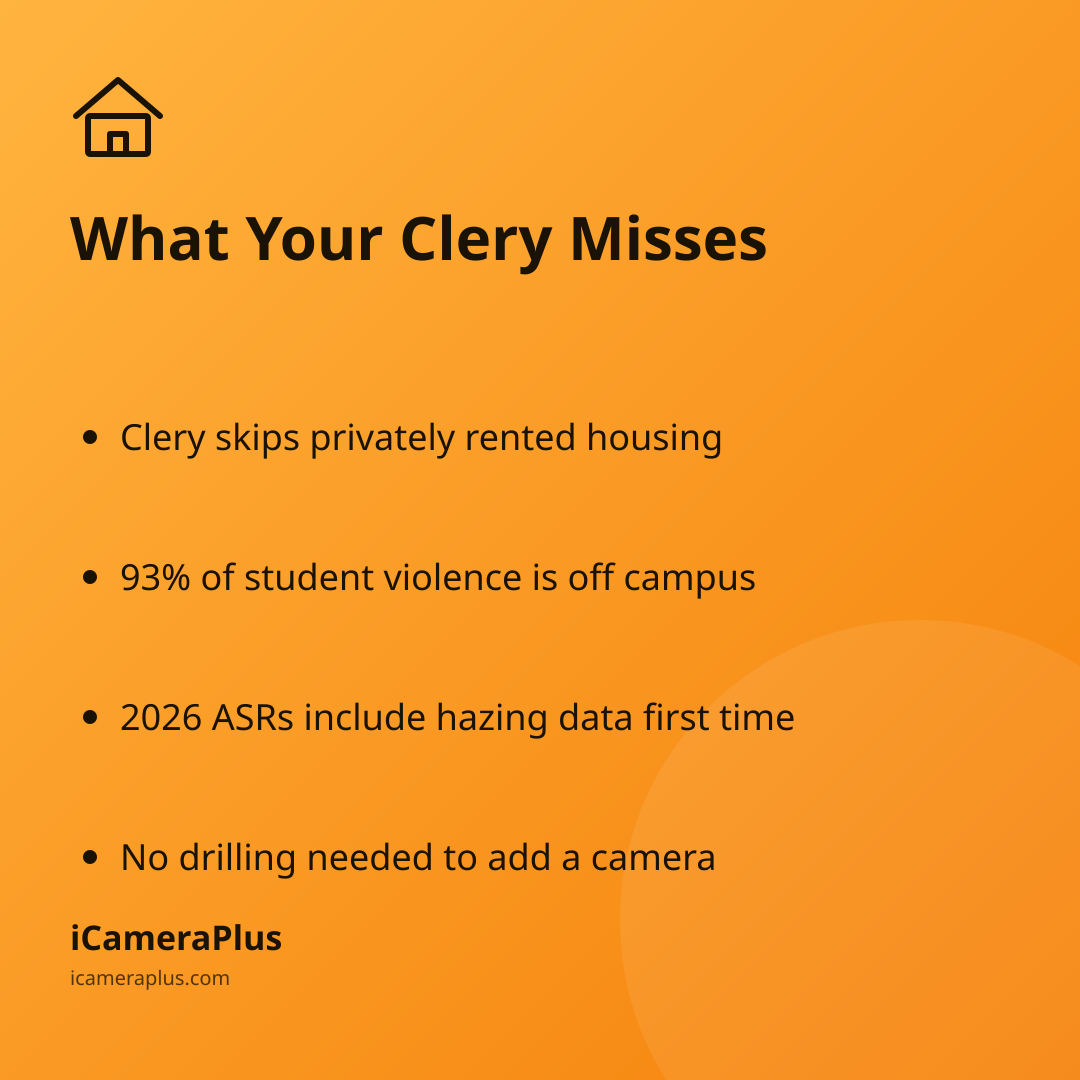
Clery statistics only cover specific categories of property: on-campus buildings, "noncampus" buildings or property owned or controlled by the institution or by a school-recognized student organization, and public property immediately adjacent to campus. According to the Clery Center's FAQ, "noncampus does not mean off campus" — it refers narrowly to property the institution owns or leases, not to the apartment complexes and houses where most students actually live.
That means a privately owned, privately managed apartment building a few blocks from campus — even one marketed as "student housing" — generally falls outside your college's crime statistics unless the school has a formal ownership or lease agreement with it. The crimes that happen there aren't absent from the world; they're just absent from the report you were handed at orientation.
How many students does this actually affect?
This isn't a rounding error. In a U.S. Department of Education survey of undergraduates, 56.9% lived off campus and not with parents, compared with 15.6% who lived in on-campus housing, according to the National Center for Education Statistics' Web Tables — Profile of Undergraduate Students: 2015–16, based on the National Postsecondary Student Aid Study (NPSAS:16). For the majority of undergraduates, the housing they actually live in sits outside the one federally mandated crime report they're given.
And the safety gap isn't just a paperwork technicality. A U.S. Department of Justice study found that of an estimated 526,000 violent crimes experienced by college students annually, about 492,000 — roughly 93% — occurred off campus, according to the Bureau of Justice Statistics. That data is older (the report was published in 2003), but it remains one of the only federal studies to separate on-campus from off-campus victimization directly, and it's still the figure most campus safety offices cite when discussing the limits of Clery coverage.
- Check the Clery report's address list
- Ask your leasing office about security
- Add your own camera — no installation needed
- Back up footage off the device
What can you actually do about it as a renter?
You generally can't change what your landlord discloses, and you shouldn't expect your school's crime report to describe your street. But you can close part of the gap yourself, without needing permission from a property manager or a campus office. A phone you already own — including an old one sitting in a drawer — can run as a dedicated security camera using an app like iCameraPlus, recording continuously and saving footage to a private cloud archive you can check from a web browser, with the ability to view things live and start or stop recording remotely. It doesn't require drilling into walls or installing hardware, which matters in rentals where even a doorbell camera can require landlord sign-off.
"Noncampus does not mean off campus." — Clery Center
If you're deciding where to put a camera in a shared apartment, start with entry points — the front door and any ground-floor window — rather than common areas where roommates or guests have less expectation of being recorded. For more on placement logic, see our guide on where to put a home security camera. And if you're weighing a phone-based setup against a bought device, our breakdown of whether a dedicated security camera is worth it over an old phone walks through the trade-offs.
Quick answers
Does Clery cover fraternity or sorority houses? Often yes — Clery Center guidance lists officially recognized Greek housing as "noncampus" property if the organization is recognized by the school, which puts it inside Clery geography even though it isn't technically "on campus."
Can I request crime data for my specific off-campus address? Not from your school's Clery report, since that data generally isn't collected there. Local police departments' public incident logs, often searchable online or by records request, are the better source for crime history at a specific off-campus address.
Does a college have to warn students about crime near off-campus apartments? Clery's timely-warning requirement applies to Clery geography, so it generally does not extend to privately rented apartments farther from campus. Check your specific institution's policy, since some voluntarily issue broader community alerts.
Sources
- Clery Center — The Clery Act
- Clery Center — Frequently Asked Questions
- Congressional Research Service — The Clery Act, as Amended by the Stop Campus Hazing Act
- National Center for Education Statistics — Web Tables: Profile of Undergraduate Students, 2015–16 (NPSAS:16)
- Bureau of Justice Statistics — Violent Victimization of College Students