Dorm Move-In 2026: What Federal Crime Data Says About Protecting Your Side of the Room
Move-in week means a few chaotic days of hauling boxes, meeting roommates, and figuring out which drawer the school-issued key actually opens. It's also, according to the federal government's own numbers, the start of the highest-risk stretch of the academic year for a very ordinary crime: someone walking into an unlocked room and taking what's inside.
Before you spend money on a dorm safe or a camera you're not sure you're allowed to use, it's worth knowing what the actual data says — and what your housing contract does and doesn't permit.
What the Federal Data Actually Shows
Every degree-granting college that receives federal financial aid is legally required to report on-campus crime under the Clery Act, and that data is compiled by the U.S. Department of Education's Office of Postsecondary Education in a public Campus Safety and Security Data tool. The National Center for Education Statistics (NCES), in a Fast Facts summary last updated in 2024, reports that in the most recent full year of Clery Act data available — 2021 — burglary accounted for 28% of all on-campus crimes reported, more than any other offense, working out to roughly 4.7 burglaries for every 10,000 full-time-equivalent students enrolled nationwide. Clery Act reporting runs on a lag, so this is the most current federal figure available, even though it isn't brand-new.
That single statistic is the reason so much back-to-school safety advice sounds repetitive: lock your door, don't prop doors open, don't leave your laptop on a library table while you grab coffee. It's repetitive because it's still the actual problem. Burglary, as Clery Act reporting defines it, isn't limited to a break-in — it also covers walking through an unlocked door or propped-open entrance to take something, which describes the vast majority of dorm theft.
It's Rarely a Stranger Kicking In a Door
The pattern campus police departments describe year after year is mundane: someone leaves a room unlocked for "just a minute," a fire door gets propped for a package delivery, or a stranger tailgates through a card-access entrance behind someone holding it open. Very little of this involves forced entry. Most of it involves an open door and someone — sometimes a stranger, sometimes another resident or a resident's guest — walking through it.
The fix is unglamorous but it's the one that actually moves the numbers: lock the door every single time, even for a two-minute trip to the shared bathroom, and don't be the person who props the stairwell door "just this once."
The Roommate Rule Nobody Explains at Orientation
If you're thinking about a camera for your dorm room, read your housing handbook before you buy anything — policies vary a lot by school, and some are stricter than students expect. Georgia State University's housing policy, for example, explicitly bans the use or possession of camera doorbells in residence halls and prohibits recording anyone "in bathrooms, showers, bedrooms, or other premises where there is an explicit expectation of privacy with respect to nudity and/or sexual activity" without the knowledge and consent of everyone being recorded. That's not an unusual policy — it reflects the basic reality that a dorm room is shared space, and your roommate has the same privacy rights you do.
The practical takeaway: a camera pointed only at your own desk or closet, with your roommate fully aware of it, is a very different thing from a camera capturing your roommate's bed or the room's shared common area without their knowledge. If you want to monitor your own belongings, tell your roommate, keep the camera's field of view limited to your own side of the room, and check whether your school's policy requires anything beyond that (some do).
Off-Campus Apartments Play by Different Rules
If you're one of the many upperclassmen or grad students renting off-campus, your school's housing handbook doesn't apply — but your lease and any roommates' consent still do. It's also worth knowing that your family's homeowners policy may not stretch as far as you'd think. Consumer Reports (2022), citing the Insurance Information Institute, notes that a parent's homeowners policy typically covers a student's belongings at no extra cost while living in an on-campus residence, but usually caps that coverage around 10% of the policy's total contents limit — and doesn't extend to an off-campus apartment at all, which is why renters insurance is worth a look once you've moved off campus.
A Move-In Week Checklist
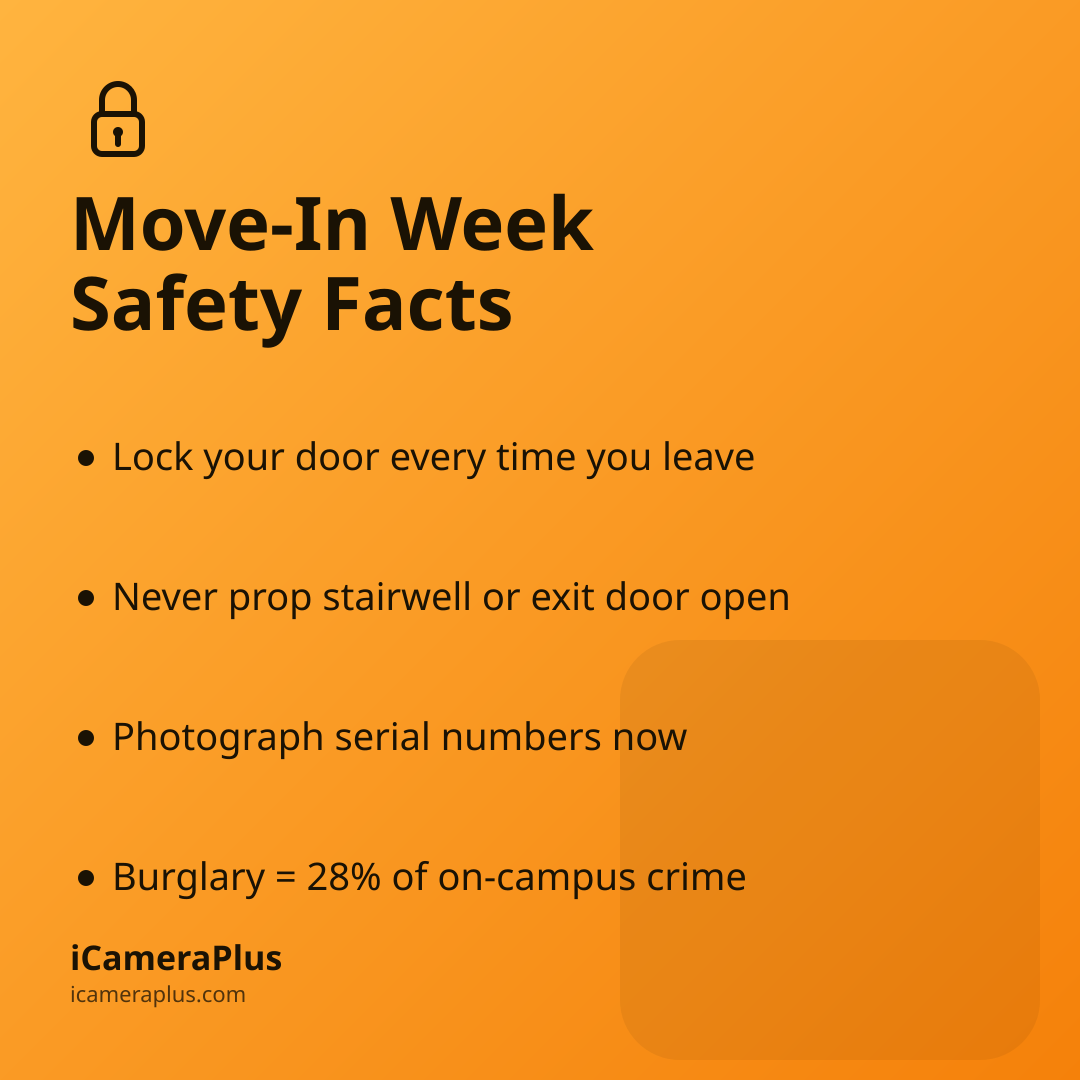
- Lock your door every time you leave, even for a few minutes.
- Never prop a stairwell, fire, or exterior door open for convenience.
- Don't hold a card-access door for someone you don't recognize.
- Photograph serial numbers and distinguishing marks on laptops, tablets, and bikes now, before anything goes missing.
- Use a laptop lock or keep devices with you in the library and dining hall rather than "saving a seat" with them.
- Save your campus police non-emergency number and your RA's contact in your phone before your first night.
- Check your school's housing handbook for its specific policy on cameras and recording devices.
Keeping an Eye on Your Own Stuff, the Legal Way
Plenty of students already own the hardware for this: the old phone that got replaced when a new one arrived, sitting in a drawer instead of getting used. An app like iCameraPlus can turn that spare phone into a camera pointed only at your own desk, closet, or the corner where your bike or gaming setup lives — recording continuously and archiving footage off the device itself, so if the phone (or a laptop sitting nearby) is ever taken, the footage isn't lost along with it. There's nothing to drill into cinderblock walls, and it comes down in thirty seconds at move-out — which matters, since most housing contracts don't allow permanent installations anyway.
Before You Leave for Thanksgiving or Winter Break
Dorms and off-campus apartments both sit mostly empty for a couple of weeks over Thanksgiving and again over winter break — exactly the kind of stretch where a burglary can go unnoticed until you're back and unpacking. Remote live view and motion alerts mean you (or a parent back home) can check in on a room without anyone needing to be there, which is a small but real source of peace of mind during the exact weeks a room is least likely to be checked on in person.
The Bottom Line
The federal numbers are clear that burglary — mostly the unlocked-door, propped-door kind, not the forced-entry kind — is still the single most reported crime on American campuses. The fixes that actually work are boring: lock the door, don't prop doors, know your school's camera policy before you buy anything, and keep an honest eye on the stuff you'd actually miss.
Sources
- National Center for Education Statistics, "Fast Facts: College Crime" (2024, reporting 2021 Clery Act data)
- U.S. Department of Education, Office of Postsecondary Education — Campus Safety and Security Data
- Georgia State University Housing, "Community Living Guide: Recording Devices"
- Consumer Reports, "Why You May Need Dorm Insurance for Your College-Bound Child" (2022)