How Do You Secure a Vacation Home You're Closing Up This Winter? 2026 Data
This article was produced with AI assistance. Sources are listed at the end.
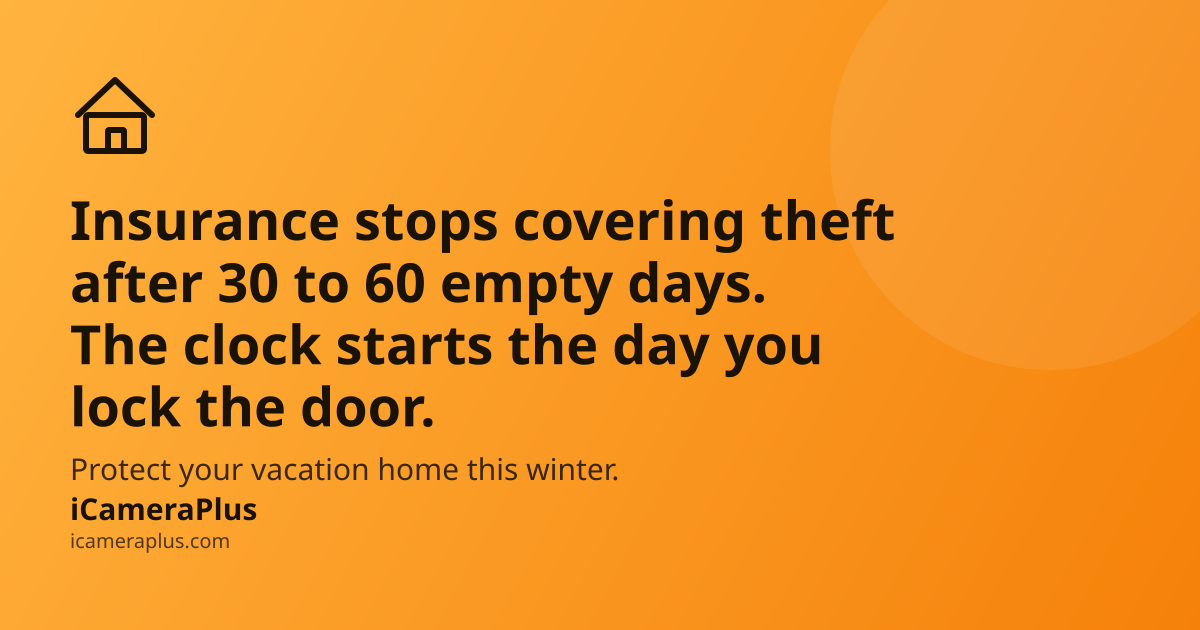
To secure a vacation home or cabin before winter, do three things before you lock the door: tell your insurer it will sit empty, remove the obvious signs that nobody's coming back for months, and keep some form of remote eyes on the property instead of just hoping for the best. Skip the first step and a break-in claim can be denied outright — most standard homeowners policies stop covering theft once a home has been vacant for 30 to 60 days in a row.
Millions of U.S. households do this every year without a formal plan. More than 4.3 million U.S. housing units are vacant simply because they're used only seasonally or recreationally — beach cottages, lake houses, hunting cabins — making seasonal use the single largest category of vacant housing in the country, according to the U.S. Census Bureau's 2023 analysis of 2020 Census data. If one of those homes is yours, the weeks right before you leave for the season are the ones that matter most.
Why Is an Empty Vacation Home Actually at Risk?
The instinct is to worry about nighttime break-ins, but the FBI's own crime data says otherwise. In 2024, daytime residential burglaries (216,601 incidents) outnumbered nighttime ones (174,053), according to the FBI's Uniform Crime Reporting Program. Offenders overwhelmingly target homes when they expect no one inside — which describes a closed-up vacation property around the clock, not just after dark.
A quick reality check before you leave:
- Notify your insurer before you go
- Stop mail and hold packages
- Put lights on random timers
- Keep a remote eye on entry points
Does Homeowners Insurance Still Cover You When the House Is Empty?
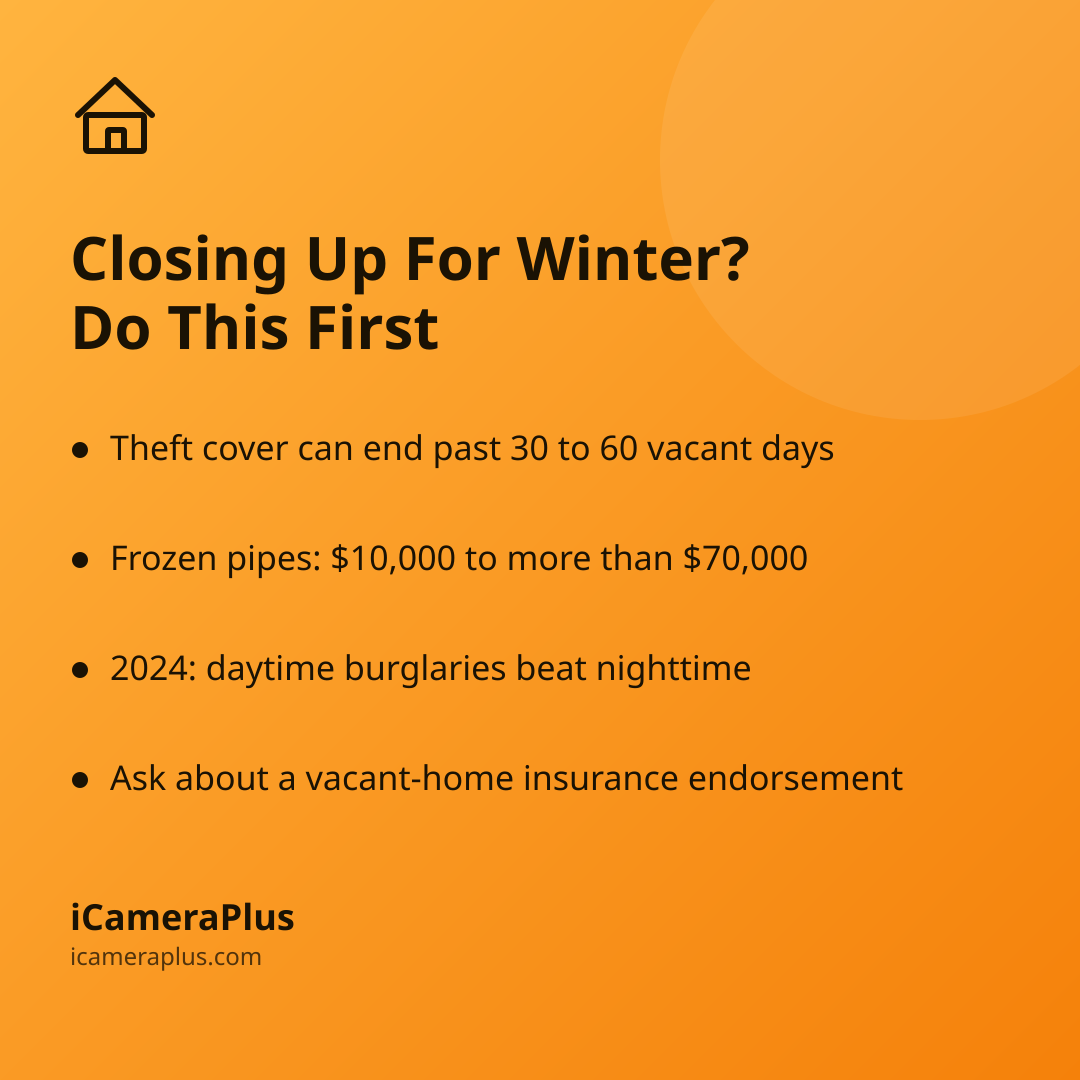
Often, no — not fully. Most homeowners policies contain a vacancy clause that will "limit or exclude coverage if the property is unoccupied for typically 30 to 60 consecutive days," according to a 2025 Insurance Information Institute (Triple-I) analysis, an industry research nonprofit. That clock doesn't ask whether you meant to be gone all winter — it starts ticking the moment the house is left unoccupied.
Standard homeowners policies frequently "limit or exclude coverage if the property is unoccupied for typically 30 to 60 consecutive days," per the Insurance Information Institute (2025).
The same Triple-I analysis flags a less obvious risk: burst pipes. A frozen, unwatched pipe can cause water damage that runs from $10,000 to more than $70,000 to repair, depending on how long it goes unnoticed. If a vacation home will genuinely sit empty for a season, ask your agent directly whether you need a vacant-home or seasonal-property endorsement rather than assuming your regular policy still applies — an insurance agent can confirm what your specific policy requires, since these clauses vary by carrier and state.
What Actually Deters Someone From Targeting an Empty House?
The basics still do most of the work: hold the mail, ask a neighbor to check in, and avoid posting travel dates publicly before you leave. Visible activity is the cheapest deterrent there is — random-timer lighting and a car in the driveway (yours or a friend's) still work because they cost a burglar time and certainty, both of which they want to avoid.
Cameras add a layer most of those tactics can't: a record of who actually came to the door, and a way to check the house without driving there. For a property you only visit part of the year, that matters more than for your primary residence, where you'd notice a problem the same day.
How Do You Keep an Eye on a House You're Not At?
This is where most people overspend, buying a full wired camera system for a property they'll see in person four times a year. A simpler option: an old phone left plugged in near the entryway or main living area, running an app that turns it into a dedicated camera. iCameraPlus is built for exactly this — it turns a phone you already own into a continuously recording camera with a private cloud archive you can browse from any web browser, a live view you can open remotely, and the ability to start or stop recording from that same web panel, on both iOS and Android. For a place that sits empty for weeks or months, being able to check in from wherever you're spending the winter is the actual point.
If the property gets genuinely cold once the heat is turned down, that's worth planning around — an unheated cabin can be hard on any electronics left running, phone included, so where you mount it and whether the space stays above freezing both matter. Our related guide on whether cold weather kills a security camera's battery covers what actually happens to batteries in unheated spaces. And since a camera itself becomes one more thing sitting in an empty house, it's worth understanding what your insurance will and won't pay if that camera goes missing too.
A Closing-Up Checklist Worth Following
- Call your insurer and ask directly whether a vacancy clause applies, and for how long
- Shut off the main water supply, or leave heat set no lower than roughly 55°F
- Hold mail and newspaper delivery through the post office
- Ask a neighbor or property manager to do periodic walk-throughs
- Set interior and exterior lights on staggered timers
- Leave a working camera running so you can check the house remotely, not just when something goes wrong
Quick answers
How long can a vacation home sit empty before insurance stops covering theft?
Many standard policies cut off theft and vandalism coverage after 30 to 60 consecutive days of vacancy, per the Insurance Information Institute (2025). The exact window depends on your carrier and state, so confirm it in writing before you leave rather than assuming your policy behaves like a primary-residence policy.
Do I need a special "vacant home" policy for a seasonal property?
If the home will be empty for an extended stretch each year, ask your agent whether a vacant-home or seasonal-property endorsement is available — standard coverage is often not designed for months of unoccupied time. This is a question for your insurer or agent, not a one-size-fits-all rule.
What's the cheapest way to monitor a second home while I'm away?
An old phone you already own, running a camera app like iCameraPlus, avoids buying and wiring a new system for a place you only use part-time — you get continuous recording and remote live view without new hardware.

Sources
- U.S. Census Bureau — Most U.S. Vacant Housing Is Seasonal Housing (2023, based on 2020 Census data)
- FBI Uniform Crime Reporting Program — Summary of Reported Crimes in the Nation, 2024
- Insurance Information Institute (Triple-I) — When No One's Home: Understanding the Role of Vacancy Insurance (2025)