International E-Waste Day 2026: Why Your Old Phone Is a Bigger Deal Than "Fast Tech"
International E-Waste Day 2026 falls on October 14, and this year's global campaign is focused on "fast tech" — cheap, everyday gadgets like earbuds, charging cables and USB adapters that get tossed without a second thought. But the category that gets far less attention on the day itself is the one already sitting in your drawer: the old phone. Mobile devices remain one of the least-recycled, most-hoarded types of electronics on the planet, and simply keeping one plugged in and working is often a better outcome than either the trash can or another year in a junk drawer.
What Is International E-Waste Day, and What Does "Fast Tech" Mean in 2026?
International E-Waste Day is an annual awareness campaign run by the WEEE Forum, a Brussels-based association of electronics take-back and recycling organizations. Now in its ninth edition, the 2026 campaign centers on "fast tech" — inexpensive, often impulse-bought electronics such as single-use vapes, LED string lights, mini fans and phone chargers that people discard without registering them as e-waste at all, according to the WEEE Forum's 2026 campaign materials reported by Recycling Today. WEEE Forum Director General Pascal Leroy called fast tech "the blind spot of the e-waste world," noting that these products "are not usually recognized" as e-waste by the people throwing them out.
Phones don't fit that "impulse buy, no second thought" description — most people know exactly what an old phone is worth and hang onto it anyway. That makes them a different kind of blind spot: not overlooked, just perpetually postponed.
How Big Is the E-Waste Problem, in Real Numbers?
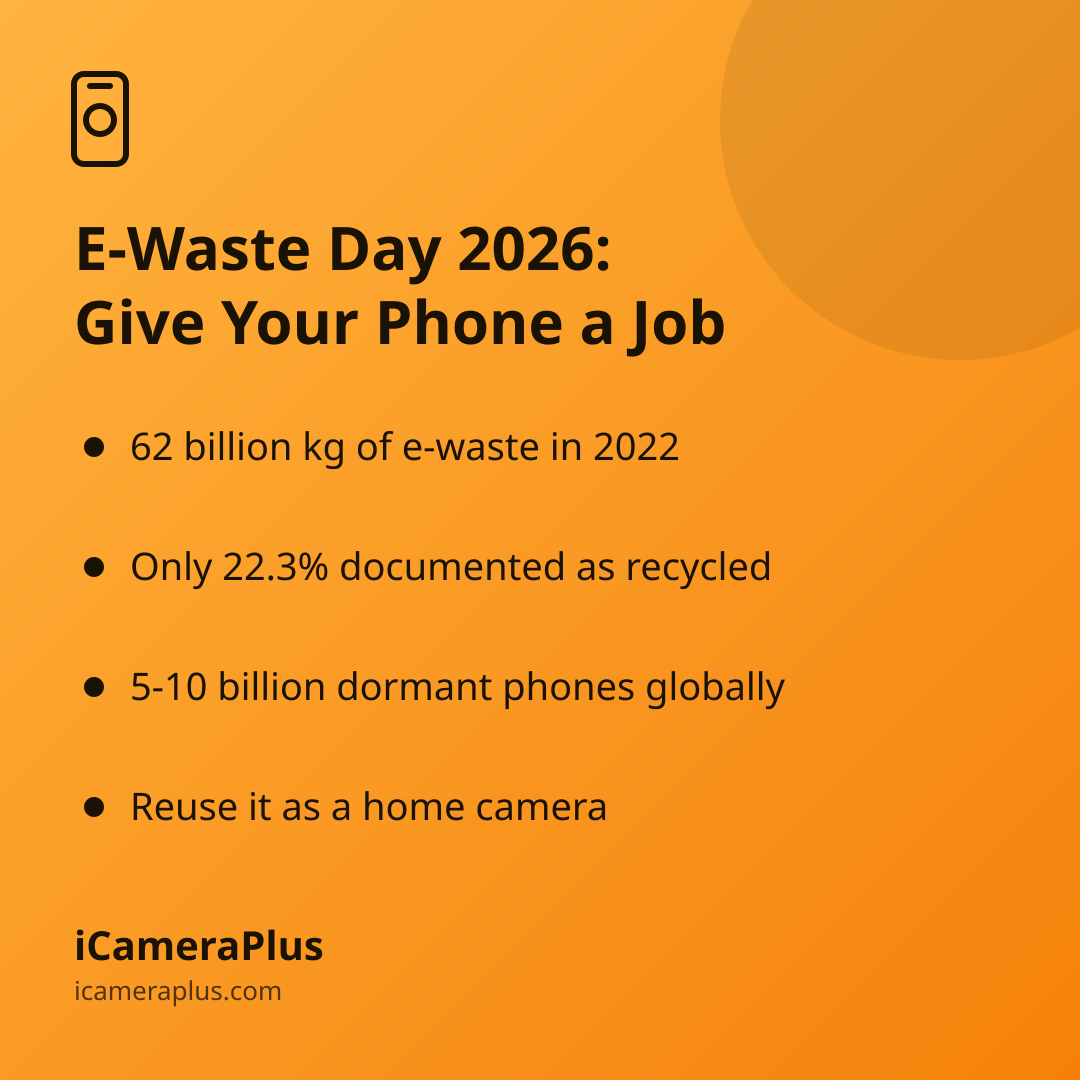
The scale is larger than most people assume. The world generated 62 billion kilograms of electronic waste in 2022 — equivalent to filling 1.55 million 40-tonne trucks — and only 22.3% of that mass was documented as formally collected and recycled, according to the Global E-waste Monitor 2024, published jointly by the International Telecommunication Union (ITU) and the United Nations Institute for Training and Research (UNITAR). The same report projects e-waste generation will climb to 82 billion kilograms by 2030, while the documented recycling rate is on track to fall to around 20%.
Small IT and telecommunications equipment — the category that includes mobile phones, laptops, routers and GPS devices — fared no better than average: just 22% of it was documented as properly collected and recycled in 2022, per the same UNITAR/ITU analysis.
A phone that's still working and still plugged in never becomes e-waste in the first place.
Why Do Old Phones Slip Through the Cracks?
Unlike a $6 charging cable, a phone is valuable enough that people rarely throw it straight in the trash — but that same value makes it hard to part with, so it ends up parked in a drawer instead. GSMA, the trade body representing mobile network operators worldwide, estimates there are between 5 billion and 10 billion dormant phones sitting unused around the globe, together holding an estimated $20 billion in recoverable gold, copper, palladium and other materials, according to its February 2025 "Rethinking Mobile Phones" report, based on a survey of more than 10,000 consumers across 26 countries. GSMA also projects the market for refurbished and "circular" devices could exceed $150 billion by 2027 — proof that reuse, not just recycling, is where the momentum is heading.
None of that value is realized while a phone sits idle. A dormant phone isn't doing anything for the environment, your wallet, or your home — it's just deferred e-waste.
What's the Single Best Way to Keep a Working Phone Out of the Waste Stream?
Recycling is the right call once a phone is truly dead. But for a phone that still turns on, charges, and holds a camera and Wi-Fi connection, reuse comes first — it avoids the manufacturing footprint of a replacement device entirely, and it's faster than waiting for a trade-in check or a refurbisher pickup. The order of preference, in practice, looks like this:
- Wipe personal data
- Check trade-in value
- Donate if it works
- Reuse it as a home camera
That last option is the one most people overlook, mostly because it doesn't feel like a "real" use for a device that used to be a phone.
How Can an Old Phone Actually Earn Its Keep at Home?
A phone that still has a working camera, microphone and Wi-Fi radio has almost everything a dedicated security camera has — it's just missing the software to run continuously and send footage somewhere you can check it. That's the gap an app like iCameraPlus is built to close: it turns a phone you already own into a 24/7 security camera with continuous recording, an off-device archive so footage survives even if the phone is damaged or stolen, remote live view, and motion alerts — all without buying new hardware or sending the phone to a landfill or a recycler.
The same idea extends past the front door. A retired phone propped in a corner can double as a baby monitor, a pet camera for checking on an anxious dog during the workday, or a household camera for extra peace of mind when a caregiver is in the home — all owner-controlled, openly in view, and watching only the property you already live in.
What Should You Do Before Recycling or Repurposing a Phone?
Whichever path you choose, the housekeeping is the same: sign out of accounts, back up anything you want to keep, and perform a full factory reset so the next stage — a recycler, a new owner, or a permanent spot on a shelf as a camera — starts with a clean device. Skipping this step is the single most common reason people say they keep old phones around instead of dealing with them.
Quick answers
Is a phone that still works considered e-waste? Not yet — a working phone only becomes e-waste once it's discarded or permanently taken out of use. Keeping it in service, whether as a backup phone or a repurposed camera, keeps it out of the waste stream entirely.
What's the environmental benefit of reusing a phone instead of recycling it? Reuse avoids the raw-material extraction and manufacturing emissions of building a replacement device, while recycling only recovers a fraction of those materials — global documented e-waste recycling sits at 22.3%, per the Global E-waste Monitor 2024.
Does International E-Waste Day apply to old phones even though 2026's theme is "fast tech"? Yes — the WEEE Forum's campaign covers all electronics with a plug, cable or battery, and phones remain squarely in scope even though 2026's messaging is aimed at smaller impulse-bought gadgets.